
- World
- Taris
- New status
- Republic member
- Senator
- Haydel Goravvus
- Corporate force
- Lhosan Industries
In 3966 BBY, Taris finally obtained formal membership in the Galactic Republic and a seat in the Galactic Senate. The accession was not portrayed in Legends as a clean triumph of representative government. Haydel Goravvus and Lhosan Industries worked through a secret political deal, while Jervo Thalien used corporate money and influence to secure enough support for admission. The immediate strategic payoff was Republic protection as Mandalorian pressure closed in on Taris's supporting worlds.
Membership becomes a military guarantee
Taris had enormous commercial importance but had remained outside the Republic. Mandalorian expansion changed the value of accession. Once the city became a Republic member, threats to Taris and its resource systems became a direct Republic security problem.
The timing explains Captain Saul Karath's later cynicism: years of frontier destruction had not forced full intervention, but a commercially important world entering the Republic did.
Corporate power helps manufacture citizenship
Lhosan Industries and Jervo Thalien were not passive beneficiaries of the political process. Corporate influence helped reshape the legal boundary of the Republic itself.
The result tied public military obligations to private economic interests, blurring the line between federal expansion and corporate strategy.
Haydel Goravvus becomes senator
Goravvus emerged from the deal as Taris's senator. His later role would become more complicated as he broke with Thalien and supported resistance to the Mandalorian occupation.
That later transformation makes the accession especially useful for examining how people embedded in corrupt systems can still make different political choices afterward.
Event sequence
Taris remains outside formal Republic membership despite its economic importance.
Lhosan-linked lobbying and bribery secure accession and a Senate seat.
The Republic organizes stronger defenses around Taris's resource worlds.
Mandalorian pressure and the Covenant crisis destabilize the planet further.
Explore this entry
Did Taris join because it wanted Republic ideals?
Security and economic interests were central, and Legends explicitly adds bribery and corporate lobbying to the accession process. That does not mean every Tarisian shared the same motive.
Why does this matter for the Mandalorian Wars?
The admission changed the legal geography of the conflict. Once Taris was inside the Republic, defending its surrounding resource network became a Republic military obligation.
Anthropological assessment
Taris demonstrates that political borders can be produced through capital. Formal membership appears constitutional, but the route to membership can depend heavily on corporations capable of making a world's protection strategically valuable.
The event also exposes center-periphery inequality. Worlds without comparable wealth or connections could suffer frontier violence without receiving the same rapid institutional protection.
3966 BBY · Legends · evidence file
Taris obtains a Senate seat as the Mandalorian threat grows
Published evidence
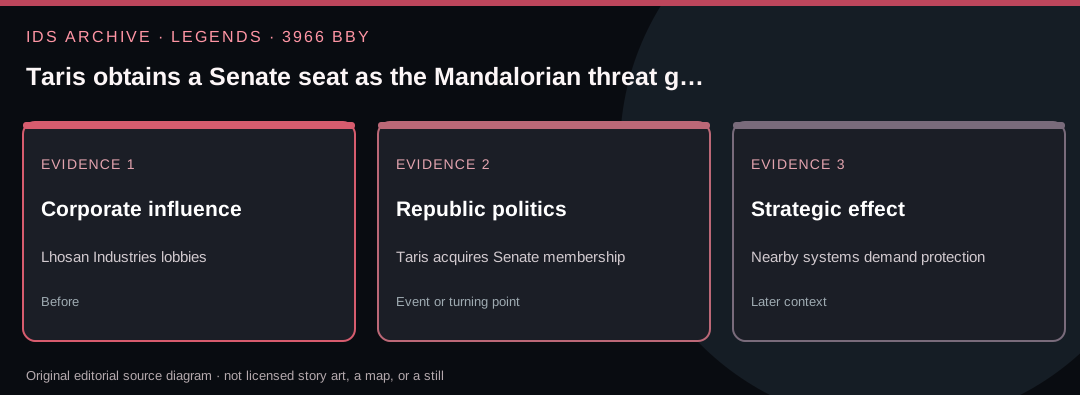
Legends reference works describe Taris gaining a Republic Senate seat in 3966 BBY through influence and payments associated with Lhosan Industries and Haydel Goravvus. The timing intersects with Mandalorian expansion into systems supplying Taris.
Institutions and culture
Political incorporation is not necessarily a referendum on equal citizenship. Wealthy institutions can seek membership to secure trade routes, defense commitments and institutional prestige. Residents of the Lower City need not have shared the priorities of corporate elites.
What remains unverified
The precise list of payees, a treaty's full text and universal Tarisian support are not evidenced by the cited overview. The term bought should be explained as a critique of political lobbying, not literal purchase of a physical seat.
Check the historical record: Does joining the Republic mean Lower City people immediately gained equal power?
Explanation: No. Senate representation and social equality are separate matters.
3966 BBY · Legends · Evidence-led expansion
Corporate bargaining behind Taris's one Republic accession
Historical sequence
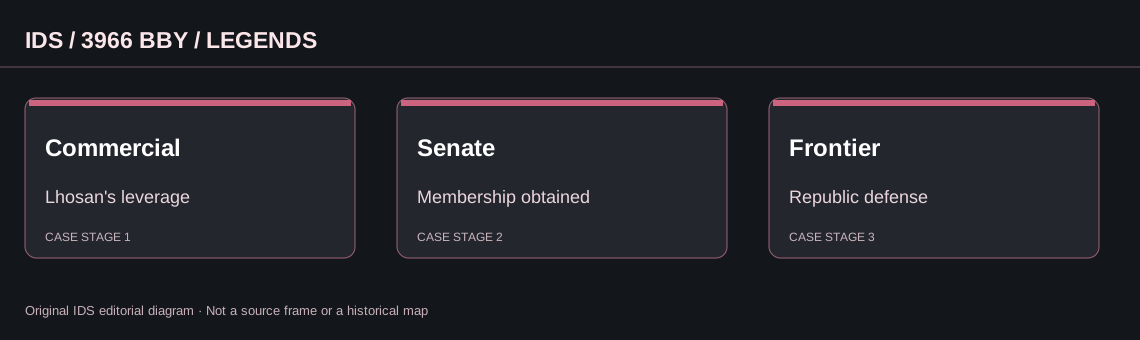
A political arrangement involving Jervo Thalien, Lhosan Industries and Haydel Goravvus helped secure Taris's admission to the Republic and a Senate seat in 3966 BBY. Later Legends histories describe bribery and a shift in corporate power on the planet. Admission also placed the planet within the Republic's military responsibilities as the Mandalorian Wars intensified. This is the same accession covered in the sister entry, approached here through its negotiations and beneficiaries.
Institutions and everyday experience
Influential corporations can help define the boundary of a state's obligations. For Taris, who would represent the planet was tied to who would defend valuable trade routes and industrial assets. Captain Saul Karath's skepticism reflected the unequal attention given to threatened unaligned worlds and a commercially valuable new member. Still, representation at the planetary level is not evidence that the social interests of everyone in the Upper, Lower and Undercity were aligned. A major institutional gain for investors and political leaders could coexist with persistent inequality for residents.
Limits of the evidence
The reference narrative does not provide a complete signed agreement, individual payment receipts or a comprehensive roll-call vote. This page is about political bargaining, whereas the sibling entry emphasizes strategic effects.
Historical judgment: Was the Senate seat a different event from the accession of Taris?
Correction and explanation: No. Both descriptions concern one 3966 BBY membership and representation process.
Source: Knights of the Old Republic comic history; Taris Legends chronology. Source bibliography ↗. Original-edition pages remain to be checked.
Sources and further reading
- Knights of the Old Republic Campaign Guide.
- “The Taris Holofeed: Prime Edition.”
- The Essential Atlas.