
- Location
- Jedi Tower, Taris
- Masters
- Lucien, Q'Anilia, Raana Tey, Xamar, Feln
- Padawans
- Zayne, Shad, Kamlin, Gharn, Oojoh
- Hidden institution
- Jedi Covenant
In 3969 BBY, the First WatchCircle of the Jedi Covenant received five Padawans. Lucien Draay, Q'Anilia, Raana Tey, Xamar, and Feln became Masters to Zayne Carrick, Shad Jelavan, Kamlin, Gharn, and Oojoh. The apprentices moved into the Jedi Tower on Taris without knowing that their teachers belonged to a secret anti-Sith organization built around prophecy and preventive action.
3969 BBY · Legends · Historical source lab
FIRST WATCHCIRCLE
Documented sequence and limitations
By 3969 BBY the First WatchCircle of the Jedi Covenant was based at the Jedi Tower on Taris. Lucien Draay supervised Zayne Carrick, Q’Anilia taught Shad Jelavan, Raana Tey taught Kamlin, Xamar taught Gharn, and Feln taught Oojoh. Their apprentices did not know their teachers belonged to a secret organization devoted to detecting a feared Sith resurgence. The 3964 Padawan killings happened five years after the appointments.
People, institutions and context
A public teaching institution and a clandestine investigation operated inside the same tower. Students faced instructors who controlled education while privately treating prophecy as a security concern. This division of responsibility created an unequal relationship and concealed conflicts of interest. It is not evidence that any of the five Padawans was guilty of a crime in 3969.
Source trail: Knights of the Old Republic #24 and Jedi Covenant history. Chronology/source record →. Exact primary edition page citations remain under review. Banner art is original IDS symbolism, not the source comic.
Teachers with a second institutional identity
The five Masters occupied two roles at once. Publicly they were Jedi educators. Secretly they were a WatchCircle expected to monitor prophetic signs of Sith return.
Those roles would later collide disastrously when visions led them to reinterpret the very students they were responsible for protecting.
Five students, five future suspects
Nothing about the 3969 transfer itself made the Padawans dangerous. The transformation from students into perceived existential threats happened later through interpretation of visions.
This distinction matters because it shows how suspicion can be institutionally produced rather than discovered.
Why Taris becomes the setting
Taris was politically ambitious, socially unequal, and increasingly important in Republic affairs. The Jedi Tower placed Covenant activity inside a city already full of tension.
When the Covenant crisis erupted in 3964 BBY, those urban conditions helped turn a secret internal Jedi event into a public manhunt.
Explore this entry
What exactly was a WatchCircle?
A Covenant cell of seers and trusted Jedi organized to watch for signs that the Sith might return. The secrecy was intended to prevent another Exar Kun, but it also weakened outside accountability.
Why is mentorship plus surveillance dangerous?
Because a teacher holds power over a student while also being responsible for care. If the student becomes a security target, the same relationship that creates trust can be weaponized against them.
Anthropological assessment
The WatchCircle shows how preventive institutions can transform relationships of care into relationships of suspicion. Prophecy magnified that risk because ambiguous information could not be tested like ordinary evidence.
It is also a case study in secret bureaucracy. Organizations created to prevent catastrophe may create new dangers when they operate beyond routine review.
How secret vigilance entered an ordinary apprenticeship
Five Padawans on Taris were trained by Jedi Masters who also belonged to the First WatchCircle of the secret Jedi Covenant. The students experienced ordinary instruction inside a tower whose teachers held additional obligations to an organization built around fears of Sith return. This dual institutional identity matters because the later Padawan Massacre was not an isolated breakdown in a private relationship. It grew from an arrangement that made hidden prophecy-driven suspicion part of professional Jedi authority.
Authority without informed consent
The Padawans did not know that their teachers were part of a clandestine structure. Their ability to understand or question the institution directing their education was therefore limited from the beginning. An apprenticeship normally gives a teacher authority to instruct, evaluate and protect a student. The Covenant introduced a competing agenda without disclosing it to the people most affected.
Future evidence was not present evidence
No act by Zayne Carrick, Shad Jelavan, Kamlin, Gharn or Oojoh in 3969 BBY proves that one was destined to overthrow the Republic. That allegation arose later from the Masters' interpretation of a collective vision. Separating the original assignments from the massacre is crucial. It shows that the category 'future Sith threat' was assigned to students through institutional fear, not established through demonstrable crimes.
Was the First WatchCircle an ordinary public Jedi Council assignment?
The Masters had public teaching roles, but the Jedi Covenant and its anti-Sith WatchCircle were secret. The students were not informed of the organization's hidden purposes.
Evidence note: These sections interpret the Legends source material cited below. The original game or comic establishes participants and outcomes; the institutional comparison is IDS analysis. Unsupported casualty totals and imagined tactics are intentionally omitted.
Historical judgment · 3969 BBY
Test your historical interpretation
Answer both questions for a scored assessment with educational explanations and corrections.
The First WatchCircle hides another chain of command
Taris Jedi Tower · Legends, c. 3969 BBY. Original published story records, later chronology and anthropological interpretation are distinct evidence types.
What the five students were told
Zayne Carrick, Shad Jelavan, Kamlin, Gharn and Oojoh entered Jedi training under Lucien Draay, Q’Anilia, Raana Tey, Xamar and Feln. To the students, these were ordinary teachers and mentors within the Jedi Order. Their masters, however, were involved in the Jedi Covenant, a secretive group claiming to prevent the return of Sith darkness. A WatchCircle was therefore a public training relationship overlaid with undisclosed institutional goals.
The catastrophe is later than the assignment
The original Knights of the Old Republic comics introduce Zayne as a fugitive after the deaths of his fellow apprentices. That massacre is a later event, not the initial establishment of the First WatchCircle. The retrospective 3969 BBY date of the assignments should be separated from the plot dates of the 3964 BBY comic opening. Treating all five masters as openly identified secret conspirators from the students’ first day would remove the central information imbalance.
Prophecy, preventive violence and legal responsibility
The Covenant’s authority depended partly on its claimed ability to anticipate catastrophe. This invites a distinction between suspicion, prediction and evidence. Preventive systems can become abusive when those under surveillance cannot challenge what is said about them. The crisis of Zayne’s apprenticeship demonstrates the danger of teachers holding coercive authority over students while pursuing undisclosed political or prophetic objectives. The original issue text and later revelations, rather than a cover alone, determine who acted and when.
Research judgment: Were the students aware from the outset that their teachers belonged to a secret Covenant?
Explanation: No. Their formal apprenticeship concealed another institutional chain of command. Later actions cannot be projected back onto their initial understanding.
Follow the evidence: Dark Horse original KOTOR collection catalog → · Writer notes for KOTOR #1 →. The linked source descriptions and commentaries are publication evidence; detailed scene claims require the original game or comic.
3969 BBY · Legends · original-source review
The First WatchCircle: five Masters and five Padawans
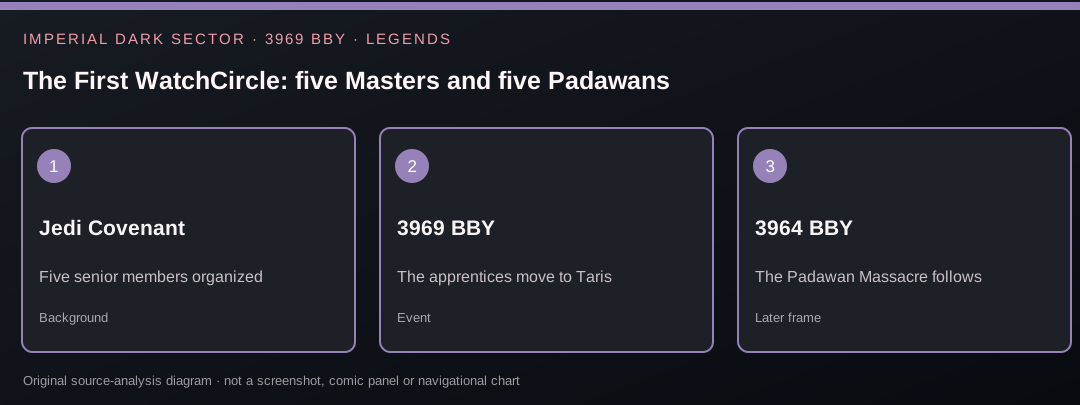
What the sources establish
By 3969 BBY, Jedi Covenant members Lucien Draay, Q'Anilia, Raana Tey, Xamar and Feln were posted at the Jedi Tower on Taris with five Padawans: Zayne Carrick, Shad Jelavan, Kamlin, Gharn and Oojoh. The assignment preceded the 3964 BBY murders by several years.
Power, identity, and society
The Padawans participated in a recognizable apprenticeship arrangement, while the Masters secretly maintained a faction dedicated to preventing an anticipated Sith threat. This institutional duality matters: the same people held public teaching responsibilities and private obligations known to neither their students nor most of the wider Order.
Evidence limits
It is inaccurate to place the Padawan Massacre at the time of the initial 3969 BBY assignment or to say all five apprentices became Jedi Knights. Later Force visions transformed the relationship in 3964 BBY.
Historical check: Were the five Padawans killed as soon as their Masters arrived on Taris?
Explanation: No. The 3969 BBY assignment came before the 3964 BBY massacre, a separate event.
Sources and further reading
- Knights of the Old Republic 24.
- Knights of the Old Republic Campaign Guide.