
Around 19,000 BBY in the Legends chronology, Kamino underwent a dramatic climate shift. Its extensive glaciers began to melt, low-lying marshes and narrow seas expanded, and the dry land on which the Kaminoans had built their earliest cities steadily disappeared. Within roughly two centuries, every major landmass was submerged beneath hundreds of meters of water. The event transformed not only Kamino's geography but the institutions, technologies, and biological practices of the people who survived it.
Kamino before the ocean world
The Kamino familiar from Attack of the Clones appears almost entirely covered by ocean. Legends gives the planet a very different deep past. Before the flood, Kamino had substantial land, extensive glaciers, low marshes, and comparatively narrow oceans.
The Kaminoans evolved in this terrestrial environment. Their early communities were not floating cities suspended above endless water. They were land-based societies whose settlements developed along coastlines and wetlands.
The global ocean was therefore a historical condition, not Kamino's original state.
The climate shift begins
Around 19,000 BBY, Kamino's climate changed sharply enough to begin melting its glaciers. The source does not supply a detailed atmospheric mechanism, so IDS does not invent one.
The important historical fact is the sustained rise in water. Ice melt enlarged the planet's existing seas and flooded low-lying regions first. Over time, coastal settlements and inland terrain alike disappeared beneath the expanding ocean.
The catastrophe unfolded over generations rather than as a single-day event.
Two centuries of rising water
Legends chronology states that all of Kamino's landmasses were submerged within approximately two hundred years. That time scale matters.
Two centuries is long enough for several generations to understand that the physical world of their ancestors is disappearing, yet short enough that political institutions and technologies must adapt under constant pressure.
The Kaminoans did not face one flood. They faced a persistent transformation of the conditions required for settlement.
The loss of ancient cities
As the seas rose, earlier Kaminoan cities disappeared. Legends identifies Derem City and the Clock Spires of Harai Nova among the architectural works lost beneath the water.
These losses were more than practical. Cities store collective memory in monuments, street plans, sacred sites, civic buildings, homes, and inherited places. When entire urban landscapes disappear, a society loses physical anchors that normally connect generations to their past.
Kaminoan history became divided into a terrestrial age and an oceanic age.
Displacement without another continent
The flooding forced Kaminoans from their original homelands, but there was no safe inland frontier to absorb the displaced population. Every continent was eventually threatened.
This distinguishes Kamino from regional flooding on a normal planet. Migration could not simply continue farther uphill forever.
Survival required a new relationship with the ocean itself.
Engineering above the water
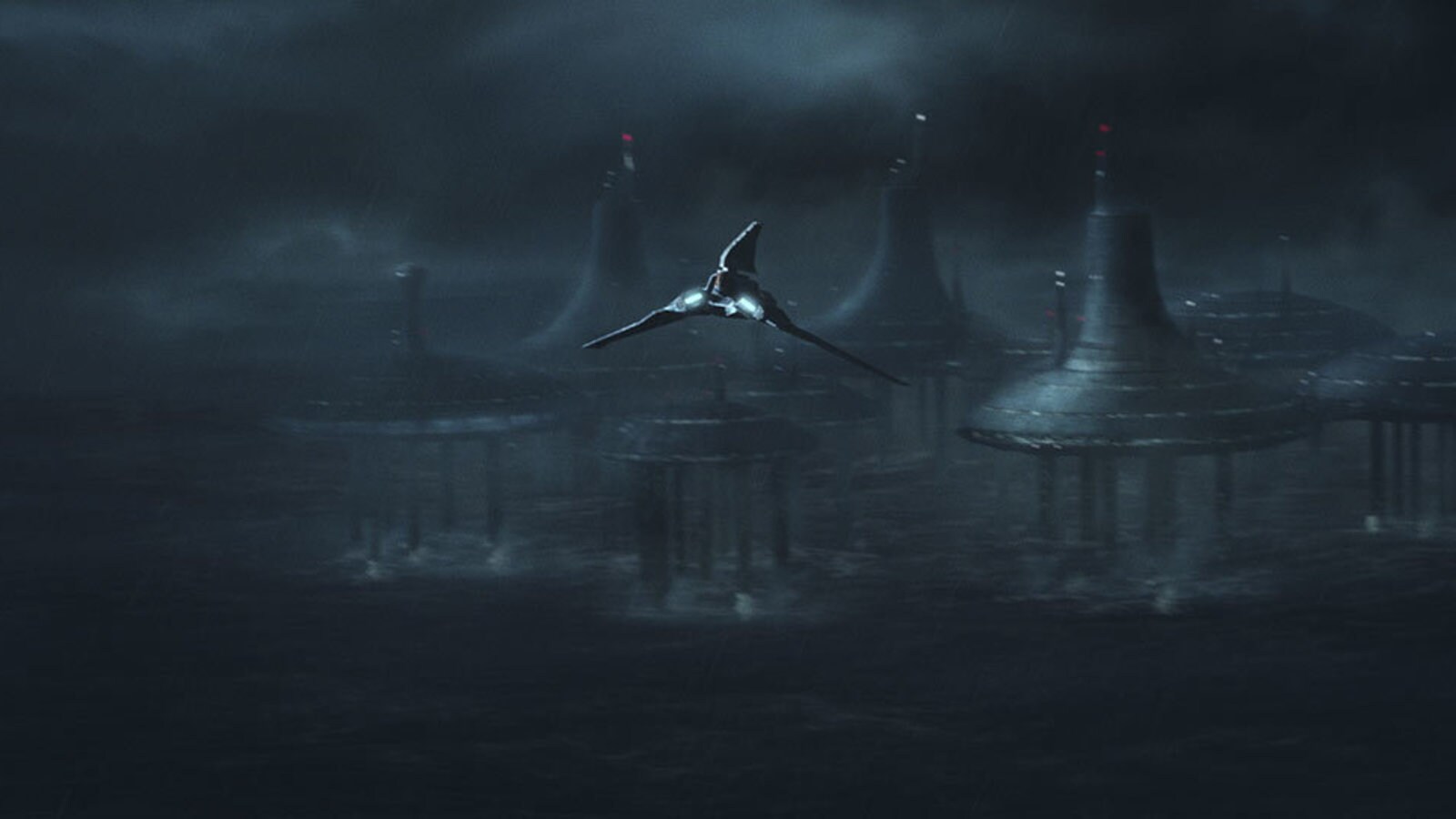
The Kaminoans adapted by constructing cities on immense supports above the rising seas. The later stilt cities seen in canon, including Tipoca City, fit the ecological logic established in Legends: permanent urban life had to be separated vertically from the ocean surface.
Architecture became a survival technology. Buildings, transport systems, laboratories, and civic infrastructure all had to function in an environment where stable land no longer existed.
The city ceased to be an extension of terrain and became an engineered platform.
Technology changes the outcome
Kamino and Neona offer two very different outcomes to ancient planetary flooding. Neona's native sentient species became extinct. The Kaminoans survived.
The difference was not simply that one species was more adaptable in an abstract sense. Kaminoan technology gave the population tools for constructing above-water settlements, maintaining complex infrastructure, and deliberately managing biological survival.
Social and technical capacity changed what the environmental crisis meant.
Cloning becomes part of survival
Legends links the catastrophe to Kamino's later expertise in genetics. As ecosystems disappeared beneath the rising water, Kaminoans used cloning and genetic engineering to preserve species that would otherwise have been lost.
Cloning was therefore not originally important only because it could create armies. It belonged to a much older relationship between Kaminoan science and planetary survival.
The Clone Wars turned that expertise into a galactic military industry many thousands of years later.
Preserving drowned life
Flooding destroyed terrestrial habitats as well as settlements. Plants and animals adapted to dry land or marsh environments faced the same shrinking geography as the Kaminoans.
By preserving genetic material and reproducing selected organisms, Kaminoan science could maintain forms of life after their original ecosystems vanished.
This was preservation through technological substitution: the laboratory replaced ecological continuity.
Preservation also means selection
Genetic preservation requires decisions about what to save. No society can preserve every organism, every lineage, or every ecological relationship equally.
That means Kaminoan survival science also created authority over biological futures. Scientists and institutions determined which organisms remained available to later generations and under what controlled conditions.
Biological rescue was therefore also a form of classification and power.
Engineering the Kaminoans themselves
Legends sources connect Kaminoan genetic expertise to changes within their own population as well. Over long periods, selective breeding and genetic manipulation contributed to the striking physical and behavioral uniformity associated with later Kaminoan society.
The same scientific tradition used to preserve life from a drowned planet could be turned inward toward the species conducting the preservation.
Environmental adaptation became social engineering.
Uniformity after catastrophe
Later Kaminoan culture is often described as controlled, restrained, technically focused, and strongly invested in biological standards. The ancient flood should not be treated as a simple explanation for every later cultural trait, but it provides important historical context.
A society that survived the loss of its entire terrestrial environment developed institutions capable of managing reproduction, infrastructure, and biological continuity over extremely long periods.
Those institutions later became central to Kamino's identity.
Remembering a vanished landscape
For the first generations after the flood, stories of drowned cities would still have referred to places remembered by parents or grandparents. Thousands of years later, those places belonged to deep history.
Submerged ruins transformed former homelands into inaccessible archaeological landscapes.
Kaminoan identity continued on a planet whose visible surface no longer resembled the world in which that identity had originated.
Outside Republic knowledge
Kamino lay far beyond the early Republic's effective political geography, near the Rishi Maze and outside the better-known routes of the Core-centered state.
The flooding therefore occurred without Republic intervention. No Senate relief program, Jedi mission, or Core-world migration scheme shaped the Kaminoan response.
Like Neona, Kamino demonstrates that major histories unfolded outside the Republic while the Great Manifest Period was expanding elsewhere.
The Republic was expanding somewhere else
Around 19,000 BBY, the Republic continued pushing settlement and administration outward from the Core. That expansion is one of the defining processes of the Great Manifest Period.
Kamino's catastrophe happened outside that story. This creates a useful chronological contrast: one civilization was extending institutions into new territory while another was struggling to keep a civilization alive after losing all conventional territory.
Galactic chronology contains simultaneous histories that do not share the same center.
Contact comes much later
Legends places formal Republic contact with Kamino thousands of years after the flood. By then, the Kaminoans had already transformed their environment, built ocean cities, and developed advanced cloning traditions.
When outsiders finally encountered Kamino, they did not discover a society waiting to be incorporated into galactic civilization. They encountered a technically sophisticated culture shaped by a long independent history.
From survival science to export industry
Kamino's genetics eventually became commercially valuable to outsiders. The same tradition that had helped preserve life and manage adaptation became a service offered to clients seeking engineered organisms and specialized clones.
This shift changed the social meaning of cloning. A technology rooted in survival could become an export industry.
Much later, that industry produced the clone army ordered in secret for the Galactic Republic.
Why the Clone Wars should not dominate this story
Kamino is usually remembered because Obi-Wan Kenobi discovered the clone army there shortly before the Clone Wars. That later episode is important, but it occupies only a tiny fraction of the planet's history.
The flood predates the Grand Army of the Republic by roughly nineteen millennia.
Understanding the ancient catastrophe prevents Kamino from being reduced to a factory setting created only for the prequel story.
What current canon still establishes
Current StarWars.com material describes Kamino as a remote ocean planet marked by storms and enormous stilt-mounted cities. It identifies Kaminoans as the world's native inhabitants and places Tipoca City at the center of its later political and cloning history.
Current canon does not, however, establish the specific 19,000-BBY glacial-melt chronology used in this article. That date remains Legends material.
Anthropological assessment
Kamino provides an unusually clear example of culture reorganizing around environmental transformation. Rising water removed the land base of an existing society. Rather than disappearing, the Kaminoans rebuilt settlement, infrastructure, biological preservation, and eventually reproduction around technical systems capable of functioning without land.
The result was not merely adaptation to an ocean. It was institutional adaptation: engineering, genetics, architecture, and scientific authority became central to the reproduction of society itself.
Later Kaminoan cloning cannot be separated completely from that deeper history of controlled survival.
Kamino and Neona compared
What the sources establish
Where the Kamino flood fits
Sources and further reading
- Daniel Wallace and Jason Fry, Star Wars: The Essential Atlas, Del Rey, 2009.
- Daniel Wallace, The New Essential Chronology, Del Rey, 2005.
- Kamino, StarWars.com Databank
- 19,000 BBY, Wookieepedia
- Kamino/Legends, Wookieepedia
- Great Manifest Period/Legends, Wookieepedia