
Around 15,000 BBY, the inhabitants of Neimoidia had become distinct enough from their Duros ancestors to be recognized as Neimoidians. Their story had begun roughly ten thousand years earlier when Duros explorers established a colony on Neimoidia during the first great age of Republic expansion. Over millennia, life under heavier gravity, a dimmer sun, persistent humidity, fog, and different atmospheric conditions was said in Legends reference works to produce visible physical differences. At the same time, the colony developed its own economy, institutions, values, and historical identity. By the beginning of the Kymoodon Era, “Neimoidian” described more than a Duros colony. It described a people.
The Duros ancestors
The Duros were among the galaxy's earliest major starfaring peoples.
They were known for exploration, astrogation, shipbuilding, and long-distance settlement.
During the early Republic period they established colonies far beyond Duro, including the world that would become Neimoidia.
Colonization around 25,000 BBY
Legends sources place the Duros colonization of Neimoidia around 25,000 BBY.
The colony belonged to the same broad expansionary age that saw the Republic's first major hyperlanes, new interstellar governments, and rapid growth of the Colonies region.
Neimoidia began as an extension of Duros migration but did not remain culturally subordinate forever.
A colony becomes its own political entity
Neimoidia developed as an allied but increasingly separate world from Duro.
By around 22,000 BBY, later histories describe Neimoidia as an independent Republic member rather than a mere administrative extension of the Duros homeworld.
Political separation therefore preceded the final recognition of distinct biological identity by thousands of years.
Ten thousand years of divergence
From roughly 25,000 to 15,000 BBY, the Neimoidian population developed apart from the main Duros population.
That interval was long enough in the fictional chronology for later observers to identify consistent physical differences.
The population also developed its own social institutions and economic orientation during the same period.
A different planetary environment
Legends reference works attribute many of the differences to Neimoidia's environment.
The planet had heavier gravity than Duro, a dimmer star, high humidity, widespread fog and mist, and atmospheric chemistry unlike the ancestral homeworld.
Those conditions became part of the canonical-in-Legends explanation for why the two populations no longer looked identical.
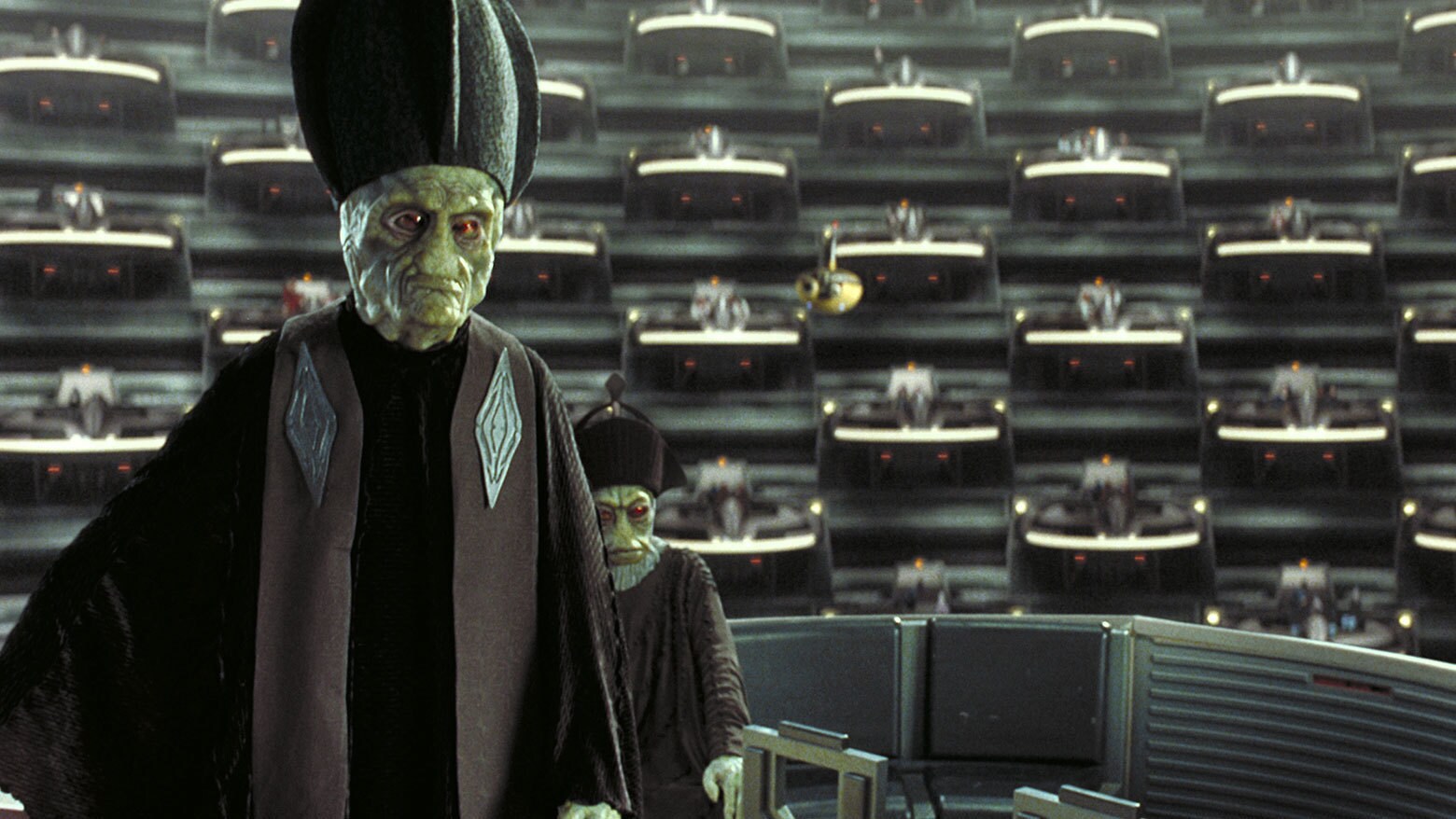
Physical distinctions
Neimoidians retained the basic Duros body plan but developed recognizable differences.
Later sources describe them as more gray-green in coloration, with slightly different facial proportions, horizontal pupils, forehead structures, and distinctive mouths.
They remained visibly related to Duros even after being treated as a separate species.
Related does not mean identical
Later galactic observers sometimes confused Duros and Neimoidians because of their shared ancestry.
That confusion could become insulting because both groups developed strong identities around their differences.
Shared ancestry did not erase separate histories.
Culture diverged before the label did
Biological distinction was only one part of Neimoidian emergence.
The colony had already developed its own political and commercial institutions before 15,000 BBY.
A new people can become culturally distinct long before outsiders decide where to draw a biological category.
A growing commercial orientation
While later histories often contrasted Duros exploration with Neimoidian commercial ambition, that contrast should be treated as cultural history rather than biology.
Neimoidian society increasingly organized wealth and prestige around trade, ownership, and economic influence.
Those values emerged through institutions, upbringing, and political economy.
Greed was not an evolutionary trait
Later Star Wars sources frequently stereotype Neimoidians as greedy, cowardly, anxious, or duplicitous.
Those are social judgments, not legitimate biological explanations for species divergence.
IDS does not turn later prejudice into genetics.
How stereotypes become attached to species
By the late Republic, Neimoidian leadership of the Trade Federation shaped how outsiders viewed the entire population.
Political conflict and commercial rivalry were generalized into claims about inherent Neimoidian character.
The stereotype became powerful precisely because species and culture were treated as if they were the same thing.
The Duros contrast became a moral comparison
Later traditions often praised Duros as adventurous and sociable while describing Neimoidians as fearful and acquisitive.
This created a moralized cousin relationship: one branch represented admirable exploration, the other suspect commerce.
Such contrasts tell us as much about later galactic prejudice as about either society.
Neimoidian identity
By 15,000 BBY, a descendant of the original Duros colonists could understand Neimoidia as a homeland rather than merely a colony.
That shift changes the politics of ancestry.
Duro becomes a place of origin; Neimoidia becomes the center of lived identity.
From colony to homeworld
Once a population has lived somewhere for thousands of years, describing that world only as a colony becomes historically misleading.
For Neimoidians, Neimoidia was the homeworld.
The fact that their distant ancestors came from Duro did not make their connection to Neimoidia temporary.
“Pure Neimoidia”
In later eras, the original world was sometimes called Pure Neimoidia to distinguish it from wealthy Neimoidian colony worlds.
The term reflected a reversal of the original colonial relationship.
A world that began as a Duros colony eventually became the ancestral center from which Neimoidians founded colonies of their own.
The Purse Worlds
Neimoidians later established wealthy colonies including Cato Neimoidia, Deko Neimoidia, and Koru Neimoidia.
These became known as Purse Worlds because of their concentration of wealth and administrative importance.
The former colony had become a colonizing society.
Colonial history repeats at a new scale
The Duros had once moved outward and settled Neimoidia.
Neimoidians later moved outward from Neimoidia and established their own dependent worlds.
Migration, settlement, and political separation can reproduce themselves across generations.
Cato Neimoidia
Cato Neimoidia became one of the most famous Purse Worlds.
Much later, its spectacular bridge cities and enormous private fortunes embodied the wealth accumulated by Neimoidian commercial elites.
Those later landscapes should not be projected backward onto Neimoidia in 15,000 BBY.
The Trade Monarch
Later Neimoidian political tradition centered on a ruler known as the Trade Monarch and a commercial governing elite.
The language of government itself reflected the importance of commerce.
Political authority and economic power were deeply intertwined.
Institutions create culture
A society organized around trade teaches people different skills and rewards different behaviors than one organized primarily around exploration or agriculture.
Those institutions can produce durable cultural patterns without requiring genetic explanations.
Neimoidian commercial identity is best understood in those terms.
The communal grub system
Later Legends sources describe Neimoidian young as being raised communally in grub-hives with deliberately limited food supplies.
That system was said to teach competition, hoarding, caution, and fear of deprivation.
Whatever its exact ancient origin, it is a cultural institution and should not be treated as a biological destiny.
Childhood as social training
The grub-hive tradition shows how societies can reproduce values through child-rearing.
If survival and status are made competitive from infancy, adults may learn to interpret scarcity and risk in particular ways.
Later observers often mistook the products of institutions for fixed species traits.
Clothing and rank
Neimoidian material culture later placed extraordinary emphasis on visible rank.
Robes, headdresses, colors, textures, and expensive accessories communicated status.
Wealth was not merely possessed; it was displayed and read socially.
Commerce becomes social identity
Economic success could therefore shape political authority, public appearance, and family reputation.
Over millennia, trade became more than an occupation.
It became one of the principal languages through which Neimoidian society organized hierarchy.
Do not project the Trade Federation backward
The Neimoidians would not help found the Trade Federation until around 350 BBY, more than fourteen thousand years after the emergence milestone on this page.
Nute Gunray, Lott Dod, Rune Haako, and the Naboo blockade belong to an unimaginably later period.
Their politics should not be used to fill gaps in 15,000 BBY Neimoidian history.
Fourteen millennia separate origin from notoriety
The Neimoidians are remembered primarily because of events surrounding the fall of the Republic.
That creates a danger of reading their entire history backward from the Trade Federation.
By 15,000 BBY, the Neimoidians already had thousands of years of independent history ahead of them before those later institutions existed.
Already inside the Republic world
Neimoidia's political relationship with the Galactic Republic predated the clear species distinction.
The planet had entered the Republic as an independent world thousands of years earlier.
The emergence of the Neimoidians therefore happened inside an existing interstellar political network rather than in total isolation.
Connected but locally distinct
Neimoidia was connected to the wider Republic while remaining environmentally and socially distinct from Duro.
Complete isolation was not required for cultural divergence.
Distance, local institutions, ecology, and separate political development were enough to produce a strong new identity.
Language and cultural separation
Later Neimoidians used Pak Pak alongside wider galactic languages.
Distinct language use reinforced cultural identity even while Neimoidian merchants operated across Republic space.
Trade does not necessarily erase local culture; it can also spread it.
Who decides a species boundary?
In fictional galactic reference works, the point at which Duros colonists become Neimoidians is presented as a biological milestone.
Socially, however, species labels also organize law, identity, prejudice, marriage, migration, and political representation.
The label therefore carried consequences beyond anatomy.
Ancestry and difference coexist
Neimoidians could be descendants of Duros and still be Neimoidian.
Those facts are not contradictory.
Historical identity is often built from both remembered ancestry and accumulated difference.
A Colonies-region story
Neimoidia lay in the Colonies region, one of the earliest great zones of settlement beyond the Core.
Many worlds there began as distant settlements and later became independent centers with their own politics.
The Neimoidian story belongs to that broader pattern of colonial societies outgrowing their founders.
At the beginning of the Kymoodon Era
The clear emergence of the Neimoidians is conventionally dated to the same broad period in which the Kymoodon Era began.
The Republic was entering another expansion boom just as one of its very old colonial populations was being recognized as a distinct people.
Expansion created new settlements; deep time transformed some settlements into new societies.
Another c. 15,000 BBY development
This milestone sits beside many approximately concurrent events: the Republic Navy's restoration, Anomid accession, Hutt political reorganization, Ando's wars, and Rodia's formal Republic membership.
The sources do not supply an internal sequence precise enough to order all of them by month or day.
IDS therefore treats c. 15,000 BBY as a cluster rather than false precision.
Current canon preserves the Neimoidians
Neimoidians remain fully part of current Star Wars canon.
StarWars.com describes them as green-skinned, large-eyed humanoids strongly associated with the Trade Federation in the late Republic.
The detailed 25,000–15,000 BBY Duros-colonist divergence belongs primarily to Legends and reference chronology.
Neimoidian worlds in current canon
Current canon also preserves Cato Neimoidia and the broader Neimoidian presence in galactic politics.
That continuity confirms the later people and worlds without automatically validating every ancient Legends detail.
The distinction matters whenever IDS mixes deep history with modern canon imagery.
Anthropological assessment
The Neimoidian emergence is a deep-time migration story. A settler population left an ancestral world, established a permanent home elsewhere, developed its own institutions, and eventually became a people whose identity could no longer be reduced to colonial ancestry.
It also demonstrates why biology and culture must be separated analytically. Legends attributes physical differences to long residence on Neimoidia, while later traits such as commercial ambition, status display, risk aversion, or competitive child-rearing arise through institutions and social history.
Finally, the story reverses the direction of colonial identity. Neimoidia began as a Duros colony. In later millennia it became a homeworld from which Neimoidians founded their own colonies. What counts as a “center” or “periphery” can change completely across deep time.
What the sources establish
Canon versus Legends
Where the emergence fits
Sources and further reading
- Ann Margaret Lewis and Helen Keier, The New Essential Guide to Alien Species, Del Rey, 2006.
- Daniel Wallace and Jason Fry, Star Wars: The Essential Atlas, Del Rey, 2009.
- Star Wars: Build the Millennium Falcon 52, “Guide to the Galaxy: The History of Neimoidia.”
- StarWars.com Databank, Neimoidian
- StarWars.com Databank, Cato Neimoidia
- Neimoidia/Legends, Wookieepedia
- Neimoidian/Legends, Wookieepedia