
Around 15,000 BBY, the Aqualish peoples of Ando fought a civil war so destructive that later sources said it nearly exterminated them. The conflict grew out of long-standing rivalry among the Aquala, Quara, and Ualaq, three closely related Aqualish populations adapted to different environments. The immediate dispute centered on declining fish harvests and accusations of overfishing. The war ended only when an offworld vessel arrived. Faced with outsiders, the rival groups united, killed the newcomers, seized their craft, and learned from it the technology of interstellar travel.
Ando
Ando was the Aqualish homeworld, a planet of oceans, wetlands, islands, rain forests, and cave systems.
Its varied environments helped shape different Aqualish populations over deep time.
Ecology and identity became tightly connected.
Aquala, Quara, and Ualaq
Legends distinguished three principal Aqualish populations.
The Aquala were associated primarily with the oceans, the Quara with wetlands and terrestrial environments, and the Ualaq with caves and dark rain forests.
They remained closely related and spoke mutually intelligible forms of the same language, but each developed a strong sense of separate identity.
Each claimed superiority
The groups did not simply recognize ecological difference.
Each could interpret its own way of life as evidence that it represented the superior branch of the species.
Environmental adaptation became social hierarchy.
Declining fish harvests
The immediate crisis was tied to declining fish stocks.
Aquala communities blamed the Quara and Ualaq for overfishing and reducing the harvests on which many Aqualish depended.
Resource scarcity transformed existing prejudice into open political conflict.
The politics of overfishing
Overfishing is not only an ecological problem.
It becomes political when different communities depend on the same resource but disagree over responsibility, access, and restraint.
On Ando, environmental decline became an accusation about which group was endangering everyone else.
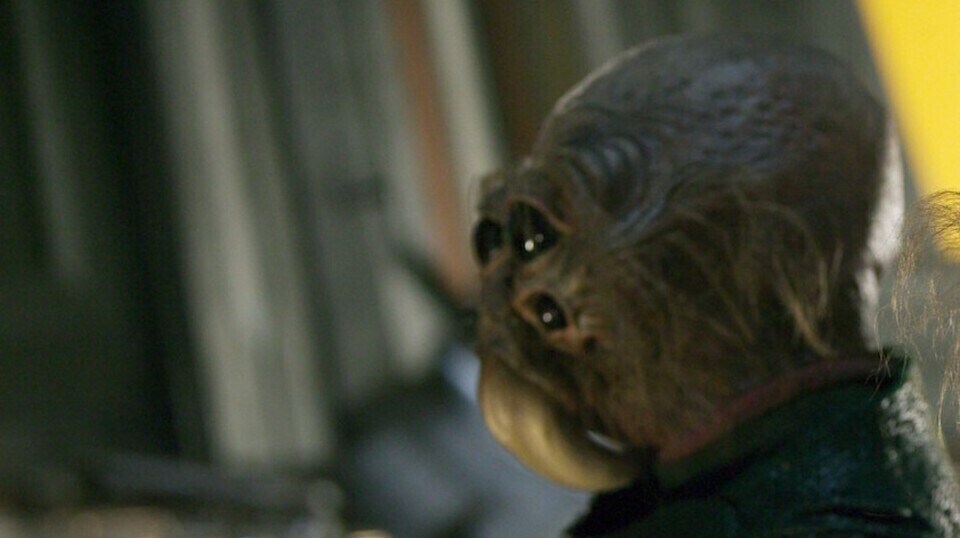
Civil war
The ecological dispute escalated into a full civil war among the Aqualish populations.
Later histories describe the fighting as so destructive that it threatened the survival of the species.
The source does not provide commanders, casualty totals, battle names, weapons, or a detailed campaign map.
Near self-destruction
The claim that the war nearly exterminated the Aqualish emphasizes the severity of the conflict.
It should not be converted into a precise population estimate because none survives.
What matters historically is that later Aqualish memory treated the war as existential.
No internal resolution appears first
The civil war did not end because the three populations peacefully settled the fishing dispute.
It ended because a new actor entered the situation.
The arrival of outsiders reorganized the meaning of who counted as enemy.
The offworld vessel
An offworld exploratory craft or settler vessel arrived on Ando during the conflict.
Later sources do not agree on whether its crew came from Corellia, Duro, or another Human-linked expedition.
The uncertainty should remain visible.
A disastrous first contact
The newcomers arrived in the middle of a society already destabilized by civil war.
Instead of becoming mediators or trading partners, they were interpreted as a common threat.
The three Aqualish groups united against them.
The external-enemy effect
Groups that define one another as enemies can temporarily suppress internal divisions when confronted by a more distant outsider.
The Aqualish Civil War is an unusually stark Star Wars example.
Aquala, Quara, and Ualaq did not cease being distinct; they discovered a larger category—Aqualish—through opposition to offworlders.
The newcomers are killed
The united Aqualish killed the vessel's crew.
The act ended the first-contact encounter violently and gave the Aqualish access to something they had not possessed before: a working interstellar craft.
Contact brought technological opportunity through violence rather than exchange.
The captured ship
The Aqualish confiscated the offworld vessel and studied it.
Later sources say they extrapolated or reverse-engineered the principles of space travel from the craft.
The source does not preserve the ship's class, manufacturer, registry, exact drive system, or original mission.
Reverse-engineering interstellar travel
The captured ship compressed a long technological learning process.
Instead of developing every component independently, Aqualish engineers could examine an integrated working system.
They learned enough to reproduce spacecraft of their own.
Technology transfer without consent
Technology can spread through trade, teaching, diplomacy, theft, salvage, espionage, or war.
On Ando, the transfer was violent.
The Aqualish acquired interstellar capability from people they had killed.
The Aqualish unify
The arrival of the outsiders transformed the civil war into species-level unification.
Aquala, Quara, and Ualaq began acting collectively as Aqualish in external affairs.
The sources describe the outcome as unification, though that did not erase later internal prejudice or political division.
Identity expands without disappearing
An Aquala could remain Aquala while also identifying as Aqualish.
The same was true of Quara and Ualaq.
The civil war's end therefore produced layered identity rather than complete cultural merger.
Unity through hostility is fragile
A common enemy can create political unity without resolving the original dispute.
The fish-harvest crisis did not become irrelevant merely because outsiders arrived.
It was temporarily displaced by a stronger external focus.
A suddenly spacefaring society
The captured technology changed Ando's strategic position almost immediately.
A world consumed by internal conflict gained the ability to project force beyond its own planet.
The violence did not disappear. Its scale changed.
Building an armada
Later Aqualish accounts say the newly united species eventually created an armada of starships.
The ships were technologically inferior to the mature vessels of established starfaring powers, but they were sufficient to carry Aqualish violence offworld.
Interstellar mobility converted local militarization into regional militarization.
Andando
The first major target of Aqualish expansion was Andando, described as Ando's sister planet.
Aqualish forces attacked the world during their early campaign of conquest.
Later histories say Andando was left a smoldering, uninhabitable ruin.
Do not confuse Ando and Andando
Ando was the Aqualish homeworld.
Andando was a neighboring world attacked after the Aqualish acquired spaceflight.
The similar names can obscure the fact that one was the center of the civil war and the other became an early victim of Aqualish external expansion.
Civil war becomes external war
The end of the civil war did not demilitarize Aqualish society.
Instead, the newly unified military capacity was redirected outward.
Violence that had threatened to destroy Ando became a tool of conquest.
Toward conflict with the Republic
As Republic exploration and diplomacy reached Ando, envoys attempted to draw the Aqualish into the Galactic Republic.
The Aqualish responded with hostility.
The encounter escalated into the Aqualish–Republic War.
A few decades later
Some chronological summaries place the Aqualish campaign of conquest and Republic war a few decades after the civil war, even though all are broadly grouped under c. 15,000 BBY.
The precise year is not securely preserved.
IDS therefore treats the Republic war as a subsequent event rather than pretending it occurred immediately on the same day.
The Republic eventually wins
The later Aqualish–Republic War ended in Republic victory.
Ando entered the Galactic Republic around this broad period.
The trajectory from isolation to civil war to violent first contact to failed conquest to Republic membership was extraordinarily compressed by deep-time chronology.
The fish crisis returns
Later summaries say the Republic helped revive Ando's fishing industry after defeating the Aqualish.
That is significant because the original civil war had begun over declining fish harvests.
The ecological problem survived every political transformation around it.
Ecology underlies the political history
The civil war can look like a story about subspecies hatred.
It is also a story about resource management.
The conflict demonstrates how ecological stress can intensify identities that already carry social tension.
Scarcity and scapegoating
The Aquala accusation placed responsibility for declining fish stocks on other Aqualish groups.
Such explanations simplify complex environmental problems by assigning blame to a recognizable community.
Scapegoating can make political mobilization easier even when ecological causes are broader.
Biological variation becomes social difference
The Aquala, Quara, and Ualaq differed physically because of long adaptation to different environments.
Those biological differences became social categories carrying assumptions about superiority and blame.
The war shows how human-style political hierarchy can be built around bodily variation even within one species.
The category “Aqualish” becomes politically useful
Before the offworld arrival, the three groups emphasized their differences.
Afterward, a shared Aqualish identity became strategically useful.
Categories are therefore not fixed; their importance changes with political context.
Unification through xenophobia
The new unity was built partly through hostility toward outsiders.
That is different from reconciliation.
The civil war ended because the boundary of exclusion moved outward.
Technology magnifies existing institutions
The captured ship did not make the Aqualish violent.
The society was already militarized by civil war.
Interstellar technology magnified the geographic reach of institutions and habits that already existed.
Conquest was not technologically inevitable
The Anomids, in the same broad era, developed hyperdrive and remained at home for about a century.
The Aqualish obtained starflight and rapidly used it for conquest.
The contrast shows why technology alone cannot explain political behavior.
Anomids and Aqualish
Both peoples entered wider galactic history around 15,000 BBY.
The Anomids were pushed outward by drought and responded to Duros contact with cooperation and eventual Republic membership.
The Aqualish faced ecological stress too, but first responded with internal war and then with violence against outsiders.
First contact depends on conditions at home
A society's internal political situation shapes how it interprets newcomers.
The explorers reached Ando during an existential civil war.
They arrived at the worst possible moment for a peaceful encounter.
The outsiders have almost no voice
The source preserves the Aqualish reaction more clearly than the visitors' identities or intentions.
We do not know their names, home system, mission orders, or what they believed they had found.
The dead explorers survive mainly as catalysts in Aqualish history.
Aqualish-centered memory
Because the visitors disappear so completely from the record, the event is remembered primarily as an Aqualish turning point.
That archival framing can make the killing look like a step in technological development rather than a first-contact tragedy.
Historical perspective changes what an event appears to be about.
A long shadow over Aqualish reputation
Later galactic sources often stereotyped Aqualish as aggressive, brutal, or quick to violence.
The ancient civil war and early conquest became part of that cultural reputation.
Such reputations can themselves become prejudicial, reducing a diverse people to selected episodes from their history.
Do not turn history into biology
A history of warfare does not prove that violence is biologically inherent to the Aqualish.
The civil war had ecological, political, and social causes.
Later Aqualish included engineers, senators, workers, traders, criminals, soldiers, and countless other social roles.
Much later: Po Nudo
Thousands of years later, Ando would be represented in the Galactic Senate by the Aqualish politician Po Nudo.
His official StarWars.com profile demonstrates that both Ando and Aqualish political participation remain part of current canon.
The ancient 15,000 BBY civil war chronology itself remains Legends.
Canon versus Legends geography
Current canon preserves the Aqualish species and identifies Ando as Po Nudo's homeworld.
Legends supplies the detailed Aquala–Quara–Ualaq civil war, fish-harvest crisis, captured explorer vessel, Andando campaign, and ancient Republic war.
IDS keeps those continuity layers distinct.
Anthropological assessment
The Aqualish Civil War is fundamentally a story about scarcity, identity, and boundary-making. Declining fish harvests intensified existing divisions until different Aqualish populations treated one another as existential threats.
The arrival of outsiders did not resolve those divisions intellectually. It changed the scale of identity. Aquala, Quara, and Ualaq could suddenly imagine themselves as one people because an even more external category had appeared.
The captured starship then magnified the political consequences of that new unity. Technology extended the reach of a society still organized around war. The result was not automatic progress but exported violence. Ando therefore provides a strong counterexample to any timeline in which spaceflight naturally leads toward peaceful galactic integration.
What the sources establish
Canon versus Legends
Where the civil war fits
Sources and further reading
- Galaxy Guide 4: Alien Races, West End Games.
- Ann Margaret Lewis, The Essential Guide to Alien Species, Del Rey, 2001.
- Ann Margaret Lewis and Helen Keier, The New Essential Guide to Alien Species, Del Rey, 2006.
- Daniel Wallace and Jason Fry, Star Wars: The Essential Atlas, Del Rey, 2009.
- StarWars.com Databank, Po Nudo
- Aqualish Civil War, Wookieepedia
- Ando/Legends, Wookieepedia
- Aqualish/Legends, Wookieepedia