
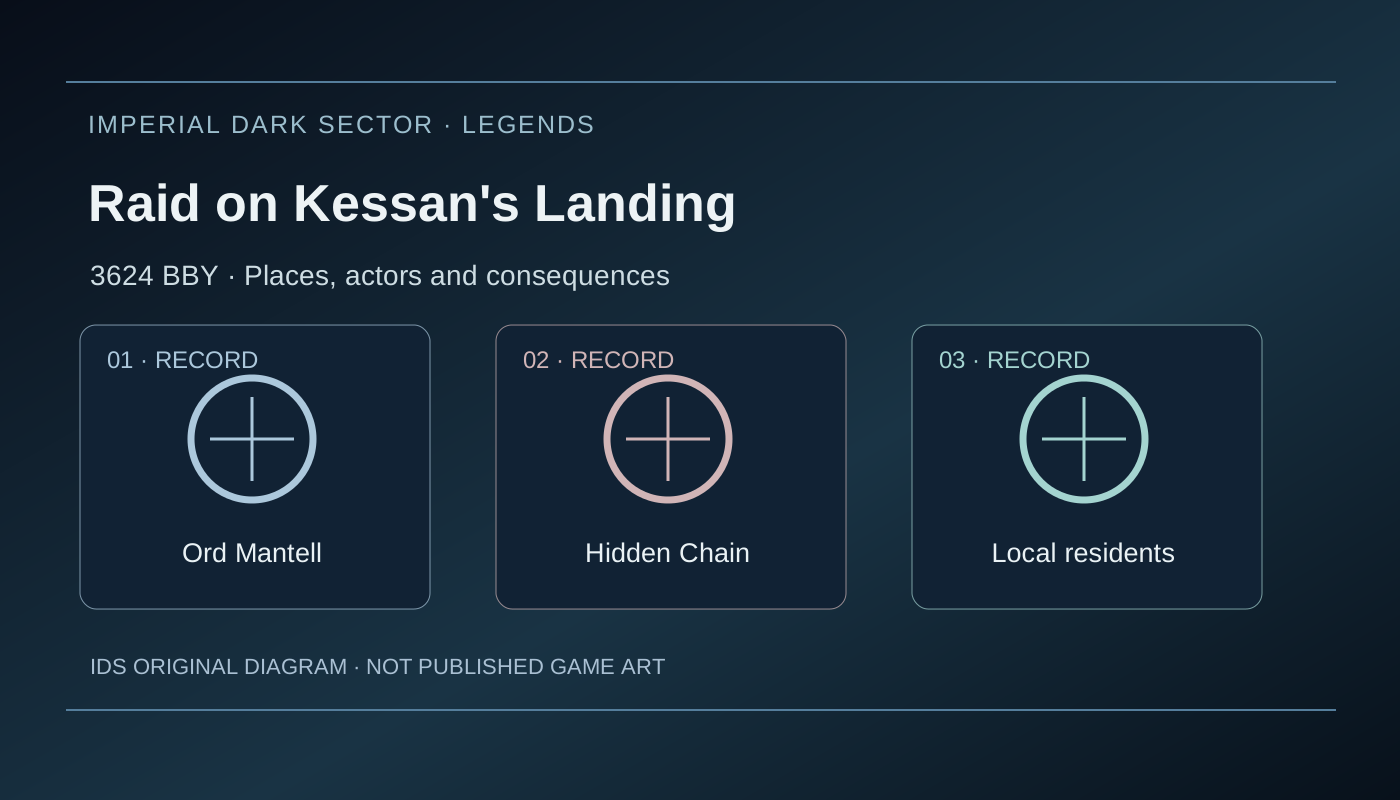
- World
- Ord Mantell
- Settlement
- Kessan's Landing
- Hidden Chain leader
- Tyrus Brokenblade
- Local allies
- Mantellian Separatists
- Result
- Raid defeated / Tyrus captured
Later in 3624 BBY, the Hidden Chain attacked Kessan's Landing, a provincial settlement built around geothermal infrastructure on Ord Mantell. Tyrus Brokenblade coordinated with Mantellian Separatists to seize hostages and coolant rods from the local plant. The attack fused two conflicts that had different histories: Heta Kol's struggle against Shae Vizla and Ord Mantell's long-running separatist insurgency. The defenders stopped the complete theft, captured Tyrus, and prevented the settlement from falling, although some assets were carried away.

Geothermal infrastructure makes a small settlement strategically useful
Kessan's Landing was not Coruscant, Vaiken Spacedock, or another obvious galactic center. Its importance came from infrastructure: energy, coolant, transport, and people who could be used as leverage.
This is how wider wars penetrate ordinary places. A community becomes strategically relevant because of what it produces or where it sits, not because its residents chose to join a galactic conflict.
The Hidden Chain builds alliances from local grievances
Mantellian Separatists had their own reasons for fighting Ord Mantell's authorities. Heta's forces could therefore cooperate with them without sharing an identical political program.
Coalitions often work through temporary overlap. One faction wants Mandalorian transformation; another wants local separatist victory. They can still share targets, intelligence, and logistics.
Sa'har Kateen intervenes and complicates the Hidden Chain story
Sa'har's appearance keeps Darth Nul's legacy entangled with Heta Kol's movement. She is not simply a passive artifact carrier; her own relationships, especially with Ri'kan, shape how the holocron moves through the conflict.
Her intervention against Tyrus also shows that individuals within a coalition can have goals that diverge sharply from the organization sheltering them.
Civilian deaths make the cost visible
Residents of Kessan's Landing die during the raid. That matters because military summaries can reduce the event to stolen coolant rods and a captured commander.
For the settlement, the event is remembered through destroyed routines, lost relatives, and damaged trust as much as through strategic outcome.
3624 BBY · Legends · Source comparison
Historical narrative and cultural analysis
What the source supports
The Hidden Chain and Mantellian separatist crisis reaches Kessan's Landing, a provincial island on Ord Mantell. In Chains in the Dark, the area receives a new story and repeatable activities as the player confronts a Hidden Chain strike team. The publisher's description establishes the location and conflict but not identical outcomes for each optional daily activity.
Institutions, beliefs and material culture
Military violence entering a small community raises questions about outside factions mobilizing local grievances. The historical account should separate island residents from combatants rather than classifying a population by the faction operating nearby. The region's geothermal installations and transport constraints also matter materially to the mission design.
Evidence limits and dating
These events follow SWTOR's Legends narrative. The BBY date is a historical placement and may not appear in the official release notes; a game's 2023–2025 publication date is not a fictional in-universe date. Dialogue and choices may vary, and unreported details remain unknown.
Publisher source: SWTOR primary update record →
Event sequence
An out-of-the-way geothermal settlement becomes the target.
Local insurgents support Tyrus Brokenblade's force.
People and infrastructure are treated as resources.
The Nul storyline intersects directly with the raid.
The main raiding force is defeated.
Some stolen assets escape, so victory is incomplete.
Explore this entry
Why Kessan's Landing?
Its geothermal infrastructure provided useful coolant rods, while its relative isolation made it more vulnerable than a heavily defended capital.
Did the defenders recover everything?
No. The raid was defeated, but the Hidden Chain escaped with part of what it sought.
Why work with Mantellian Separatists?
Because their local struggle created ready-made fighters and knowledge of the terrain. Heta's movement could exploit that conflict without needing to create one from scratch.
What happens next?
The hunt shifts toward Hutta and the Minboosa District as Sa'har, Ri'kan, the Nul holocron, Shae Vizla, and Malgus become increasingly entangled.
Anthropological assessment
Kessan's Landing is a strong example of conflict layering. A new civil war does not replace an older insurgency; it attaches itself to existing grievances and infrastructure, creating a coalition whose members interpret the same battle differently.
The raid also demonstrates how strategic thinking turns people and utilities into equivalent assets. Hostages provide coercive leverage. Coolant rods provide material capability. For residents, however, neither category captures the lived experience of invasion.
Sources and further reading
- SWTOR Game Update 7.4: Chains in the Dark
- SWTOR: Chains in the Dark launch preview
- Raid on Kessan's Landing — Wookieepedia
Test your historical judgment
Your results will include an explanation of each correct answer and corrections for errors.