
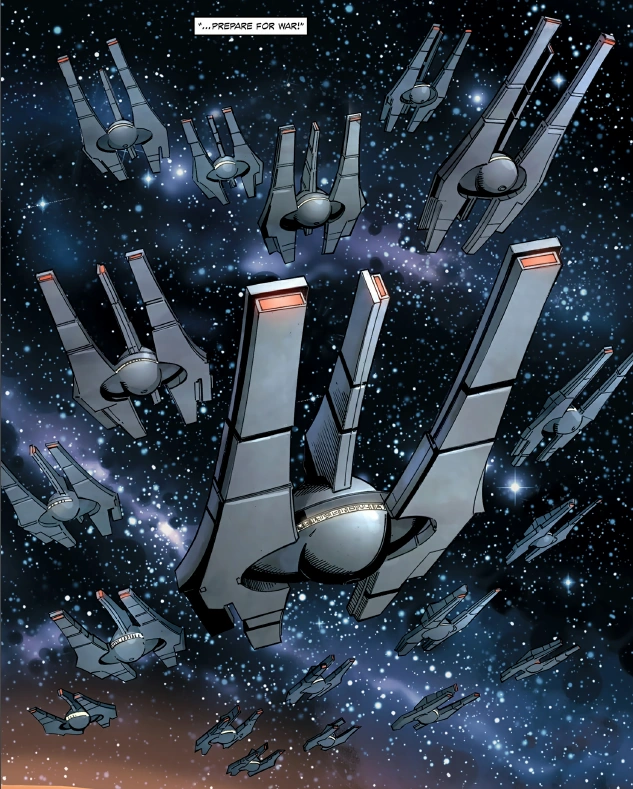
Around 30,000 BBY, the Rakatan Infinite Empire stood among the dominant powers of the prehistoric galaxy. The empire was older than this date, and it would survive for millennia afterward, but licensed Legends sources repeatedly use this period as a high point in Rakatan expansion. From Lehon in the Unknown Regions, the Rakata linked hundreds of worlds selected not by ordinary geography but by the ability of their Force-based hyperdrives to locate planets rich in life and the Force.
The source tradition
The Rakata were introduced as the lost Builders in the 2003 video game Star Wars: Knights of the Old Republic. The game revealed Lehon, the Temple of the Ancients, the Star Maps, the Star Forge, and surviving Rakatan tribes whose descendants remembered only fragments of their imperial past.
Later sources expanded that history. The New Essential Chronology, The Essential Atlas, The Essential Guide to Warfare, Star Wars: The Old Republic, and the Dawn of the Jedi comics placed the Rakata within a much older web of conflict involving the Kwa, Gree, Celestials, Humans, Sith, and other peoples.
The strongest official synthesis remains the StarWars.com publication of “The Vanished,” where Imperial-era pre-Republic specialist Insmot Bowen describes the Infinite Empire as a major galactic power around 30,000 BBY and argues that later galactic technology inherited much from Rakatan systems.
Lehon: center of the Infinite Empire
The Rakata were native to Lehon, later also known as Rakata Prime, in the region called the Tempered Wastes. The world functioned as the political and technological center of the Infinite Empire.
By the time Revan visited Lehon thousands of years later, Rakatan civilization had collapsed into isolated tribal societies. The ruins of temples, machines, defensive systems, and the surviving Star Forge revealed a social order whose material remains had vastly outlasted the institutions that created them.
Lehon therefore works as both imperial capital and archaeological warning. A civilization can dominate enormous distances and still leave descendants who no longer understand the systems surrounding them.
Technology built around the Force
Rakatan technology was not simply advanced machinery with mystical decoration. Legends sources describe the Force as structurally embedded in the technology itself. Their ships, shields, weapons, navigation systems, and industrial systems depended on Force-sensitive operation or Force-focused energy.
The Rakatan hyperdrive was especially distinctive. It did not navigate between arbitrary coordinates in the way later hyperdrives did. Instead it located worlds strong in the Force, which usually meant worlds rich in life. The result was an empire spread across widely separated systems rather than a neat contiguous territory.
This is one of the clearest cases in Star Wars where transportation technology shapes political geography. Rakatan imperial space followed a network created by what its machines could detect.
A patchwork empire
The name “Infinite Empire” suggests limitless territory, but the actual political geography was selective. Later Legends material places more than five hundred worlds within the Rakatan network at its height, scattered across enormous stretches of the galaxy.
That structure differs from the later Republic, whose hyperspace lanes and commercial networks encouraged contiguous regional blocs. Rakatan dominion could leap over vast areas and seize strategically useful worlds while ignoring systems that did not register strongly enough through their navigation technology.
Political maps can therefore mislead. An empire does not need to control every point between its possessions if transportation allows rulers to move directly between distant nodes.
Slavery as infrastructure
The Infinite Empire was built on enslavement. The Rakata conquered populations, extracted labor, exploited Force-sensitive captives, and incorporated subjugated worlds into an imperial system designed for Rakatan power.
This was not incidental exploitation around an otherwise neutral technological project. Slavery was part of how the empire reproduced itself. Conquered populations built, maintained, supplied, and were consumed by the systems that enabled further conquest.
Later Legends sources differ on specific details of which populations were enslaved at particular dates, but they consistently depict domination and forced labor as defining features of Rakatan rule.
The Star Forge
The greatest surviving symbol of Rakatan imperial technology was the Star Forge, an enormous station in the Lehon system that drew energy from the local star and from the dark side of the Force. It could manufacture warships, droids, weapons, and military material on a scale capable of supporting imperial expansion.
Knights of the Old Republic also depicts the Star Forge as more than a passive factory. Its systems were intertwined with dark-side energy and could amplify the violence and aggression of those who controlled it. The Rakata built a machine intended to expand their capacity for domination, but the machine also intensified the social conditions under which domination operated.
This makes the Star Forge anthropologically interesting. Technology does not merely serve political systems. It can change incentives, concentrate power, normalize particular kinds of violence, and reshape the institutions built around it.

War against the Kwa
Legends traditions place the Kwa among the ancient peoples who first contacted and educated the Rakata. The relationship later turned violent. The Rakata sought control of Kwa Infinity Gate technology, while the Kwa attempted to deny them access.
Later sources describe catastrophic conflict on Dathomir and elsewhere, with the Rakata destroying much of Kwa civilization. Whether every later myth preserves the conflict accurately is uncertain, but the broader pattern is consistent: knowledge transfer did not produce equality. The beneficiary of technological exchange became an imperial power and turned against its former teachers.
Breaking other ancient powers
The Gree were another major prehistoric civilization pushed back by Rakatan expansion. Later histories say the Infinite Empire drove the Gree toward their home cluster while attacking other Celestial-associated cultures.
This transition is significant because it marks a change in prehistoric galactic power. Earlier deep-time history contains multiple old starfaring civilizations. By the Rakatan high point, one imperial system increasingly dominates the surviving narrative.
Worlds transformed by empire
Rakatan occupation left environmental as well as political effects. Legends sources connect the empire to experimentation and terraforming on worlds including Kashyyyk, where ancient machinery altered the development of the wroshyr forests. Other worlds were exploited, stripped, used as prisons, or incorporated into military systems.
Empire therefore operates at several scales at once. It controls people, but it can also alter landscapes, ecosystems, infrastructure, and the long-term material conditions inherited by later societies.
These interventions make archaeology difficult because later inhabitants may experience an engineered environment as if it were natural.
Imperial control of knowledge
Rakatan technology depended on specialized knowledge that the rulers attempted to keep from subject populations. Later sources describe enslaved peoples reverse-engineering aspects of Rakatan machines while deliberately removing Force-dependent elements.
This process becomes one of the most important legacies of the Infinite Empire. Technologies associated with hyperspace travel, weapons, shields, and navigation survive not through straightforward inheritance but through appropriation, adaptation, and technical translation by former subjects.
Knowledge moves even when empires try to monopolize it.
The empire after the empire
When the Rakatan system eventually collapsed, its infrastructure and ideas did not disappear. Former subject peoples reused and transformed what they had learned. Later interstellar civilizations developed technologies that no longer required Rakatan Force sensitivity.
The result is a familiar historical paradox: a violent empire can be destroyed politically while remaining embedded in the institutions, technologies, languages, routes, and categories of the societies that replace it.
The Rakata therefore matter not only because they ruled. They matter because later galactic civilization developed partly inside the technological ruins they left behind.
The collapse ahead
The Infinite Empire did not survive indefinitely. Legends chronology places its final collapse around 25,200 BBY after civil war, slave revolts, a devastating plague, and the loss of the Rakata's connection to the Force.
Because their machines depended on that connection, biological catastrophe became technological catastrophe. Systems that once sustained imperial control became difficult or impossible to operate. Former subjects rebelled. Rakatan territories fractured, and survivors retreated toward Lehon.
That collapse deserves its own dossier rather than being compressed into the end of the empire's high-point page.
What current canon has restored
The detailed Infinite Empire chronology remains Legends, but the Rakata themselves have crossed back into current canon. In Andor, Luthen Rael gives Cassian a Kuati signet containing blue kyber and says it commemorates an uprising against ancient Rakatan invaders. Current reference material also preserves Lehon as a named world.
Those references confirm that ancient Rakatan invasions existed in current continuity. They do not automatically canonize the Star Forge, the full Infinite Empire chronology, Force-driven hyperdrives, or every Legends conquest.
Empire, extraction, and technological inheritance
The Infinite Empire is useful anthropologically because it makes imperial power material. Conquest is not only armies and rulers. It is forced movement, labor systems, control of technical knowledge, altered environments, transport infrastructure, resource extraction, and institutions that classify conquered populations according to imperial usefulness.
The Rakata also show that technological sophistication and ethical development are unrelated. Extraordinary engineering capacity did not prevent the empire from organizing society around slavery and violence. Technical complexity can expand the scale at which domination operates.
Finally, Rakatan history demonstrates that conquered populations are not passive recipients of imperial systems. Subject peoples adapt, conceal knowledge, reverse-engineer technology, rebel, and ultimately reshape the material inheritance of the empire for purposes its rulers never intended.
Where the Infinite Empire fits
Sources and further reading
- Star Wars: Knights of the Old Republic, BioWare/LucasArts, 2003.
- Daniel Wallace, The New Essential Chronology, Del Rey, 2005.
- Daniel Wallace and Jason Fry, Star Wars: The Essential Atlas, Del Rey, 2009.
- Jason Fry and Paul R. Urquhart, Star Wars: The Essential Guide to Warfare, Del Rey, 2012.
- “The Vanished,” The Essential Guide to Warfare Author’s Cut, StarWars.com
- Knights of the Old Republic, StarWars.com
- Infinite Empire/Legends, Wookieepedia