
Around 15,000 BBY, the Galactic Republic constructed the Senate Hall on Coruscant. The building became the principal meeting place of the Galactic Senate for the next eleven millennia. It was not the enormous mushroom-shaped Senate Rotunda seen in the prequel films. That later complex was erected around 3996 BBY, after the Great Sith War, on or over the remains of the older hall. The c. 15,000 BBY construction therefore marks an earlier stage in the monumentalization of Republic politics: a legislature that had existed for roughly ten thousand years was given a durable architectural center worthy of a galaxy-spanning state.
The Senate existed long before the building
The Galactic Senate had governed the Republic since its founding in 25,053 BBY.
For roughly ten thousand years, therefore, the institution existed before the c. 15,000 BBY Senate Hall.
A legislature and the architecture housing it are related but not identical historical developments.
Why construct a monumental hall now?
The sources do not preserve a founding decree or named architect explaining why the hall was built at this exact moment.
The wider context is suggestive: the Republic was entering a new expansion boom, adding member worlds, restoring its Navy, and deepening bureaucratic infrastructure.
A larger permanent political center fit that transformation.
The Kymoodon expansion context
The Kymoodon Era is associated with more routine hyperspace travel, renewed exploration, new member worlds, growing industries, and denser political networks.
As the Republic expanded, the Senate needed to represent more systems and manage more disputes.
Architecture followed institutional scale.
Coruscant as political center
The Senate Hall stood in Galactic City on Coruscant.
By this period, Coruscant had already been the Republic's principal political center for millennia.
Constructing a permanent monumental chamber reinforced the city's claim to be the place where galactic politics happened.
The Senate District
The building stood in the area later known as the Senate District.
Over deep time, the district accumulated government offices, residences, plazas, memorials, embassies, and administrative infrastructure.
The political landscape of Coruscant grew around repeated layers of construction.
Not the prequel-era Senate Building
The structure most viewers know from the films is the later Senate Building, also called the Senate Rotunda or Senate Dome.
Its vast circular chamber held thousands of delegate pods and created the political stage for Palpatine's rise.
That building belongs to a later architectural layer.
The later Rotunda
Legends dates construction of the later Senate Building to around 3996 BBY.
It was built after the Great Sith War and after the old Senate Hall had fallen out of use.
Coruscant's habit of building new structures atop older ones meant the ancient hall became part of the physical foundation of later government architecture.
Government literally built on its own past
Coruscant is a world of architectural strata.
New buildings are often erected over earlier ones rather than clearing the site completely.
The Senate complex therefore made political continuity physically visible: later government stood on earlier government.
The ancient hall
The old Senate Hall is described in later Legends references as a substantial stone structure.
It belonged to a more intimate phase of Republic political architecture than the vast floating-pod chamber of the later Rotunda.
The contrast reflects enormous growth in the scale of representation.
A more intimate legislature
Current canon reference material also remembers an early debating chamber on Coruscant that was smaller and more intimate than the later Galactic Senate Building.
The exact relationship between that canon chamber and the Legends Senate Hall should not be assumed to be one-to-one.
But both traditions preserve the idea that the earliest Senate met in a physically smaller environment.
Architecture and representation
A legislative chamber shapes how political actors encounter one another.
A smaller room produces different sight lines, acoustics, personal encounters, and coalition dynamics than a cavernous hall holding thousands of delegations.
Political architecture therefore influences the social experience of representation.
Proximity matters
In a more intimate chamber, senators are more physically aware of one another.
Debate can feel less abstract because opponents and allies occupy the same visible space.
As the Republic expanded, architecture had to solve the opposite problem: how to make a huge assembly function at all.
The problem of scale
A galaxy-spanning republic creates an architectural problem.
Every new member world increases the demand for seats, offices, security, translation, records, transportation, and public access.
The Senate Hall was an early physical answer to that problem.
Legislation requires bureaucracy
The building would have functioned alongside clerks, aides, guards, messengers, legal specialists, archivists, and administrators.
Senate history is therefore not only the history of famous chancellors and speeches.
It is also the history of the labor that makes collective government possible.
Senate security
Senate guards were responsible for protecting the building, senators, the Supreme Chancellor, the Vice Chair, and staff during official sessions.
That role demonstrates how political architecture becomes a security problem once state leadership is concentrated in one place.
A hall meant to embody openness also required controlled access.
A symbol of the Republic
Monumental government buildings do more than house meetings.
They materialize the state.
For visitors to Coruscant, the Senate Hall would have represented the claim that thousands of worlds could be governed through one shared institution.
Architecture and legitimacy
Grand buildings communicate permanence.
Stone, scale, ritual entrances, and ceremonial space can make political arrangements appear natural and enduring.
The Senate Hall helped turn the Republic from an abstract network of agreements into something visible.
The building also reinforced Coruscant's power
Every senator who traveled to the hall had to travel to Coruscant.
That concentrated diplomatic traffic, lobbying, information, money, and prestige on the capital world.
Federal representation therefore strengthened the political centrality of one planet even while claiming to represent many.
Center and periphery
A frontier system might formally possess a voice in the Senate while remaining weeks or months away by difficult travel in earlier eras.
The hall symbolized equality of membership, but distance still shaped access to political power.
Improved hyperspace travel during the Kymoodon Era gradually reduced—but did not erase—that imbalance.
Political ritual
Senates depend on repeated ritual: opening sessions, speeches, votes, petitions, committee work, ceremonies, and formal recognition.
A permanent hall gives those rituals a stable stage.
Over generations, place and procedure become inseparable in political memory.
The building becomes historical memory
Senators would enter a chamber already associated with earlier debates and crises.
That accumulation of memory can shape political behavior.
Invoking what happened “in this hall” gives institutional history spatial form.
The hall survives to the Old Sith Wars
The ancient Senate Hall remained in use into the era of the Old Sith Wars.
Its longevity was extraordinary.
A building constructed around 15,000 BBY still mattered politically roughly eleven millennia later.
The Exar Kun era
By 3996 BBY, the Senate Hall had become associated with the political crisis surrounding Exar Kun.
The duel between Jedi Master Vodo-Siosk Baas and Sith Lord Exar Kun marked one of the final dramatic episodes connected to the old hall.
The exact architectural transition followed in the aftermath of that era.
Replacement, not disappearance
The old hall was eventually replaced by the much larger Senate Building.
But replacement did not mean the earlier site ceased to matter.
The later complex was erected over its remains, incorporating the old political center into a new monumental form.
Institutional continuity through rebuilding
A legislature can survive even when its physical chamber changes.
The Galactic Senate outlived multiple buildings, wars, constitutional shifts, and political crises.
Architecture gave the institution continuity without fixing it permanently in one form.
The Republic outgrew the old hall
The later Rotunda's enormous size reflects how much the Republic had expanded since 15,000 BBY.
More member systems meant more delegates and more bureaucratic support.
The architectural history of the Senate is therefore also a rough history of Republic growth.
Why the later Senate used pods
The famous later chamber solved the problem of scale with thousands of mobile repulsorpods arranged around a central podium.
Delegations could detach from the chamber wall and move toward the center to speak.
That technological solution belonged to the later building, not the ancient hall.
Technology solved scale but created distance
The pod system made an enormous assembly manageable.
It also physically separated delegations into isolated units arranged around a distant central authority.
Architecture can solve one political problem while creating another social experience.
Do not read Palpatine backward into 15,000 BBY
The familiar Senate Building is strongly associated with Palpatine because the films show him manipulating the institution there.
That later collapse should not define the meaning of the ancient hall.
For most of its history, Senate architecture represented ordinary political negotiation rather than the end of democracy.
The Republic as daily practice
Large institutions survive not because their constitutions exist on paper but because people repeatedly perform their roles.
Senators travel, clerks record, guards protect, aides negotiate, and citizens petition.
The Senate Hall provided the physical environment in which that daily work could occur.
A public political place
Government buildings create boundaries between officials and the public.
They also create gathering places for protest, ceremony, lobbying, and observation.
The Senate district became a social environment around the legislature, not merely a sealed chamber.
Monumentality and political imagination
To build a large permanent Senate Hall is to assume that the Republic will continue.
The project embodies confidence in institutional longevity.
The fact that the site remained politically important for millennia made that confidence partly self-fulfilling.
Part of the 15,000 BBY institutional cluster
The Senate Hall's construction belongs to the same broad era as the restored Republic Navy and the founding of Republic Fleet Systems.
These are different institutions—legislative, military, and industrial—but all show a Republic increasing its capacity at the beginning of the Kymoodon expansion boom.
The state was becoming physically larger as well as territorially larger.
New members need representation
Rodia and Ando entered the Republic around this same period, while the Anomids also joined in Legends chronology.
Each accession added political relationships the Senate had to manage.
Expansion translated directly into institutional pressure on the capital.
Politics is material
Political systems are often described through laws and constitutions.
But government also requires stone, metal, communications systems, transportation, offices, power, food, housing, and security.
The Senate Hall reminds us that political order is built materially.
Canon versus Legends
Current canon recognizes an early debating chamber on Coruscant that predated the later Senate Building, but does not currently preserve the full Legends 15,000 BBY construction chronology.
Legends specifically dates the Senate Hall to c. 15,000 BBY and describes it as the Senate's home until the Old Sith Wars.
The familiar later Senate Building exists in both continuities.
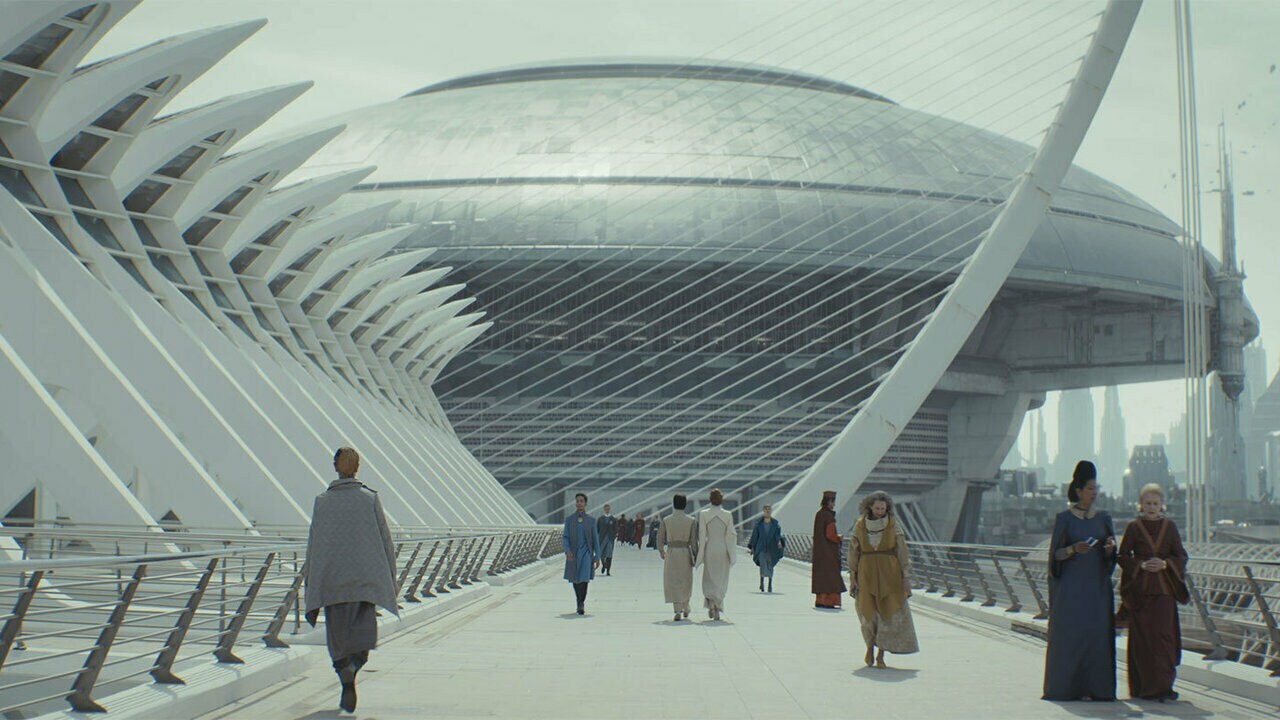
Why the image shows the later building
No reliable official modern image is available for the c. 15,000 BBY Senate Hall itself.
The page therefore uses the official StarWars.com image of its much later successor.
The caption explicitly identifies that distinction rather than presenting the later Rotunda as ancient architecture.
Anthropological assessment
The Senate Hall is a useful example of architecture as political technology. It organized movement, debate, security, ceremony, and visibility while turning the abstract idea of a Galactic Republic into a place people could physically enter.
Its location also demonstrates the unequal geography of federal government. Thousands of worlds could claim representation, but political life remained concentrated on Coruscant. Representation expanded the Republic while simultaneously reinforcing the capital's centrality.
Finally, the hall's long life shows how built environments accumulate authority. Later governments did not abandon the site; they built over it. The Republic literally placed new political architecture on top of its older institutional past.
What the sources establish
Where the Senate Hall fits
Sources and further reading
- Star Wars: Complete Locations, DK, 2005.
- Daniel Wallace and Jason Fry, Star Wars: The Essential Atlas, Del Rey, 2009.
- The Mandalorian Visual Guide, DK.
- StarWars.com Databank, Coruscant Senate Building
- Senate Hall, Wookieepedia
- Senate Building/Legends, Wookieepedia
- Debating chamber, Wookieepedia