
In 25,053 BBY, representatives of the Core Worlds ratified the Galactic Constitution and created the Galactic Republic. The founding did not unite the entire known galaxy overnight. It created a political framework through which a growing network of Core worlds could regulate trade, mediate disputes, recognize rights, coordinate defense, and expand outward without reproducing the same kind of centralized imperial domination that had defined the Rakatan age.
The source tradition
The Republic's foundation is described across The Essential Atlas, The New Essential Chronology, The Complete Star Wars Encyclopedia, and The Old Republic Encyclopedia. Official SWTOR material describes the Republic as a constitutional system founded more than twenty thousand years before the game's era, governed through the Galactic Senate and built around democracy, freedom, and individual rights.
The exact 25,053-BBY precision belongs to the later SWTOR chronology. Earlier books generally used “25,000 BBY,” which remains useful as a rounded date for the beginning of the Expansionist Era.

After Rakata and Xim
The Republic emerged from a political world shaped by the collapse of older empires. The Rakatan Infinite Empire had disintegrated roughly a century and a half earlier. Xim's regional empire had also fallen after Vontor.
Those collapses created a powerful historical memory: large political systems could connect worlds, but they could also enslave populations, monopolize technology, and concentrate power in rulers who had few institutional limits.
The Republic offered a different answer to the problem of interstellar scale.
The Unification Wars
Legends places the founding after a period known as the Unification Wars. The details of those wars are fragmentary, but they represent the political struggle through which rival Core powers moved toward a common constitutional order.
“Unification” should not be mistaken for automatic harmony. The Core Worlds already possessed old rivalries, distinct monarchies, commercial systems, military traditions, and competing claims to prestige.
The Republic began by persuading or compelling powerful worlds to place some disputes inside shared institutions.
The Core Founders
Later histories remember twenty-two worlds as the Core Founders. Not every source preserves the exact full list consistently, but securely associated founders include Coruscant, Alderaan, Corellia, Duro, Kuat, Humbarine, Caamas, Chandrila, Alsakan, Anaxes, Axum, Brentaal, Esseles, Rendili, Rhinnal, Shawken, and Tepasi.
The diversity of the founders matters. They were not culturally identical Human colonies. Duros, Caamasi, Humans, monarchies, corporate systems, shipbuilding powers, military centers, trading worlds, and philosophical cultures all entered the new state.
Republic identity was therefore supraplanetary from the beginning.
The Galactic Constitution
The Galactic Constitution served as the founding legal framework and highest law of the Republic. Legends tradition associates its drafting with a member of House Organa of Alderaan.
The Constitution distributed authority rather than placing sovereignty in a single ruler. The Republic would eventually develop legislative, executive, and judicial institutions, with the Galactic Senate as the most visible arena for representation and negotiation.
That distribution of power became one of the Republic's central claims to legitimacy.
Power invested in many
The political theory behind the Republic was that power divided across worlds and institutions would be harder for one conqueror to seize.
This was a direct contrast with Rakatan Predors, Xim's personal rule, and other pre-Republic political systems centered heavily on rulers, dynasties, or conquest elites.
The Republic attempted to make procedure stronger than personality.
The Rights of Sentience
Legends material remembers the Constitution as containing an especially radical principle called the Rights of Sentience. It declared sentient beings equal before Republic law and formally opposed slavery and species-based discrimination.
Those ideals were extraordinary in a galaxy where slavery had been central to Rakatan, Hutt, Tionese, and many local political economies.
But constitutional declaration did not produce universal compliance. The Republic repeatedly struggled to enforce those rights, especially on distant or politically powerful worlds.
Law and practice are not the same thing
The gap between constitutional ideals and lived reality is essential to understanding the Republic. A law can establish a normative claim without immediately transforming every institution that violates it.
Slavery, exploitation, species hierarchy, oligarchy, and unequal representation persisted in many places across later Republic history.
The Constitution still mattered because it gave communities a legal language with which to challenge those practices.
Why Coruscant?
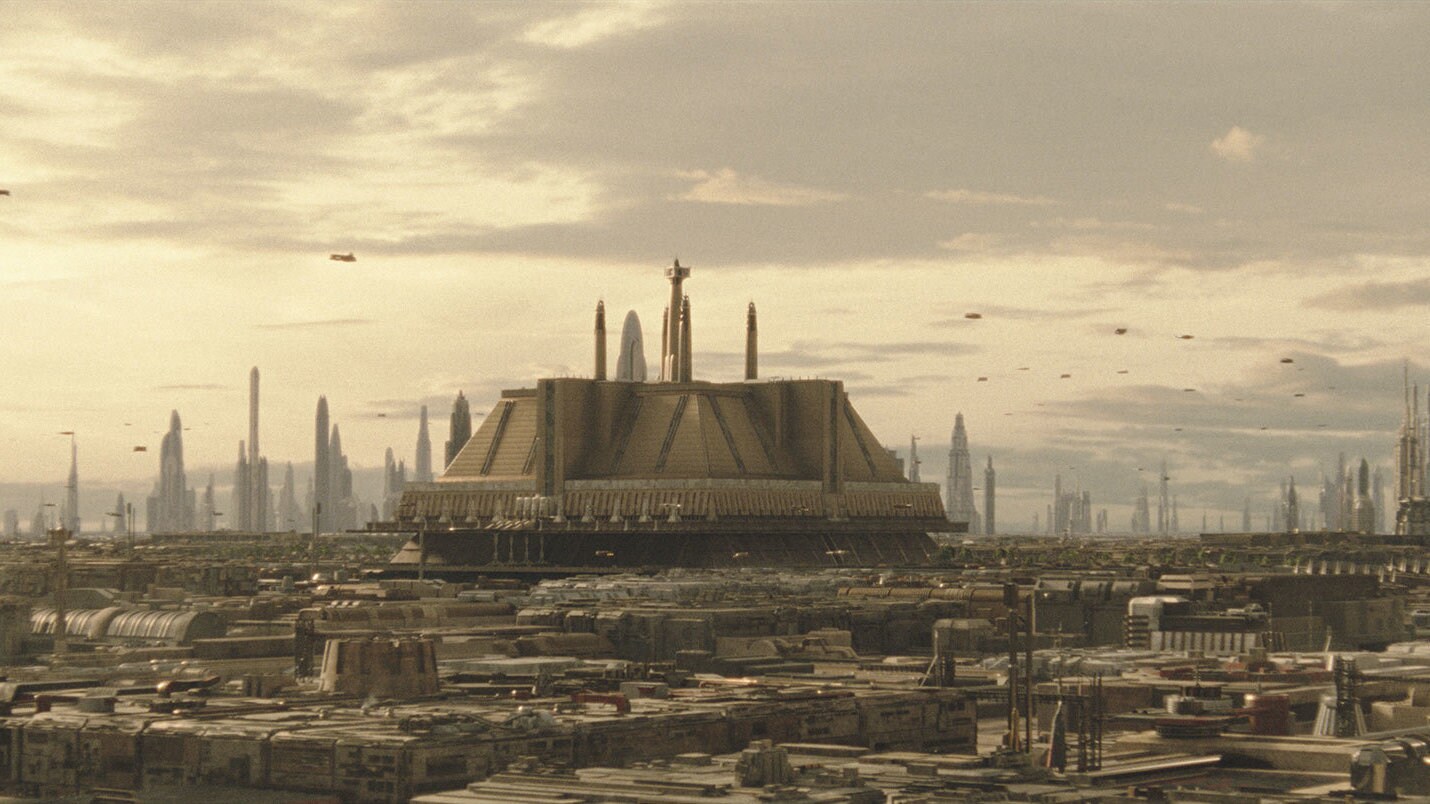
Coruscant had extraordinary advantages as a political center. It was already one of the oldest and most densely populated Human worlds, possessed ancient connections with other Core colonies, and occupied a strategic position in emerging transportation networks.
The planet also carried symbolic weight as a place that had survived Rakatan domination and then reconnected with other former colonies.
Later traditions make Coruscant the enduring capital of the Republic, though some early chronology sources differ over exactly when that capital status was formalized.
The transportation revolution behind political unification
The Republic could not exist at interstellar scale without faster and more dependable travel. Human and Duros engineers had spent generations studying and adapting technologies ultimately descended from Rakatan systems.
By the founding era, non-Force-dependent hyperdrive had advanced far beyond sleeper ships and unstable tumbledrives. Worlds that had once been separated by generations could now participate in repeated diplomacy, commerce, and military coordination.
Political scale followed transportation scale.
What had not happened yet
Some developments often associated with the Republic belong slightly later. The Perlemian Trade Route is conventionally established around 25,000 BBY, linking Coruscant toward Ossus and the Tion region. The Corellian Run is also mapped around that time.
Those routes should not be projected backward into the exact founding moment.
The Republic began with improving Core connectivity and then rapidly built the route network that made large-scale expansion possible.
The Senate as political technology
The Senate was not merely a building or assembly. It was a technology for transforming interplanetary conflict into procedure.
Representatives could negotiate tariffs, borders, defense, membership, infrastructure, and disputes without immediately resorting to war.
This did not eliminate violence. It created a recognized alternative to it.
Representation and inequality
Representation also created new political questions. Who selected a world's representative? Did monarchies, corporations, aristocracies, and democracies participate on equal terms? How were populations of radically different size compared?
The Republic solved the problem of interplanetary representation without necessarily democratizing every member world internally.
A representative federation can contain deeply unequal local political systems.
Collective defense
The early Republic also required military coordination. A constitutional state needed the ability to defend trade, suppress piracy, protect member worlds, and prevent regional powers from simply overturning agreements by force.
Legends dates the Republic's formal military institutions to the founding era, although the scale and organization of those forces changed enormously over the next twenty-five thousand years.
Collective defense made membership materially meaningful.
The Jedi are not yet the Republic's guardians
The Jedi Order already existed, but the familiar Jedi-Republic partnership should not be moved into 25,053 BBY automatically.
Later chronology places Republic contact with the Jedi on Ossus and the Order's formal pledge of service around 25,000 BBY, roughly fifty years after the Republic's founding.
The Republic therefore begins as a political project before the Jedi become one of its defining institutions.
The Expansionist Era begins
The founding traditionally marks the start of the Expansionist Era. Once a constitutional Core alliance and better hyperdrive technology existed together, exploration and settlement accelerated.
This expansion created opportunities for trade and diplomacy but also reproduced older colonial patterns. Republic-linked settlements could move into territories inhabited by peoples who had not participated in the Constitution.
A government founded partly in opposition to imperial domination could still become an expanding power.
From planetary subject to Republic citizen
The Republic introduced a political identity that could exist above local belonging. A person might be Alderaanian, Duros, Corellian, Caamasi, or Coruscanti while also becoming a citizen or protected resident of a larger constitutional order.
That layered identity was one of the Republic's greatest institutional innovations.
It also created tension whenever loyalty to a homeworld conflicted with obligations to the Republic.
Federation, law, and political scale
The Republic is best understood anthropologically as a solution to the problem of governing across enormous social distance. Worlds with different languages, economies, species, religions, and political systems needed shared rules without becoming culturally identical.
Its answer was federation: preserve substantial local autonomy while building institutions capable of acting at a higher scale.
That compromise would define both the Republic's extraordinary longevity and many of its recurring crises.
The Republic was not inevitable
It is tempting to read the Republic backward from its twenty-five-thousand-year history and imagine its creation as the obvious next stage of galactic development.
Nothing made that outcome inevitable. The same technologies could support conquest, piracy, corporate oligarchy, Hutt clientage, or another Xim-like empire.
The Republic was a political choice made within a specific historical landscape created by older failures.
Canon versus Legends
Where the Republic's founding fits
Sources and further reading
- Star Wars: The Old Republic Encyclopedia, DK, 2012.
- Daniel Wallace and Jason Fry, Star Wars: The Essential Atlas, Del Rey, 2009.
- Daniel Wallace, The New Essential Chronology, Del Rey, 2005.
- The Galactic Republic, official SWTOR Holonet
- Coruscant, StarWars.com Databank
- Galactic Republic/Legends, Wookieepedia
- Galactic Constitution/Legends, Wookieepedia