
Article contents
- An encounter beneath the surface
- Biology and physical design
- Habitat, diet, and scarcity
- Behavior, reproduction, and territory
- Relations with Mustafarians and visitors
- Material representation and immersive horror
- Historical significance and appearances
- Anthropological assessment
- Collecting this Character
- Sources and continuity
01 / DOSSIER
An encounter beneath the surface
The Darkghast appears in Vader Immortal: Episode II as the player moves through ruined environments beneath Mustafar's volcanic surface. Lucasfilm's developer interview places it in and around the Corvax Fortress, where it stalks passages and survives by taking other creatures as prey.
This is a setting already shaped by Lady Corvax's catastrophe. The ruins have become part of a harsh subterranean ecosystem rather than an intact society. The animal's presence signals that the old halls are inhabited by life that does not observe either Imperial law or ancient ceremonial boundaries.
The VR format changes the encounter. The player sees the creature approaching at a sense of real scale, and the creature's body can dominate the visual field. Its threat is communicated through distance, mass, sound and movement rather than statistics on a game interface.
02 / DOSSIER
Biology and physical design
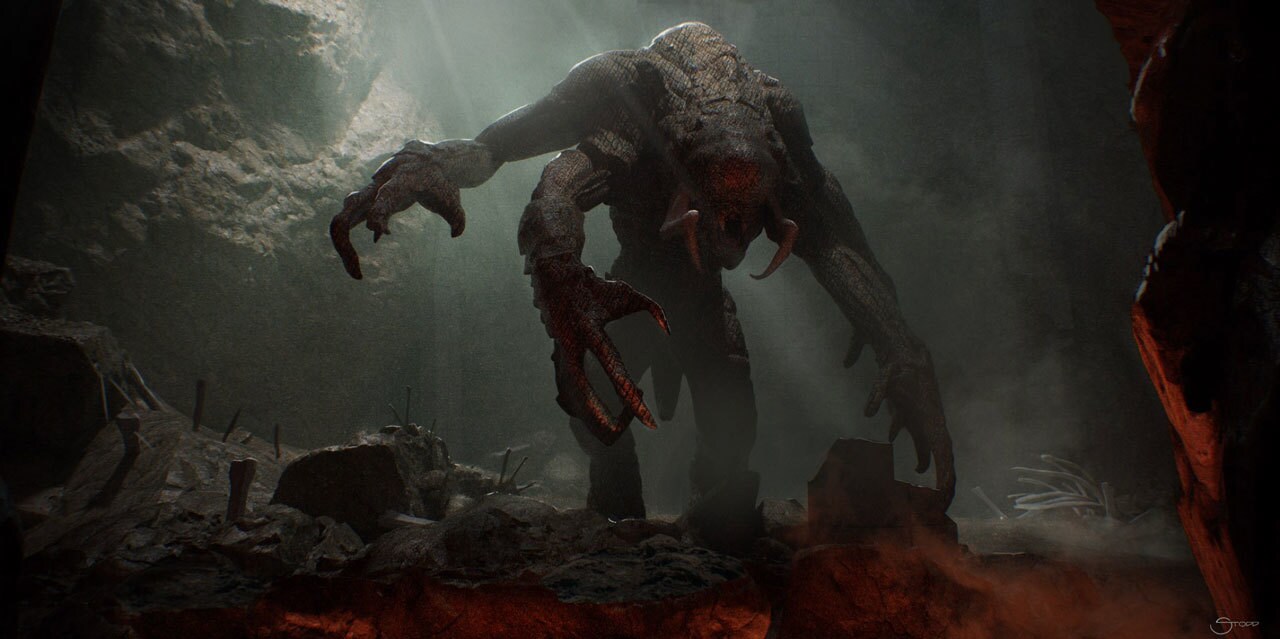
ILMxLAB director Ben Snow described the Darkghast as related to the rancor. The design recalls the famous monster from Return of the Jedi, but adds extra limbs and a more specialized silhouette suited to traversing underground passages.
Lead modeler Jung Yoon Choi gave the creature areas of thickened hide with the appearance of rhinoceros-like plating, plus red markings that suggest danger. Those details are confirmed by developers discussing the production design, not by an invented taxonomy.
Only a limited number of biological facts have been established. The game portrays a particular female Darkghast. A formal species name, standard adult weight, maximum lifespan, or full reproductive ecology should not be manufactured from this single encounter.
03 / DOSSIER
Habitat, diet, and scarcity
The animal occupies the underground ruins and passages associated with ancient Corvax architecture. It lives below a planet whose surface climate was damaged by the Bright Star catastrophe, and it finds food among other surviving creatures in the dark.
Developers specifically describe food as scarce. The Darkghast's apparent hunger should therefore be understood partly as a response to ecological conditions, not proof that the animal exists only to attack intruders.
Extra limbs may improve its ability to move around irregular ruins and rocky terrain. The official design notes support that functional reading, although the game does not offer measurements of climbing performance or a scientific survey of its range.
04 / DOSSIER
Behavior, reproduction, and territory
The Darkghast is depicted as dangerous when approached, particularly in close underground spaces. The game emphasizes stalking, sudden proximity and confrontation with a much smaller player character.
ILMxLAB's Episode II interview identifies the specimen as female and points players toward eggs found during exploration. That is evidence of reproduction in the depicted individual, not evidence that every Darkghast has identical nesting behavior.
It is tempting to label the creature an evil guardian or an Imperial asset, but the source material does not establish either description. It survives among the ruins and responds to the demands of an environment with limited resources.
05 / DOSSIER
Relations with Mustafarians and visitors
The creature shares physical territory with traces of old Mustafarian settlement, and its appearance in Vader Immortal places it in the path of a stranger searching for the Bright Star. That overlap creates contact without demonstrating a domesticated or ritual relationship.
Rancors elsewhere in Star Wars have been captured, trained, transported and used in arenas or confinement pits. The Darkghast's appearance should not automatically be assigned the same social history. There is no verified keeper, owner or military deployment for the specimen in the game.
Instead, the encounter highlights a distinction between occupying a place and controlling it. Even where Imperial structures loom above, the underground animal is not shown to be a subject that Vader's bureaucracy can completely command.
06 / DOSSIER
Material representation and immersive horror
Darkghast concept art combines recognizable Star Wars creature design with a more unusual body. Heavy limbs, protective hide and vivid marks make the animal readable instantly as a large physical danger, while its resemblance to a rancor creates a point of familiarity.
Director Ben Snow and ILMxLAB's artists emphasized the effect of a massive creature occupying the viewer's apparent personal space. Unlike a flat display, VR can make an approaching body seem large enough to force a physical reaction.
Official imagery released with the D23 presentation shows the animal in the ruined subterranean landscape and in a close-range scene. Those visual sources give IDS a reliable way to portray this specific creature rather than using generic rancor art.
07 / DOSSIER
Historical significance and appearances
The Darkghast was revealed publicly in ILMxLAB's D23 coverage of Vader Immortal: Episode II in 2019. Its appearance helped establish that the game was not solely about lightsaber training or meeting Vader, but also about exploring Mustafar's unknown wildlife.
The design connects the ancient ruin narrative to an ecological question: which organisms survived beneath the planet's fiery crust, and what happens when strangers enter their territory?
Because few licensed appearances are clearly documented, this dossier limits its appearance list to Vader Immortal and the official production coverage. New material can be added when reliable sources establish it.
08 / DOSSIER
Anthropological assessment
The Darkghast offers an opportunity to examine how stories define a creature as a monster. Its size and predatory behavior are real dangers in the fictional world, but presentation also shapes the audience's reaction. Camera scale, darkness, sudden movement and sound do significant work.
A creature that survives in a scarce habitat should not be interpreted exclusively through human fear. The surrounding ecology matters: ruined architecture has become habitat, and hunger is part of the conditions of life there.
Unlike a domesticated bantha or a rancor used for public spectacle, the Darkghast has no confirmed social role as labor, transport or punishment. The useful distinction is between the animal's own survival and the ways visitors experience it as a threat.
OFFICIAL SECOND VIEW
What the player sees

These images belong to the Darkghast encounter rather than a generic rancor. For a player the creature's ability to approach the VR viewpoint is central to the effect of the scene.
COLLECTING
Collecting this Character
There is no verified Darkghast-specific trading card, toy or LEGO set documented by the sources used here. IDS will not substitute a rancor collectible for an actual Darkghast product.
SOURCE RECORD
Material fandom · Collector reference
Collecting this Character
Sources and continuity
Canonical information comes from Lucasfilm's game coverage and official universe features. Interpretive anthropology paragraphs are IDS analysis; undocumented specifications, unseen scenes and merchandise are not inferred.
KEEP EXPLORING