Mae Aniseya enters The Acolyte as the apparent architect of a Jedi murder investigation, but her violence is rooted in a childhood shaped by loss, separation, and a story she cannot verify. Raised by the Brendok coven after being separated from Osha, Mae is taught that the Jedi destroyed her family. Her journey tests what revenge can and cannot repair when memory is incomplete.
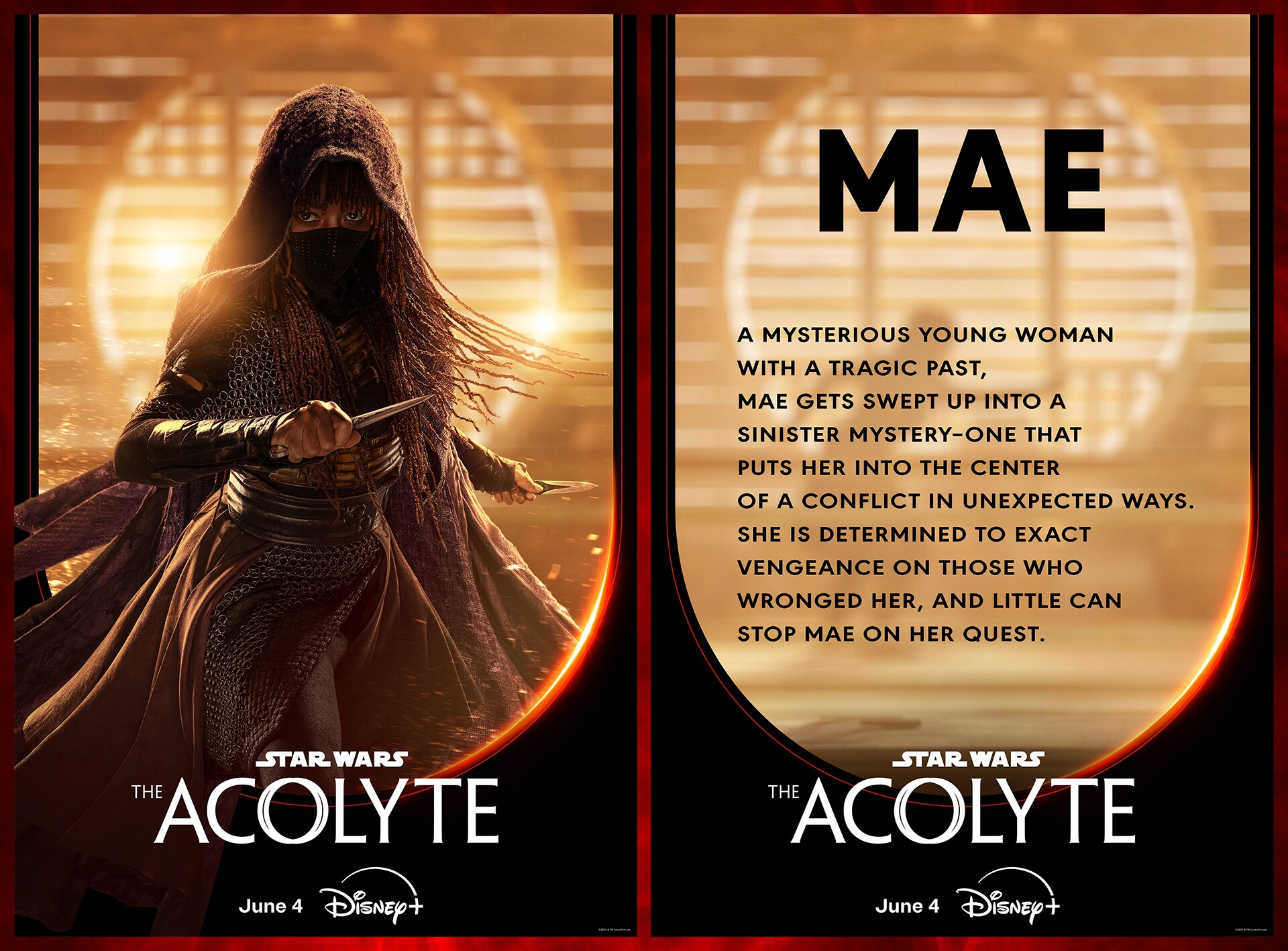
Revenge as a social obligation
Mae does not begin with a general hatred of the Jedi. She begins with named targets and a specific demand: each Jedi must confess what happened on Brendok. That structure matters. Revenge becomes a form of inquiry, and confession becomes the condition for deciding whether violence is justified.
Her plan also reflects the authority of the coven’s account. Mae has been raised inside a community that treats its history as a living obligation. The deaths of Mother Aniseya and Mother Koril are not private memories. They organize Mae’s duties, loyalties, and understanding of who belongs on the side of justice.
Twinship, separation, and recognition
Mae’s relationship with Osha gives the plot its emotional and political structure. Each sister becomes evidence that the other’s remembered history is incomplete. Mae’s certainty that Osha is dead makes her revenge possible, while the discovery that Osha lives destabilizes the identity Mae built around loss.
Recognition is therefore dangerous. To see Osha is to see the limits of Mae’s account, but it is also to recover the person whose absence shaped her life. The sisters do not simply reunite. They negotiate whether kinship can survive different memories and different choices.

Training, bodily discipline, and the assassin’s role
Mae’s combat skills are learned within a social environment that links protection to readiness. Her body becomes an instrument of the coven’s grievance and a visible sign of the work she has undertaken. The assassin role gives her status, but it also narrows her identity around a task assigned by the past.
The Jedi read Mae’s movement as proof of danger. Mae reads her own skill as evidence that she can act when institutions refuse to answer. These interpretations compete because the same body can be understood as a criminal weapon, a daughter seeking accountability, or a person trying to recover control over a stolen history.
Memory, manipulation, and the limits of certainty
Mae’s memories do not function as a neutral recording. They are shaped by childhood, grief, social teaching, and later intervention. The series uses altered memory to show that political communities often depend on partial accounts. A person can act sincerely while still acting on information that has been controlled by others.
The question is not whether Mae is simply deceived or truthful. It is how authority decides which memory counts as evidence. The Jedi possess archives, witnesses, and official procedures. Mae possesses embodied memory, family teaching, and the consequences of survival.
Anthropological assessment
Mae’s story shows how violence can be produced by unresolved institutional harm. The revenge cycle continues because the Jedi treat the Brendok event as a threat to the Order’s legitimacy rather than as a history that requires public accountability.
Mae’s eventual movement away from revenge does not erase the damage. It changes the social meaning of her actions. She becomes a person trying to repair kinship while carrying the consequences of having made violence her primary language of recognition.
Sources and status
This is a canon character file based on the first season of The Acolyte. It includes spoilers and separates confirmed story events from anthropological interpretation.
- StarWars.com, The Acolyte series guide
- StarWars.com, The Acolyte Character Posters
- StarWars.com, The Acolyte Stills Gallery
Revenge built from incomplete memory
Mae’s campaign against the Jedi depends on a story of Brendok shaped by childhood trauma and years of separation. She knows harm occurred, but she does not begin with access to every perspective or institutional record.
That uncertainty makes revenge unstable. Each new fact changes what responsibility means without erasing the losses that made the search for accountability possible.
Twinship as an alternative claim on identity
Osha’s survival creates a relationship stronger than the political roles Mae has taken on. The twins are not interchangeable, but each becomes evidence that the other’s understanding of the past is incomplete.
Their bond repeatedly interrupts the simpler identities offered by Jedi, coven, mentor, or avenger.
Connected archive