Osha Aniseya stands at the center of The Acolyte because several institutions claim the right to define her. The Jedi remember her as a former Padawan. The Brendok coven remembers her as a daughter. The Republic treats her as evidence in a murder investigation. Qimir offers her a new form of apprenticeship. Her story follows what happens when a person’s identity is divided among family memory, institutional records, and political accusation.
Twinhood, memory, and social identity
Osha and Mae are not simply two versions of the same character. They are related persons whose lives are organized through separation, competing memories, and different relationships to authority. Osha grows up believing that Mae died on Brendok. Mae grows up believing that Osha died. That loss creates identities shaped by absence before either sister understands what happened.
When Osha encounters Mae’s face in a criminal investigation, the Republic’s categories become inadequate. The Jedi need a suspect, a victim, and a motive. Osha instead confronts a kinship relation that the official record cannot explain. The investigation becomes a struggle over which account of the past will govern the present.
Jedi training and institutional abandonment
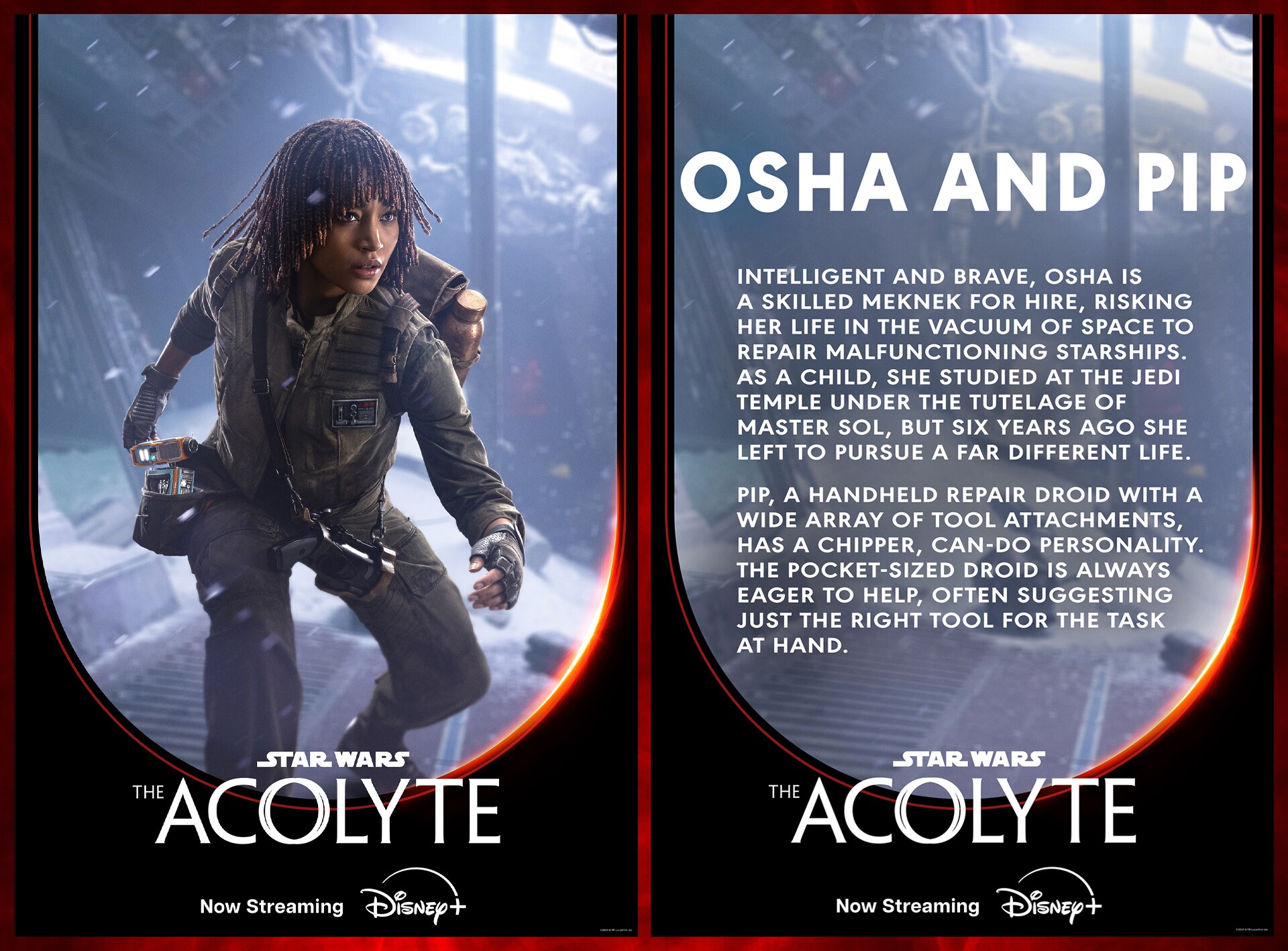
Osha’s time as a Jedi apprentice gives her discipline, technical knowledge, and a vocabulary for ethical action. Leaving the Order does not erase those practices. She carries them into work as a meknek, where careful repair and practical problem-solving replace formal Jedi training. Her departure also shows that institutional belonging can end without ending the habits an institution teaches.
The Jedi’s interest in Osha is never only personal. Her testimony can support or threaten the Order’s authority. She is therefore moved through systems of custody, investigation, and supervision that treat her experience as information to be managed. Her distrust grows from this gap between being protected as a person and being used as evidence.
Work, technology, and embodied competence
Osha’s labor as a meknek gives her a position outside the heroic image of the Jedi. She works with machinery, diagnoses failures, and survives through technical competence. The job connects her to the working infrastructure of the galaxy, where ships and settlements depend on people who repair systems rather than command them.
That material knowledge becomes part of her identity. Osha is not only a Force-sensitive person deciding between light and darkness. She is also a skilled worker whose hands, tools, and practical judgment matter. The contrast between repair work and lightsaber combat makes the series ask which forms of knowledge receive institutional respect.
Choice, violence, and political recognition
The truth about Brendok changes Osha’s relationship to Sol and to the Jedi Order. Her anger is not presented as a simple rejection of morality. It is a response to concealed violence, unequal authority, and the discovery that people she trusted shaped her life through incomplete information.
Her decision to follow Qimir is therefore both personal and political. It gives her recognition outside the Jedi system, but it also places her inside another hierarchy organized around secrecy, apprenticeship, and controlled violence. The choice expands her agency while creating new obligations.
Anthropological assessment
Osha’s story is most useful anthropologically when it is read as a conflict over personhood and historical authority. Family, Jedi institutions, Republic law, and dark-side apprenticeship each offer different explanations of who she is. None can be separated from the relationships and material practices that make those explanations persuasive.
The character’s final position remains unstable. Osha gains the power to reject the Jedi account of her life, but she does not escape social organization. She enters a new community with its own rules, symbols, teacher, and expectations. Her biography shows that freedom from one institution can become dependence on another.
Sources and status
This is a canon character file based on the first season of The Acolyte. It includes spoilers and separates confirmed story events from anthropological interpretation.
- StarWars.com, The Acolyte series guide
- StarWars.com, The Acolyte Character Posters
- StarWars.com, The Acolyte Stills Gallery
Identity claimed by competing institutions
Osha is repeatedly told who she is by groups with different kinds of authority. Family, Jedi training, Republic investigation, and dark-side apprenticeship each offer a framework that explains her past and directs her future.
Her story becomes a struggle over which claims deserve trust when every institution has withheld something important.
Leaving the Jedi does not end the Jedi past
Osha’s attempt to live outside the Order shows that institutional membership can end before institutional effects do. Training, disappointment, memory, and relationships continue shaping how she interprets danger and belonging.
Returning to the Brendok history forces her to reconsider whether leaving was freedom, failure, or simply one stage in a larger search for control over her own life.
Connected archive