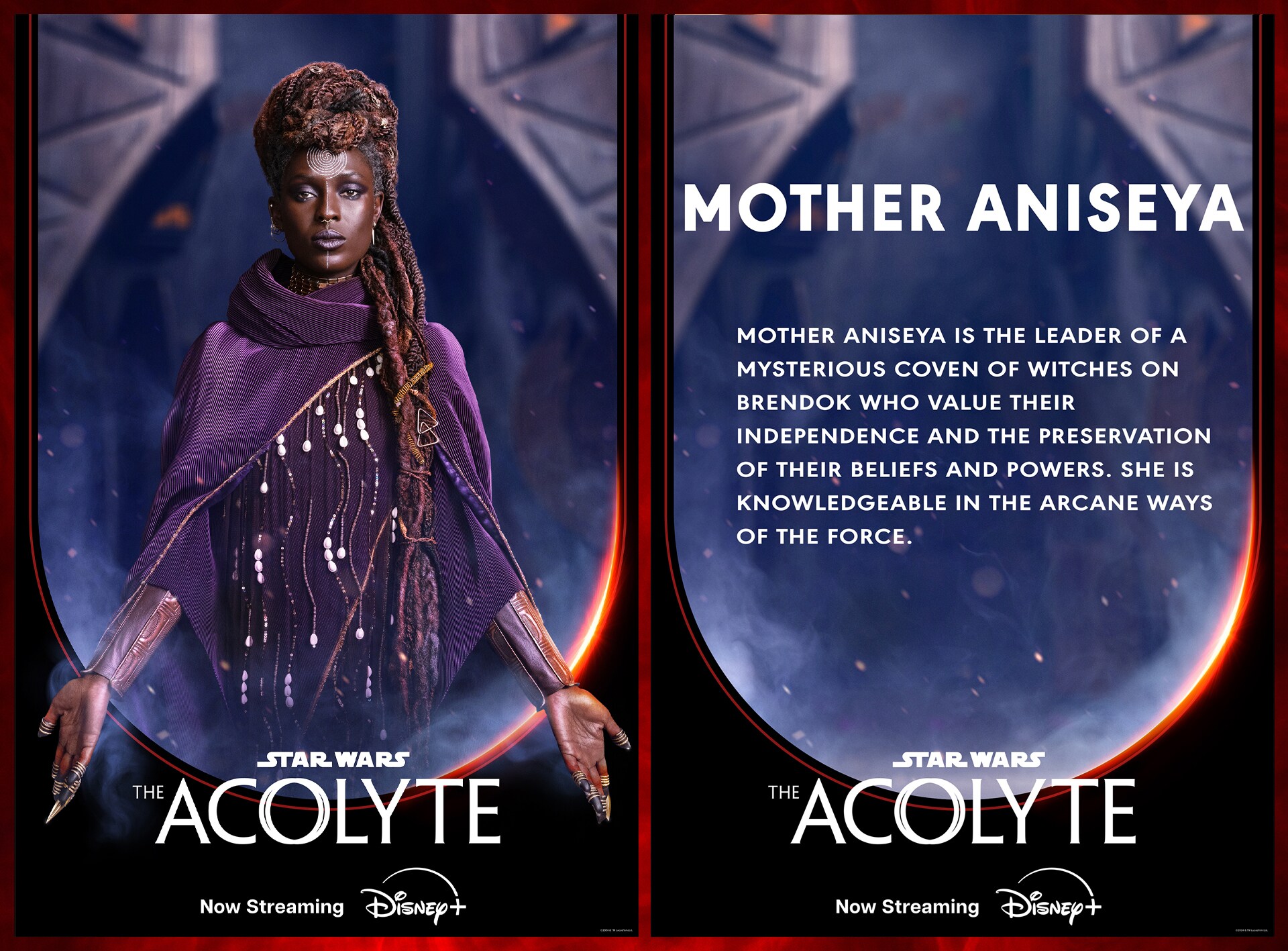
Mother Aniseya leads the coven on Brendok and raises Osha and Mae within a community that values collective life, inherited knowledge, and protection from outside control. She is not simply an opponent of the Jedi. She is a political and cultural leader whose authority comes from kinship, ritual, and responsibility for the next generation.
Coven, kinship, and collective authority
Mother Aniseya’s leadership is tied to the coven’s survival. The group is not only a religious community. It is a household, school, political unit, and refuge. Its members share labor and knowledge while remaining responsible for the children who will carry the community forward.
The titles of mother and leader overlap. Aniseya’s authority is personal because she is responsible for Osha and Mae, but it is also collective because her decisions affect every member of the coven.
Education outside the Jedi Order
The twins are raised within the coven’s own system of training. Their abilities are understood through rituals and relationships that the Jedi do not immediately recognize as legitimate. This creates a conflict over education before it becomes a conflict over violence.
The Jedi’s interest in the children reflects a wider pattern in which powerful institutions define some forms of teaching as protection and others as danger. Aniseya resists because accepting Jedi authority would mean surrendering control over the community’s future.
The body as ritual and political statement
Aniseya’s clothing, markings, jewelry, and movement make leadership visible. Material culture communicates that the coven has its own history and that its members do not require Jedi symbols to establish authority.
Her ability to transform her body during the confrontation also makes the Force a social practice rather than a private talent. The body carries communal knowledge, and the Jedi’s response demonstrates how unfamiliar practices can be interpreted as threats.
Brendok and the destruction of a community
The encounter between the coven and the Jedi escalates because each side believes that the other threatens the children. The result is the destruction of the community and the separation of the twins. The event becomes the origin point for the later murder investigation and the sisters’ opposing lives.
Aniseya’s death is remembered differently by different survivors. For the Jedi, it becomes part of an event to be contained. For Mae, it becomes the basis of revenge. For Osha, it becomes a missing piece of identity.
Anthropological assessment
Mother Aniseya represents community autonomy under pressure from a larger institution. Her leadership is not free of conflict, but it is grounded in a social world that the Jedi attempt to classify without fully understanding.
Her death shows how quickly a dispute over knowledge and child-rearing can become a political catastrophe when unequal institutions meet without shared rules for consent.
Sources and status
This is a canon character file based on the first season of The Acolyte. It includes spoilers and separates confirmed story events from anthropological interpretation.
- StarWars.com, The Acolyte series guide
- StarWars.com, The Acolyte Character Posters
- StarWars.com, The Acolyte Stills Gallery
The coven as a political community
Aniseya’s authority comes from more than Force ability. She is responsible for a community with rituals, kinship, education, and a collective future that exists outside Jedi recognition.
The conflict on Brendok begins partly because the Jedi encounter a Force tradition they do not control and immediately have to decide how much authority they have over its children.
Protection and negotiation under pressure
Aniseya repeatedly tries to preserve the coven while negotiating with outsiders whose institutional power is far greater. Her position requires balancing Osha’s wishes against the survival of the group.
That tension makes her leadership politically difficult. Family autonomy and individual autonomy do not always point in the same direction.
Connected archive