Garazeb Orrelios, usually called Zeb, is a Lasat warrior and former captain of the Lasan High Honor Guard. The Empire's destruction of Lasan leaves him carrying grief, anger, and the belief that he may be one of the last of his people. On the Ghost, his physical force is visible, but so are his education, strategy, humor, and capacity for care.
Zeb's story moves from survival through revenge toward a more difficult form of restoration. His journey to Lira San does not undo the Siege of Lasan. It gives memory a future, while his relationship with Agent Kallus shows that understanding an enemy can alter the boundaries of community without excusing the violence that created the conflict.

Character in social context
Zeb enters the archive as a displaced Lasat, a rebel fighter, and a member of a small crew that becomes a political community. The Empire's occupation of Lasan is not background decoration. It explains why weapons, uniforms, and Imperial language carry a personal charge for him.
The Ghost gives Zeb a place to use his strength while also demanding trust, humor, and cooperation. He is often introduced as the crew's muscle, but his intelligence and knowledge of Lasat history complicate that role. The story makes room for both the visible fighter and the person who remembers what the Empire tried to erase.

Formation, training, and social position
As a member of the Lasan High Honor Guard, Zeb learned a social position that joined combat with duty to a people. His training made him a protector, but the fall of Lasan left him without the institution that had given that protection a recognized purpose.
The Ghost crew becomes a new setting for those skills. Hera's command, Ezra's presence, and the wider rebellion turn Zeb's inherited discipline into a different kind of service. His growth depends on learning that protecting a people can include preserving stories, guiding survivors, and accepting help.
Institutions and the distribution of power
The Empire's power is experienced through occupation, weaponry, forced movement, and the destruction of Lasan's political life. Zeb's anger is therefore directed at a system rather than only at individual stormtroopers. The archive keeps that institutional scale visible even when the story gives him a personal opponent.
The Rebel Alliance offers Zeb coalition rather than restoration. He works with cells, pilots, intelligence officers, and local communities that do not share one species or one history. His later role training New Republic recruits continues the movement from surviving a destroyed institution to helping build another.
Kinship, community, and belonging
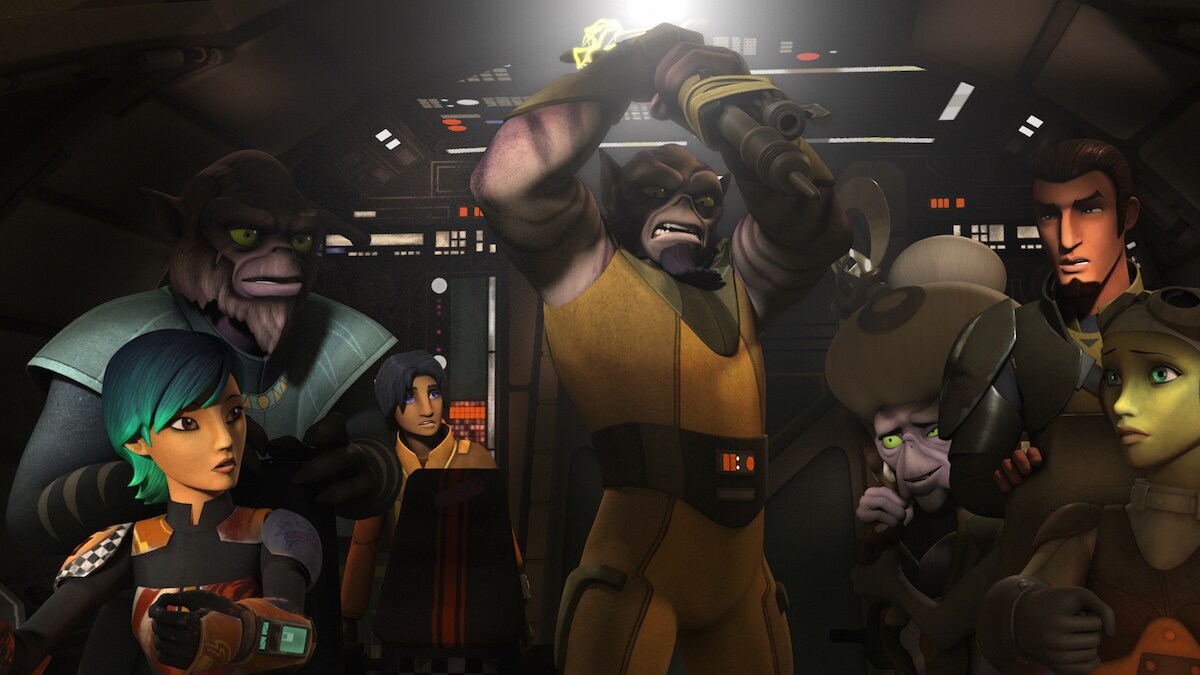
Zeb's relationship with Ezra begins like a quarrelsome sibling bond and grows into chosen kinship. Hera's command becomes a form of trust, while Sabine and Chopper fill out the household around him. The Ghost crew does not replace Lasat community, but it keeps Zeb from being isolated inside the identity of last survivor.
The meeting with Gron, Chava, and the other Lasat survivors changes what belonging can mean. Lira San offers a future for the species, while Zeb's decision to remain with the Ghost shows that home and chosen family do not have to be mutually exclusive.
Labor, tools, and material culture
Zeb's labor includes combat, protection, piloting, strategy, and the practical work of keeping a crew alive. He distributes stolen supplies, guards vulnerable people, and contributes technical knowledge when a rebel base must remain hidden. Strength is one tool among many.
The bo-rifle is both weapon and cultural archive. In the Lasat ritual that leads to Lira San, it becomes a means of connecting a living survivor to ancestral practice. The Ghost, rebel gear, and the weapon taken and used by Kallus all show how objects can carry conflict across generations.
Body, environment, and representation
Zeb's large body invites others to read him as dangerous, simple, or disposable. The story repeatedly interrupts those readings with his education, emotional intelligence, and strategic judgment. His body is powerful, but the social meaning assigned to that power is always contested.
Lasan, Lothal, the cold moon of Bahryn, Atollon, and Lira San produce different versions of Zeb. In one place he is a displaced guard; in another he is a rebel protector; in the recovered homeworld he becomes a living connection between loss and renewal.
Memory, narrative, and historical change
Zeb's memory of the Siege of Lasan is personal, communal, and political. His guilt reflects the impossible demand that a single survivor account for a state-sponsored destruction. The journey to Lira San allows memory to move from accusation and grief toward continuity.
The relationship with Kallus changes the narrative of the war without making the violence disappear. Their survival on the Geonosian moon creates knowledge that later shapes Kallus's defection and Zeb's welcome. The archive treats that change as a negotiated social process, not an instant forgiveness.
Anthropological assessment
Zeb's central anthropological importance is that he makes diaspora visible through the ordinary life of a rebel crew. He carries a lost institution, a damaged homeland, and a future community into the same cockpit. His story asks how people preserve identity when the political structures that named them have been destroyed.
Canon establishes Zeb's Lasat identity, honor guard history, Ghost crew service, relationship with Kallus, and connection to Lira San. The interpretation focuses on displacement, survivor guilt, cultural memory, chosen kinship, and the labor of rebuilding.
Sources and further reading
- Garazeb “Zeb” Orrelios | StarWars.com Databank
- Who is Zeb?
- Studying Skywalkers: Zeb's Character Growth in Star Wars Rebels Season Two
Survivorhood without cultural erasure
Zeb initially carries the destruction of Lasan as evidence that his people may be disappearing. Grief is therefore collective as well as personal.
His later discovery of Lira San changes the social meaning of survival. The Lasat are not reduced to one traumatized survivor, and Zeb can imagine a future larger than preserving memory alone.
The Ghost turns military identity into family identity
As a former Honor Guard captain, Zeb brings combat training into the rebel cell, but the Ghost crew gives that skill a different social setting.
He becomes protector, friend, rival, and comic presence inside a household that is also a military unit. The overlap lets him build belonging without abandoning the history that made him a warrior.
Connected archive