
01 · Orientation
Who the Geonosians were
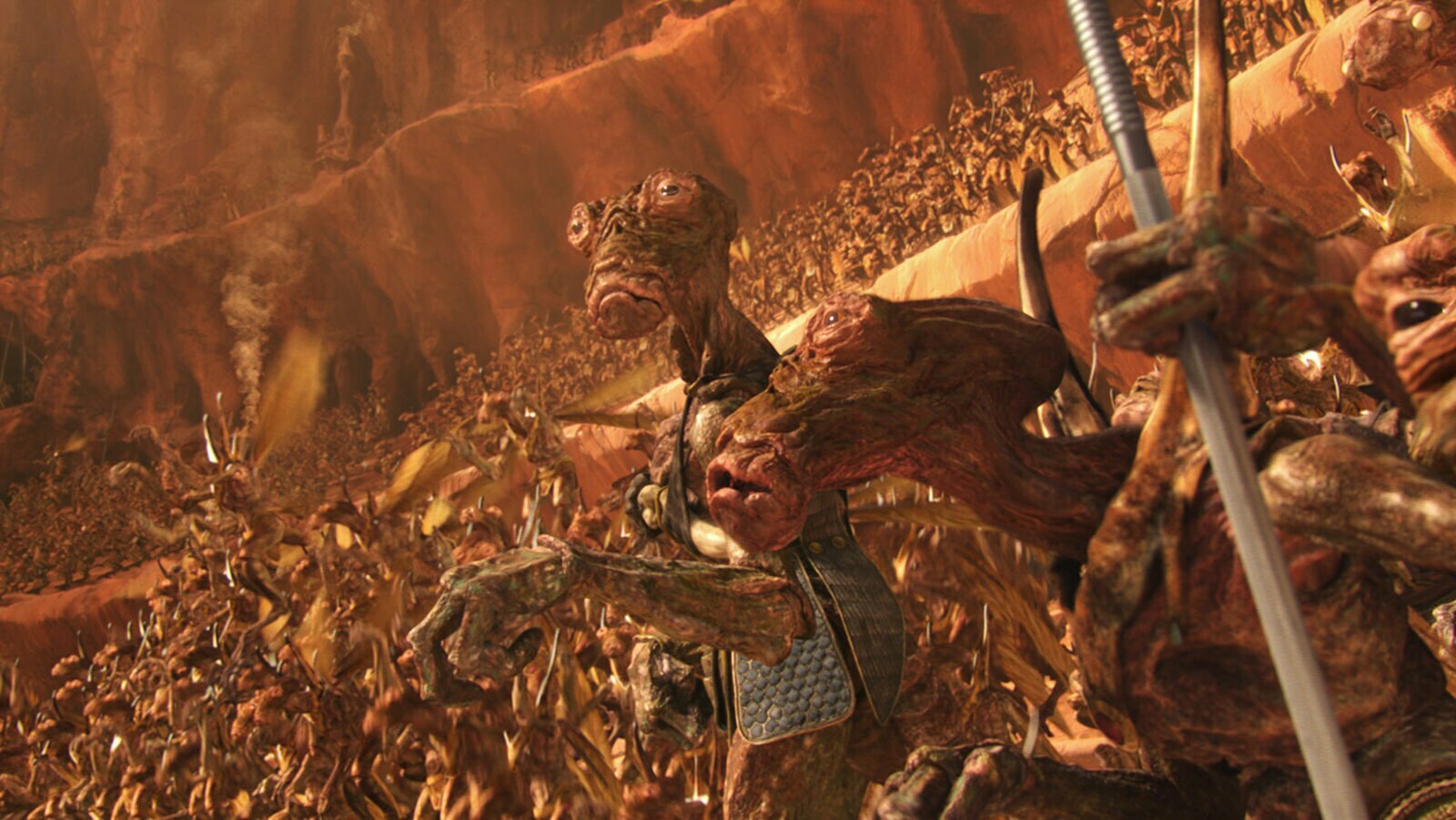
Geonosians were a sentient insectoid people whose homeworld became one of the most important industrial centers of the late Republic and early Imperial periods. They lived in towering spire-hives, maintained vast underground factories, fielded warriors and laborers organized through hive structures, and developed advanced weapons, vehicles, battle droids, and engineering projects. Outsiders most often encountered them as soldiers or factory workers during the Separatist crisis, but those roles represented only parts of a much larger society.
Their political importance came from the combination of local organization and industrial capacity. Under Poggle the Lesser, Geonosis supported Count Dooku and the Confederacy of Independent Systems with armies, weapons, and manufacturing infrastructure. Queen Karina the Great, hidden beneath the surface, reveals that visible political leadership existed alongside deeper hive authority. The species therefore cannot be understood simply as an obedient extension of Separatist command. Their institutions had their own hierarchy, labor systems, and internal centers of power.
Geonosian history also changes dramatically after the Clone Wars. The same population whose factories and engineers were useful to the Separatists and later to the earliest Death Star project became a liability to the Empire. Imperial secrecy turned an inhabited industrial world into a target for extermination. By the time rebel investigators returned to Geonosis, the civilization that had once filled hive towers and foundries had been reduced to near silence.
02 · Biology
Bodies, castes, and adaptation
Geonosians were insectoid sentients adapted to the harsh, rocky environment of Geonosis. Canon shows winged and wingless forms as well as queens, drones, workers, warriors, and political leaders with visibly different bodies. Those differences mattered socially because some forms were associated with specific hive roles, but biology should not be treated as a complete explanation for status. The existence of queens, public officials, engineers, laborers, soldiers, and survivors shows that Geonosian life involved institutions as well as anatomy.
The species' wings, exoskeletal appearance, narrow frames, and distinctive vocalizations made Geonosians immediately recognizable to outsiders. Their bodies were also well adapted to vertical hive environments and underground spaces. Yet the repeated tendency of Republic, Separatist, and Imperial characters to describe them as bugs or drones can flatten the distinction between a sentient society and an insect metaphor. IDS treats the biological comparison as descriptive, not as a substitute for social analysis.
Queen Karina demonstrates the most extreme biological differentiation visible in canon. Her enormous body, reproductive role, and control over drones placed her at the center of hive continuity. That reproductive structure made survival after the Imperial genocide especially precarious. A queen egg guarded by Klik-Klak later represented not merely one individual life but the possibility of rebuilding an entire population.
03 · Hive order
Queens, public leaders, and social hierarchy
Geonosian political and social hierarchy operated on more than one level. Poggle the Lesser was the Archduke and public leader most familiar to the Confederacy, Republic, and Jedi, but Queen Karina the Great occupied a deeper position within the hive. Official material identifies her as the secret leader of the Geonosians, living beneath the Progate Temple and issuing orders to public leaders such as Poggle. This distinction suggests that external diplomacy and internal hive authority were not identical.
Below elite leadership, Geonosian society included workers, soldiers, and other drones tied to large-scale collective labor. Canon material also depicts arena combat as one way status could be displayed or contested. That does not mean every Geonosian occupied a fixed, biologically predetermined place. It does show a society in which hierarchy, labor, reproduction, military service, and public spectacle were closely connected.
The hierarchy also matters for understanding responsibility. Poggle chose political alliances and committed Geonosian industry to the Separatist cause. Workers and soldiers lower in the system did not necessarily exercise the same level of political choice. Treating the entire species as equally responsible for elite decisions repeats a common wartime logic in which civilian populations become indistinguishable from governments or military leadership.
04 · Society
Hive life, arena culture, and collective organization
Geonosian life centered on dense hive settlements rather than isolated individual households of the sort most often shown for humans in Star Wars. The monumental spires of Geonosis were both architecture and social infrastructure, connecting populations to underground chambers, factories, temples, arenas, and workspaces. Public life therefore appears highly collective. Labor, spectacle, military mobilization, political leadership, and reproduction all took place within institutions built into the same physical landscape.
The Petranaki Arena gives one view of Geonosian public culture. It served as a place of execution and combat, but it was also a mass social venue. Official material describes arena battles between Geonosians of different castes and the consumption of local foods during events. This places violence inside a broader world of audience participation, status, entertainment, and ritualized competition rather than treating it as random savagery.
The underground catacombs reveal another side of the society. Beneath the visible political and industrial world existed spaces tied to Queen Karina, eggs, drones, religious or ceremonial authority, and biological continuity. The contrast between the arena above and queen-centered hive structures below suggests a society with layers that outsiders rarely saw.
05 · Material life
Cities, factories, weapons, and engineering
Geonosian material culture was highly industrial. Their hives contained enormous automated factories capable of producing battle droids, weapons, vehicles, and military equipment on a scale large enough to support the Separatist war effort. The Geonosis droid factory shown in Attack of the Clones is a functioning production environment filled with assembly lines, molten metal, stampers, cutters, and automated machinery. It makes clear that Geonosians were not simply consumers of outside technology; they were major manufacturers.
Their engineering extended beyond factory production. Geonosians built fighters, sonic weapons, artillery, and infrastructure integrated into a difficult desert and subterranean environment. Hive towers themselves are significant objects of social organization. They convert the geology of Geonosis into dense vertical settlements, while underground chambers connect industrial, political, and biological functions.
The Death Star plans represent the most consequential Geonosian technological contribution. At the beginning of the Clone Wars, Count Dooku carried plans associated with Poggle and Geonosis away from the battle. Later Imperial construction took place in the system. Geonosian design work therefore became entangled with a weapon that eventually embodied Imperial terror on a galactic scale.
06 · Labor
Industrial production and the Separatist war machine
Industry was not a background feature of Geonosian society. It was the basis of the species' strategic importance. Poggle's control of battle-droid factories made him valuable to the Confederacy, while Geonosian foundries helped arm and supply Separatist forces. Republic attacks on Geonosis repeatedly targeted this productive capacity. The second major campaign against the planet was explicitly aimed at shutting down renewed droid and weapons production.
This makes Geonosians useful for thinking about wartime labor. Factory workers who manufacture weapons may become militarily important without holding the same power as the leaders who decide how those weapons are used. Geonosian workers were embedded in an economy organized around mass production, but the archive rarely gives those workers individual names or voices. Their anonymity resembles the way states often reduce laboring populations to productive capacity.
The relationship between labor and disposability becomes especially stark under the Empire. Geonosian technical expertise remained useful during early Death Star construction, yet usefulness did not produce security. Once the project required deeper secrecy, the population itself became a threat to be eliminated. The trajectory from valued industrial labor to exterminated witnesses is central to the Geonosian story.
07 · Institutions
Poggle, the Confederacy, and political power
Poggle the Lesser placed Geonosis at the center of the Separatist project. His factories had already helped produce battle droids associated with the Trade Federation, and he later promised Count Dooku armies, weapons, and continued manufacturing support. As a member of the Separatist Council, Poggle linked local Geonosian industry to a galaxy-wide political movement opposing the Republic.
Geonosis therefore functioned as both a homeworld and a strategic industrial node. The Republic did not attack it simply because Geonosians were hostile. It attacked because the planet's factories, leadership, and position within the Confederacy mattered materially to the war. Political power came from the ability to produce armies and weapons as much as from formal titles.
At the same time, Poggle's authority should not be confused with the entirety of Geonosian social power. Queen Karina's hidden role shows a separate structure of internal authority. Geonosian politics had at least two visible levels: public leadership dealing with outside powers and hive leadership rooted in reproduction and internal organization.
08 · Clone Wars
Two invasions of Geonosis
The first Battle of Geonosis marked the beginning of the Clone Wars. Obi-Wan Kenobi's discovery of the Separatist gathering brought Jedi and Republic forces to the planet, while Anakin Skywalker and Padmé Amidala were captured and sentenced to execution in the Petranaki Arena. The rescue attempt escalated into a massive confrontation involving Jedi, newly deployed clone troopers, Separatist battle droids, and Geonosian defenders. Count Dooku escaped with plans for a secret superweapon as Republic forces claimed the field.
Victory did not remove Geonosis from the war. Poggle resumed weapons and droid production, prompting a second Republic invasion. Clone Wars episodes centered on the campaign show how costly it was to penetrate Geonosian defenses, disable energy shields, and reach the factories. The fighting demonstrates that Geonosis was not a passive industrial site guarded by Separatist machines. Geonosian soldiers fought directly for the defense of their world and political order.
The aftermath exposed hidden layers of hive society. Jedi searching for Poggle entered the catacombs and encountered Queen Karina, reanimated Geonosian drones, and parasitic brain worms. Those events broaden the archive beyond conventional military history and reveal how little outside powers understood about the social and biological systems beneath the planet's factories.
09 · Death Star
From Geonosian design to Imperial superweapon
The Death Star connects the Separatist and Imperial phases of Geonosian history. Plans for a planet-killing battle station were already associated with Poggle and Count Dooku at the opening of the Clone Wars. Official Star Wars material later places early construction above Geonosis under Imperial control. The species' engineering knowledge therefore crossed a regime change: technology developed in a Separatist context became part of the new Empire's most ambitious weapons program.
That continuity is politically important. The Empire did not simply inherit territory from the Republic; it absorbed knowledge, personnel, infrastructure, and secret projects created during the war. Geonosian engineers and workers became part of that transfer. Their expertise was useful even though their former leadership had fought against the Republic that became the Empire.
The project also changed the status of the entire system. Travel was restricted, construction was hidden, and Geonosis became a secret zone. The presence of a large native population with direct knowledge of the project created a contradiction for Imperial security. The Empire resolved that contradiction not by integrating the population but by attempting to erase it.
10 · Imperial genocide
Sterilization, poison, and state secrecy
After the Clone Wars, the Empire nearly exterminated the Geonosian population. Official material states that the surface was sterilized, while Rebels later reveals giant Imperial canisters that had contained poison used against the population. The method matters because it shows planned state violence rather than accidental wartime destruction. Geonosis was not merely abandoned after a battle. Its inhabitants were targeted after the war.
The motive was closely tied to secrecy surrounding the Death Star. Geonosians knew what had been constructed in their system and had participated in the project. A population that had once been useful became dangerous because it possessed knowledge the Empire wanted hidden. The genocide therefore links political secrecy to the destruction of witnesses.
This history also complicates the way Geonosians had been framed earlier in Star Wars. During the Clone Wars, audiences often encounter them as enemy soldiers or workers serving a hostile regime. Imperial extermination forces a different perspective: military affiliation does not erase civilian existence, collective history, or a population's right to survive. A society can participate in war and still become the victim of genocide.
11 · Survival
Klik-Klak and the queen egg
By the time the Ghost crew and Saw Gerrera returned to Geonosis, the once-populated world appeared empty. Klik-Klak emerged as the known survivor who gave that absence a personal scale. He hid in the caves, used leftover battle droids for protection, and initially appeared threatening to the rebels searching for answers. His behavior made sense in the context of a world whose people had been destroyed by outsiders.
Klik-Klak was protecting more than himself. He guarded a queen egg that could make the survival of the species possible. This gives the egg social as well as biological significance. Because Geonosian society depended on queens for reproduction and hive continuity, safeguarding a queen meant preserving the possibility of future community, memory, and collective life.
The rebels discovered evidence of Imperial poison but lost the canisters during their escape. That detail is important to the politics of atrocity. The genocide happened, survivors knew it happened, and investigators encountered evidence, yet producing proof that could circulate publicly was difficult. Klik-Klak remained behind with the queen egg, making survival itself a form of resistance to an Imperial project designed to leave no witnesses.
12 · Representation
Beyond the image of hostile insect soldiers
Geonosians are visually coded in ways that make dehumanization easy. Their insectoid bodies, clicking speech, hive organization, massed soldiers, and anonymous workers can make them appear less individual than human characters. Early stories often emphasize threat, factory labor, or battlefield opposition. That framing can encourage audiences to see an enemy swarm rather than a sentient population with political leaders, workers, public culture, reproductive institutions, and historical memory.
Later material complicates that image. Queen Karina reveals internal authority invisible to outsiders. Poggle demonstrates strategic political agency. Klik-Klak is presented as frightened, protective, and concerned with the survival of his people. Together these characters make it harder to treat Geonosians as interchangeable drones.
IDS therefore reads the species across the full chronology rather than from one battle scene. The question is not whether Geonosian society contained violent practices or authoritarian hierarchy; canon clearly shows both. The question is whether those facts justify reducing an entire people to disposable enemies. The Imperial genocide demonstrates the danger of exactly that reduction.
13 · IDS lens
Labor, empire, and disposable populations
Geonosian history brings together labor, political economy, hierarchy, war, technological expertise, genocide, and historical memory. Their factories show how productive capacity can generate political importance. Their alliance with the Confederacy shows how local institutions can become embedded in larger wars. Their later extermination shows how quickly a powerful state can redefine a useful population as a security problem.
The species is especially valuable to IDS because its story forces a distinction between government, military participation, and civilian existence. Poggle made decisions. Geonosian soldiers fought. Workers manufactured weapons. Queens reproduced hives. None of those roles makes every individual interchangeable. The tendency to collapse them into a single swarm mirrors the logic by which collective punishment becomes easier to imagine.
Geonosians also expose the moral instability of imperial extraction. Their knowledge and labor contributed to one of the galaxy's largest weapons projects, but participation did not grant them ownership, protection, or political power over the final weapon. Once their knowledge became inconvenient, the Empire attempted to erase both the people and the evidence. In that sense, Geonosis is not merely a battlefield. It is a case study in how states use labor, appropriate technology, control information, and dispose of populations.
14 · Canon record
Official sources used for this file
This dossier uses official StarWars.com Databank material as its factual baseline and cross-reads those entries across the Clone Wars and Rebels eras. The source list documents the canon evidence behind Geonosian biology, political leadership, industrial production, Death Star involvement, Imperial extermination, and survival. The anthropological interpretation surrounding those facts is independently written for Imperial Dark Sector and keeps inference separate from explicitly documented canon.