
01 · Orientation
Who the Mirialans are
Mirialans are visually recognizable, but canon gives relatively little direct information about ordinary Mirialan social life compared with the attention given to individual Jedi and Imperial figures. That imbalance is itself important. Luminara Unduli, Barriss Offee, and the Seventh Sister follow sharply different institutional paths, demonstrating that markings, ancestry, or homeworld identity do not predict political loyalty. The species page therefore distinguishes established cultural markers from assumptions created by the prominence of a few Force-sensitive characters.
02 · Biology
Bodies and adaptation
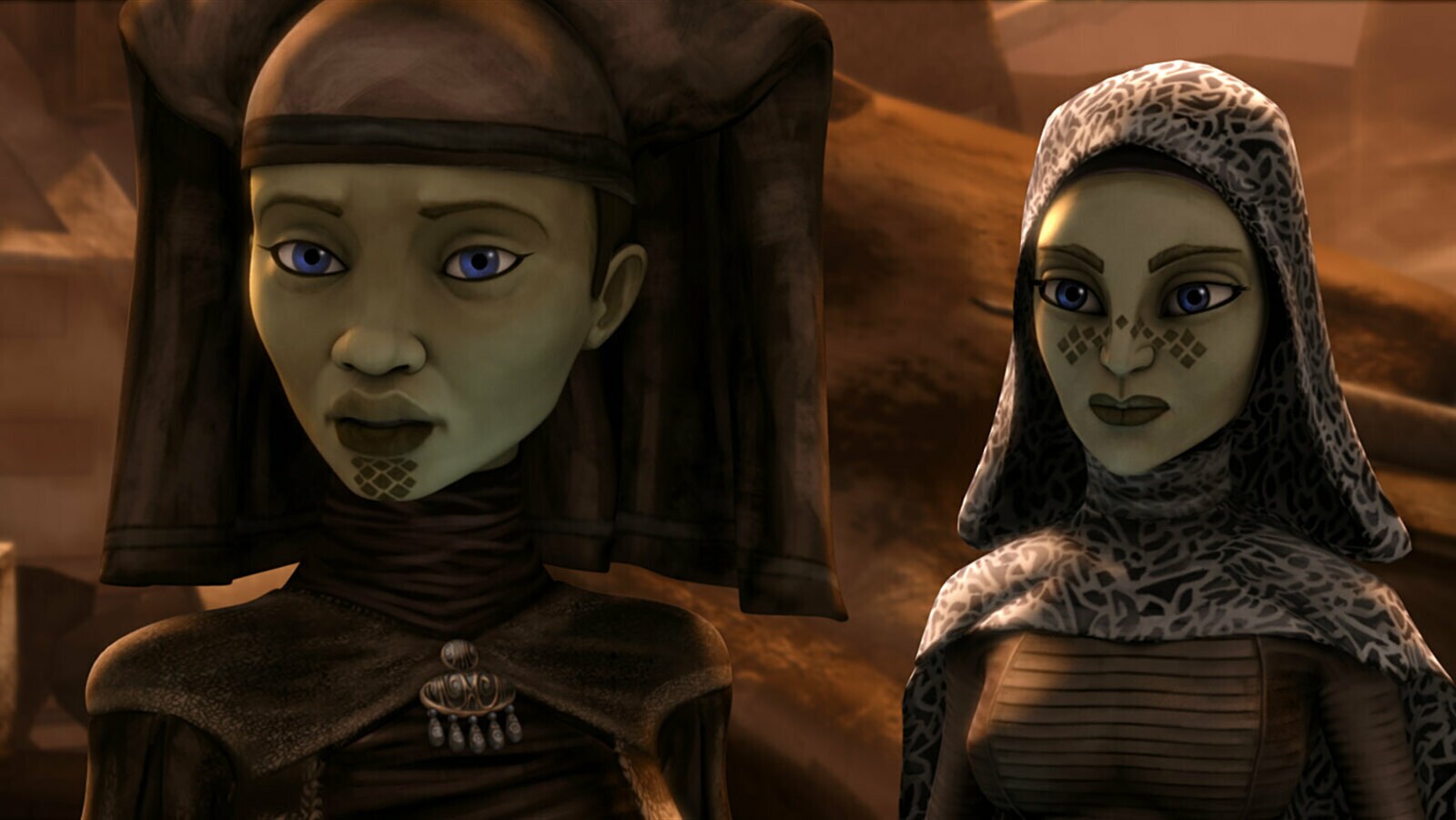
Mirialans are near-human in form with green or yellow-green skin. Facial markings are culturally significant and should be understood as social symbols rather than merely biological decoration.
For Mirialans, the important distinction is between physical traits and the meanings societies attach to them. Quick Facts summarizes the body as Near-human; green to yellow-green skin; geometric facial markings. Those characteristics can shape movement, perception, environment, or adaptation, but they do not determine intelligence, morality, occupation, political loyalty, religion, or personality. Social institutions give biological difference its historical significance.
03 · Social organization
Community, identity, and variation
Mirialan identity can include traditions surrounding markings, spirituality, family, and homeworld ties, but diaspora and institutional membership create many different life paths.
Community life among Mirialans is better understood through place, kinship, work, class, institutions, and historical circumstance than through species identity alone. Populations associated with Mirial and diaspora may live differently from communities elsewhere in Mirial, Jedi communities, galaxy-wide diaspora. The archive therefore treats cultural patterns as learned and historically produced, with room for regional difference, disagreement, migration, and individual choice.
04 · Place
Homeworld, settlement, and distribution
The archive associates Mirialans most strongly with Mirial and diaspora. Canon also places members of the species across Mirial, Jedi communities, galaxy-wide diaspora. That geography matters because a homeworld can shape memory and identity without determining the life of every person who leaves it. Migration, war, work, family, institutional membership, and local environment can all create different versions of species identity.
IDS therefore treats location as social context rather than a label. Where a population lives affects access to resources, political authority, language, technology, neighboring communities, and exposure to larger galactic conflicts.
05 · Material life
Environment, technology, and objects
Facial markings are the most visible Mirialan cultural feature in the archive, making the body itself a site of social symbolism. Their exact meanings should not be generalized beyond what sources support, but they clearly show that appearance can carry learned cultural significance rather than merely biological difference. Clothing, Jedi robes, Inquisitor equipment, and other material forms then add institutional identities on top of species identity, creating layered visual signals of belonging.
06 · Everyday life
Work, movement, and social roles
The strongest recurring IDS theme for this file is marking, identity, religion, individual variation. That theme becomes visible through ordinary roles as much as through famous battles or political leaders. Work, travel, family obligations, military service, craft, trade, religion, and institutional membership can matter more to everyday life than species identity by itself.
The material record also matters. Facial markings are the most visible Mirialan cultural feature in the archive, making the body itself a site of social symbolism. Their exact meanings should not be generalized beyond what sources support, but they clearly show that appearance can carry learned cultural significance rather than merely biological difference. Clothing, Jedi robes, Inquisitor equipment, and other material forms then add institutional identities on top of species identity, creating layered visual signals of belonging. Objects and environments should therefore be read as evidence of particular communities and historical conditions, not as a single timeless package shared by every member of the species.
07 · Institutions
Politics and power
Mirialans appear in the Jedi Order, the Inquisitorius, civilian communities, and Imperial-era conflict. Luminara Unduli, Barriss Offee, and the Seventh Sister illustrate sharply different political trajectories.
Those differences are visible in figures such as Luminara Unduli, Barriss Offee, Seventh Sister, whose lives place Mirialans inside institutions with different and sometimes opposing goals. Rather than implying a species-wide political allegiance, these examples show how authority is produced through training, patronage, government, military service, family networks, and local history. The key question is which institution a person enters and what power that institution gives them.
08 · Change over time
Historical pressures
The fall of the Jedi Order and rise of the Empire scattered Mirialans across competing institutions. Barriss Offee's changing relationship with the Jedi is particularly useful for separating species identity from institutional ideology.
The main canon appearances for Mirialans include The Clone Wars, Tales of the Empire, Rebels, and those stories place the species inside changing political conditions rather than a timeless cultural snapshot. Wars, regime changes, migration, occupation, trade, and institutional collapse can alter what communities are able to preserve or rebuild. IDS treats history as a force that changes social life instead of presenting culture as something static.
09 · Encounters
Relations, diaspora, and outside powers
Mirialans appear in some of the galaxy's most powerful institutions, especially the Jedi Order and later the Inquisitorius. Barriss Offee's changing relationship with Jedi authority and the Seventh Sister's Imperial role show that shared species does not create a shared political trajectory. The limited amount of homeworld-centered material also creates an archival caution: when source material privileges exceptional individuals, readers must avoid mistaking institutional biographies for a complete picture of a people.
10 · Representation
Stereotypes and source visibility
Many viewers first encounter Mirialans through a small number of highly visible characters or settings, especially Luminara Unduli, Barriss Offee, Seventh Sister. That creates a source problem: memorable individuals can become shorthand for an entire population even when their occupations, politics, or institutions are exceptional.
The main screen and story record for this file comes from The Clone Wars, Tales of the Empire, Rebels. IDS treats those appearances as partial evidence. Repeated visual or narrative patterns can reveal how the franchise represents a species, but repetition alone does not make a stereotype into an in-universe biological fact.
11 · People
Known individuals and variation
Known individuals include Luminara Unduli, Barriss Offee, Seventh Sister. They are useful because they show the species inside specific biographies, institutions, conflicts, and relationships. They should not be used as demographic averages. A Jedi, senator, criminal, soldier, worker, ruler, or rebel represents a life history before representing a species-wide norm.
Reading several individuals together is more useful than selecting one famous example. Differences between them can reveal class, region, generation, ideology, occupation, or migration history that a species label would otherwise hide.
12 · Archive limits
What canon shows and leaves unseen
The canon record for Mirialans is uneven. The best-known material emphasizes The Clone Wars, Tales of the Empire, Rebels, which means some parts of social life are documented far better than others. Domestic life, childhood, ordinary work, local religion, language use, class difference, and internal political disagreement may receive much less attention than war, adventure, or elite institutions.
Where the source record is thin, IDS keeps the gap visible rather than filling it with invented customs. The goal is to separate what canon establishes from what can only be inferred, while still asking anthropological questions about the institutions and histories surrounding the evidence that does exist.
13 · IDS lens
What this species reveals
Mirialan facial markings make material symbolism visible on the body. They offer a way to study how identity is communicated socially without assuming that all marked individuals share one politics or personality.
This makes marking, identity, religion, individual variation especially useful for understanding the species without reducing it to appearance or a famous character. IDS compares the lives of Luminara Unduli, Barriss Offee, Seventh Sister with the wider settings in which Mirialans appear. The analytical goal is to identify how institutions, history, place, and material conditions create difference within a population as well as between species.
14 · Canon record
Official sources used for this file
The primary official reference for this species file is the StarWars.com Databank. Context is cross-read against the canon appearances listed in Quick Facts and the connected IDS archive. The source list documents the official baseline used for factual claims about Mirialans while the surrounding interpretation is independently written for Imperial Dark Sector. Where canon leaves ordinary social life undocumented, the article identifies that absence rather than presenting inference as established fact.