
IDS Film Hub · A Star Wars Story · 2018
Solo
One screen story, connected to the larger Imperial Dark Sector archive through anthropology, characters, institutions, places, events, and lore.
Story record
Movie summary
2018 · A Star Wars Story
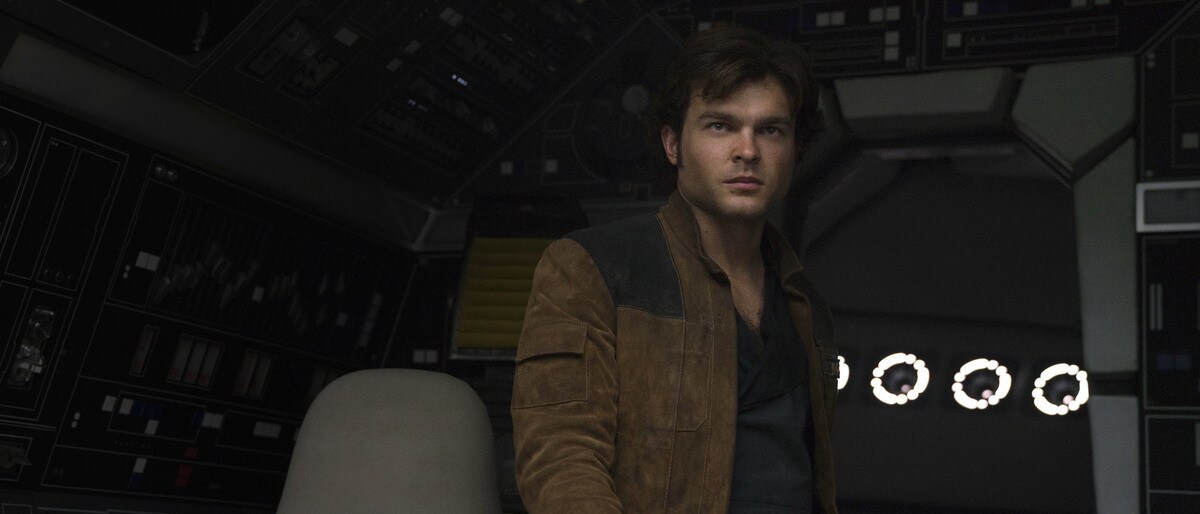
Solo: A Star Wars Story begins on Corellia, an industrial world where poverty, shipbuilding, organized crime, and Imperial control exist side by side. Young Han and Qi'ra survive by working for the White Worms gang led by Lady Proxima. Han steals a valuable quantity of coaxium and plans to use it to buy passage offworld for both of them. At a spaceport checkpoint they try to escape, but Qi'ra is captured before she can pass through. Han promises that he will return for her. With few alternatives, he enlists in the Imperial Navy and gives the recruiting officer the surname Solo after admitting that he has no family name. His decision is practical rather than ideological. Imperial service appears as one of the limited institutions available to a poor young man who needs mobility, training, and a path away from local criminal dependence.
Three years later, Han is serving as an infantry soldier rather than the pilot he hoped to become. During fighting on Mimban he notices that Captain Tobias Beckett and his companions Val and Rio Durant are thieves posing as Imperial troops. Han tries to blackmail his way into their crew, but Beckett reports him as a deserter and Han is thrown into a pit with a supposed monster. The captive is Chewbacca, a Wookiee who has been separated from his people. Han reveals that he can speak some Shyriiwook and persuades Chewbacca to cooperate in escaping. Their alliance begins as mutual survival. Beckett, impressed by the escape, allows both of them to join his crew for a train robbery intended to steal refined coaxium for the criminal organization Crimson Dawn.
The robbery on Vandor becomes catastrophic. Beckett's crew attempts to remove a cargo car from a high-speed conveyex train while Imperial range troopers defend it. A group of masked raiders led by Enfys Nest attacks at the same time. Rio is killed while piloting the transport, and Val sacrifices herself to destroy a bridge when the operation begins collapsing. Han chooses to release the coaxium rather than allow the transport to crash, but the cargo is destroyed. Beckett now owes a shipment to Crimson Dawn leader Dryden Vos and expects that failure will be punished with death. Han and Chewbacca remain with him partly because they share responsibility and partly because Han sees the job as a possible route toward the money and ship he still needs to return to Corellia for Qi'ra.
At Vos's luxury yacht, Han unexpectedly finds Qi'ra alive and working as a senior Crimson Dawn lieutenant. Her position signals how much her life changed after Han escaped Corellia. Qi'ra has gained status and skills but remains bound to a violent organization. Vos demands replacement coaxium. Han proposes stealing unrefined fuel from the mines of Kessel and refining it before the unstable material degrades. Qi'ra is sent to supervise the mission. To obtain a fast ship, the group finds smuggler and gambler Lando Calrissian, who owns the Millennium Falcon. Han challenges Lando to sabacc and loses after Lando cheats, but Qi'ra persuades Lando to join the job in exchange for a share. Lando's droid navigator L3-37 accompanies them and openly advocates droid independence, giving the mission another participant whose status as property conflicts with her self-understanding.
On Kessel, the group infiltrates a mining facility where enslaved workers and droids extract resources under brutal conditions. Chewbacca separates from the crew after seeing imprisoned Wookiees and helps free them. L3 begins a droid revolt by removing restraining bolts and opening control systems. The revolt creates the chaos needed for the crew to steal the coaxium but also exposes the scale of coerced labor underlying the mine. L3 is mortally damaged during the escape. Lando carries her components back to the Falcon, where her navigational memory is integrated into the ship's computer. The crew then must cross the dangerous Kessel Run quickly enough to reach a refinery on Savareen before the raw coaxium explodes. Han takes an unconventional route through the Maelstrom, escaping an Imperial blockade and a giant space creature while making the run in an unusually short distance.
At Savareen, Enfys Nest and the raiders confront the crew again. Han expects another attempt to steal the fuel, but Enfys removes her helmet and reveals that her group is not a conventional pirate organization. They are resisting Crimson Dawn and similar syndicates that exploit communities and supply Imperial power. The coaxium could support a broader rebellion. The revelation forces Han to decide whether the cargo is only a debt payment or a resource with political consequences. Qi'ra understands the stakes but remains trapped by her relationship to Vos. Beckett chooses self-preservation and secretly informs Vos about Han's plan. Han anticipates that betrayal and arranges a deception using false containers while the real coaxium remains hidden.
Vos arrives with armed personnel and initially believes Beckett has exposed Han. The confrontation turns as Han's deception is revealed and alliances change rapidly. Beckett takes Chewbacca hostage and steals the coaxium. Qi'ra fights Vos and kills him, telling Han to go after Beckett while she follows later. Instead, after Han leaves, Qi'ra contacts Vos's superior: Darth Maul, the former Sith apprentice now leading Crimson Dawn from Dathomir. Maul orders her to meet him, and Qi'ra accepts responsibility for the organization. Her decision shows that killing Vos does not free her from the larger structure. She has survived by becoming more deeply embedded in it. Han still imagines that they might leave together, but the woman he returns for is no longer situated socially where he left her.
Han catches Beckett before he can escape. Beckett tells him that everyone eventually betrays everyone, reinforcing the cynical worldview he has tried to teach throughout the film. Han shoots him before Beckett can complete his own attack. Beckett dies acknowledging that Han made the correct tactical choice. Han and Chewbacca then give the coaxium to Enfys Nest, who tells them that the material will help build a resistance movement. Enfys invites Han to join, but he declines. He is willing to help but is not yet prepared to become part of a political cause. His identity remains tied to independence, earning a ship, and choosing his own jobs rather than committing to an institution.
Han returns to Lando for another sabacc game. This time he steals the card Lando uses to cheat and wins the Millennium Falcon. He and Chewbacca leave together for Tatooine after hearing that a powerful gangster is assembling a crew for a job. The ending points toward Han's later relationship with Jabba the Hutt while establishing the partnership and ship that will define his public reputation. Yet the film also shows how much hidden infrastructure lies behind that future identity. Han's movement from Corellian street survivor to independent smuggler depends on Imperial training, criminal work, friendships, betrayals, exploited mines, droid labor, Wookiee captivity, stolen fuel, and the political economy of syndicates such as Crimson Dawn.
Solo therefore treats mobility as both freedom and privilege. Han wants a ship because a ship means the ability to leave employers, planets, armies, and criminal rulers behind. But every route he uses is connected to systems of power. The Empire recruits the poor, Crimson Dawn controls debt and violence, Kessel converts captive bodies into labor, and emerging rebels need the same fuel that criminal organizations trade. Han and Chewbacca create a chosen partnership inside these systems without fully joining any of them. Qi'ra survives through a different strategy, gaining authority within Crimson Dawn while accepting obligations she cannot easily abandon. By the end, Han has achieved the independence he wanted, but the film has shown that independence is never absolute. It is made possible by relationships, technology, and resources that connect even the most self-described free agent to larger social worlds.
IDS anthropology
Anthropological analysis
The full IDS long-form analysis is included directly on this film page.
01 · Central reading
What an anthropology lens changes
Solo is less a biography of a future hero than a tour through unstable forms of work and belonging. Han moves from Corellian street survival to Imperial service, criminal crews, smuggling, and partnerships that operate through reputation rather than formal law.
This review does not score the film. It asks what kinds of social relations the story makes visible: who has authority, how institutions reproduce themselves, what counts as family, how belief is organized, who performs necessary labor, how violence is justified, and how people attach meaning to places and objects. The aim is to connect character decisions to the systems around them without pretending that one interpretive framework exhausts what the film can mean.
02 · Anthropology lens
Corellia and precarious life
Young Han and Qi'ra live inside an economy where local criminal power controls resources and mobility. Escape requires bribery, transport access, and risk. The opening treats poverty not as an individual condition but as something structured by local institutions and restricted movement.
Place matters in Solo because environments are socially organized rather than empty backdrops. Settlements, borders, routes, sacred sites, workplaces, farms, palaces, industrial zones, and informal markets determine which relationships are possible and which authorities are visible. Different communities can inhabit the same world while experiencing law, mobility, danger, and political membership very differently. Local knowledge therefore becomes a form of power. People who understand terrain, customs, trade, language, or neighborhood networks may possess capacities that larger outside institutions overlook. Reading place this way helps explain why control of a planet is never identical to control of every community living on it, and why alliances often depend on recognizing knowledge that centralized actors initially dismiss.
03 · Anthropology lens
Conscription and military labor
Han joins the Empire as a route off Corellia. Imperial service offers mobility but demands discipline and obedience. His later position in infantry mud shows the gap between recruitment promises and lived military labor. The Empire absorbs people seeking opportunity as well as ideological loyalists.
Solo also makes this theme useful for material anthropology because political life depends on things being built, moved, repaired, bought, extracted, and maintained. Weapons, ships, droids, fuel, housing, sacred objects, uniforms, factories, and transport systems distribute possibilities unevenly across the galaxy. The characters who control those resources do not necessarily perform the labor that keeps them functioning, and the people who do that work are often pushed to the edge of the story. Following the material chain makes inequality easier to see. It connects spectacular events to ordinary work, infrastructure, property, and supply. It also shows why the same object can mean something different depending on who owns it, who repairs it, who is allowed to use it, and what institution gives it value.
04 · Anthropology lens
Criminal crews as temporary kin groups
Beckett's crew depends on trust, specialized skills, and shared risk, but relationships remain fragile. The crew resembles a household organized around work rather than descent. Loyalty has economic value, yet survival can override attachment. Han learns that belonging in the underworld is continually negotiated.
Solo also makes this theme useful for material anthropology because political life depends on things being built, moved, repaired, bought, extracted, and maintained. Weapons, ships, droids, fuel, housing, sacred objects, uniforms, factories, and transport systems distribute possibilities unevenly across the galaxy. The characters who control those resources do not necessarily perform the labor that keeps them functioning, and the people who do that work are often pushed to the edge of the story. Following the material chain makes inequality easier to see. It connects spectacular events to ordinary work, infrastructure, property, and supply. It also shows why the same object can mean something different depending on who owns it, who repairs it, who is allowed to use it, and what institution gives it value.
05 · Anthropology lens
Debt and syndicate authority
Dryden Vos and Crimson Dawn enforce contracts through personal violence and reputational fear. Their power operates across legal boundaries and depends on intermediaries. The film presents criminal organizations as institutions capable of regulating trade, labor, and punishment where state authority is weak or corrupt.
What makes this especially important in Solo is that authority is never only a matter of who gives an order. Power has to move through institutions, recognized offices, information systems, material resources, and relationships that persuade or compel other people to act. The film repeatedly distinguishes formal legitimacy from practical capacity: a government may possess law without control, a commander may possess rank without autonomy, and a resistance movement may lack legal recognition while still exercising real political coordination. Reading the sequence this way shifts attention from individual intention to institutional conditions. It asks who can convert a decision into action, who can challenge that decision, which groups are excluded from the process, and what happens when public rules and lived experience stop matching one another.
06 · Anthropology lens
Chewbacca and chosen partnership
Han and Chewbacca meet as prisoners and become collaborators before they become friends. Their relationship develops through escape, shared risk, communication, and reciprocal aid. It becomes one of Star Wars' clearest examples of durable chosen kinship built across species difference.
This theme deepens the anthropology of Solo because the scene connects individual choice to a wider social environment. Characters act through institutions, relationships, objects, inherited expectations, and unequal access to information or resources. The question is therefore not only why one person behaves as they do, but what social arrangements make that behavior possible, rewarding, dangerous, or difficult to refuse. Looking at those arrangements also reveals variation inside groups that the plot can otherwise make appear uniform. People who share a government, religion, military, species identity, or homeworld do not automatically share the same interests. The film becomes more interesting when those differences are kept visible and when personal decisions are read alongside the systems that shape their consequences.
07 · Anthropology lens
Resources and extraction
Coaxium is valuable because transportation, warfare, and criminal economies depend on it. The Kessel sequence connects dangerous labor, imprisonment, extraction, and high-value commodities. The plot repeatedly shows that adventure rests on material supply chains and people positioned unequally within them.
Solo also makes this theme useful for material anthropology because political life depends on things being built, moved, repaired, bought, extracted, and maintained. Weapons, ships, droids, fuel, housing, sacred objects, uniforms, factories, and transport systems distribute possibilities unevenly across the galaxy. The characters who control those resources do not necessarily perform the labor that keeps them functioning, and the people who do that work are often pushed to the edge of the story. Following the material chain makes inequality easier to see. It connects spectacular events to ordinary work, infrastructure, property, and supply. It also shows why the same object can mean something different depending on who owns it, who repairs it, who is allowed to use it, and what institution gives it value.
08 · Synthesis
What the film reveals when the lenses are connected
Taken together, the major lenses in this review — Corellia and precarious life, Conscription and military labor, Criminal crews as temporary kin groups, Debt and syndicate authority, Chewbacca and chosen partnership, and Resources and extraction — show why Solo works as more than a sequence of plot events. Solo is less a biography of a future hero than a tour through unstable forms of work and belonging. Han moves from Corellian street survival to Imperial service, criminal crews, smuggling, and partnerships that operate through reputation rather than formal law. The recurring pattern is that large historical changes become real through ordinary social mechanisms. Institutions classify people, families create competing obligations, religious traditions authorize some forms of knowledge, labor and technology make political projects possible, and places shape who can move or act safely. The film also leaves tensions unresolved, which is analytically useful. Social systems rarely change all at once, and a victory, revelation, or regime shift does not erase the institutions and memories that came before it. For IDS, the value of the film lies in following those continuities and contradictions instead of reducing the story to a single political message.
09 · Method
How IDS is reading this film
The analysis treats Star Wars as a fictional social world rather than evidence about any real population. Anthropological concepts are used as questions, not as claims that fictional societies map directly onto real cultures. The review distinguishes events shown or established by the story from IDS interpretation about institutions, kinship, belief, political economy, identity, material culture, and historical change. That distinction matters because interpretation should make the source material more legible without quietly turning analysis into additional canon.
People in this story
Character list
Open existing IDS dossiers or search the archive for additional coverage.