01 · Central reading
What long-form television makes visible
Resistance is strongest as a local study of how a distant political conflict enters an ordinary community. The Colossus is not initially organized around galactic war. Its residents have jobs, rivalries, businesses, families, and competitions that become politicized as First Order influence expands.
Television gives social institutions time to recur. A government office, household, prison, crew, religious community, workplace, or settlement can appear under different pressures across multiple episodes, which makes rules and exceptions easier to distinguish. This review does not rank seasons or assign a score. It asks how recurring relationships, institutions, forms of authority, material systems, identities, and practices change as characters continue living inside them.
The Colossus lets the series observe a relatively ordinary community before, during, and after First Order penetration. Political change becomes visible through security arrangements, work, friendship, racing culture, displacement, and the reclassification of neighbors as allies or threats.
02 · Anthropology lens
The Colossus as a social world
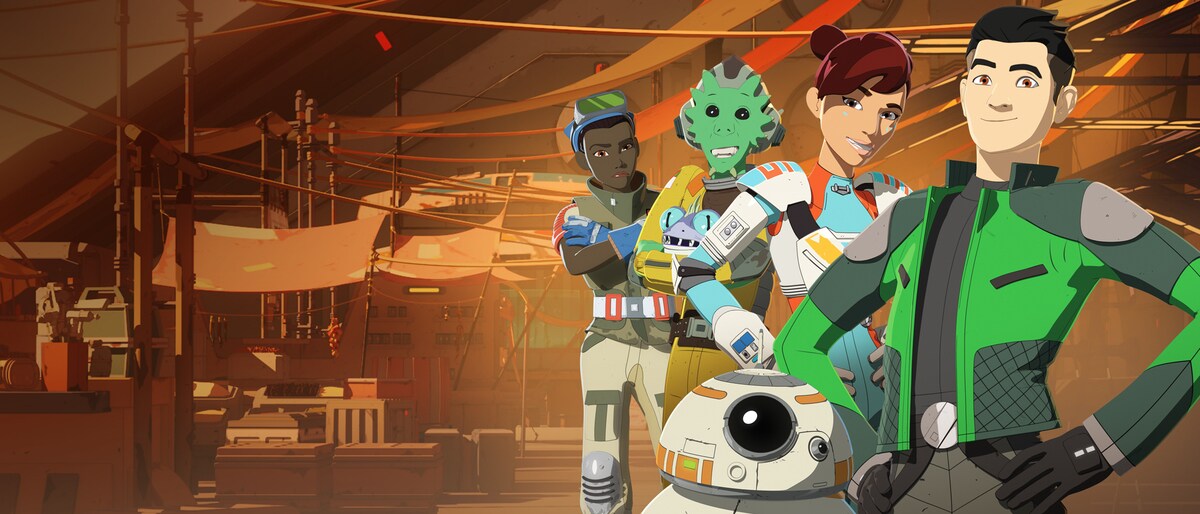
The station is simultaneously workplace, settlement, transport hub, racing venue, and political territory. Mechanics, pilots, merchants, security personnel, families, and visitors occupy different positions. This makes it useful for studying how a community functions before crisis turns everyday roles into political ones.
Place in Resistance is never only scenery. Settlements, stations, homeworlds, routes, sanctuaries, and borders organize what people know and which authorities can reach them. A community may understand a location as homeland while an outside state sees territory, a pirate sees opportunity, or a displaced population sees refuge. Movement between places also redistributes knowledge. Travelers learn customs, discover inequalities, and carry information or obligations back to previous communities. Over several episodes, geography becomes social history: places accumulate memories of occupation, loss, work, family, ritual, and return.
The longer time scale matters here. The Colossus lets the series observe a relatively ordinary community before, during, and after First Order penetration. Political change becomes visible through security arrangements, work, friendship, racing culture, displacement, and the reclassification of neighbors as allies or threats. Seen through the lens of the colossus as a social world, recurring settings and relationships let consequences accumulate. An arrangement that first appears normal can later be exposed as fragile, coercive, privileged, or historically contingent. Characters also learn from earlier encounters, so institutions are not static backdrops: they adapt, fail, harden, fragment, or become newly meaningful as circumstances change.
03 · Anthropology lens
Espionage and ambiguous belonging
Kaz must gather information while appearing to belong to the community he is observing. Espionage therefore requires performance, trust, secrecy, and divided loyalty. The series shows how political information is produced through relationships rather than only technology.
The series develops this theme through repeated encounters with information and classification. States, militaries, employers, prisons, and clandestine networks all need to know who people are, where they belong, what they have done, and whether they can be trusted. Records, informants, interrogation, secrecy, aliases, architecture, and surveillance turn social relationships into administrative problems. At the same time, people learn to manipulate those systems by withholding information, performing acceptable identities, building trust networks, or creating spaces where institutional observation becomes harder. Control therefore depends on knowledge, but knowledge is always incomplete and contested.
The longer time scale matters here. The Colossus lets the series observe a relatively ordinary community before, during, and after First Order penetration. Political change becomes visible through security arrangements, work, friendship, racing culture, displacement, and the reclassification of neighbors as allies or threats. Seen through the lens of espionage and ambiguous belonging, recurring settings and relationships let consequences accumulate. An arrangement that first appears normal can later be exposed as fragile, coercive, privileged, or historically contingent. Characters also learn from earlier encounters, so institutions are not static backdrops: they adapt, fail, harden, fragment, or become newly meaningful as circumstances change.
04 · Anthropology lens
Pilots, status, and competition
Racing creates prestige and local hierarchy. Skill becomes socially visible through competition, sponsorship, reputation, and access to machines. The Ace pilots demonstrate how occupational expertise can become a source of identity and political importance.
Resistance repeatedly links political life to work. Occupations organize schedules, status, mobility, income, discipline, access to equipment, and relationships with institutions. That means labor scenes are not simply background texture. They reveal who controls resources, who performs necessary maintenance, whose expertise is valued, and what happens when a regime or market no longer needs particular workers. Television is especially useful here because employment can change over time. Characters lose jobs, acquire new roles, build reputations, become disposable, or discover that professional identity conflicts with family and moral obligation.
The longer time scale matters here. The Colossus lets the series observe a relatively ordinary community before, during, and after First Order penetration. Political change becomes visible through security arrangements, work, friendship, racing culture, displacement, and the reclassification of neighbors as allies or threats. Seen through the lens of pilots, status, and competition, recurring settings and relationships let consequences accumulate. An arrangement that first appears normal can later be exposed as fragile, coercive, privileged, or historically contingent. Characters also learn from earlier encounters, so institutions are not static backdrops: they adapt, fail, harden, fragment, or become newly meaningful as circumstances change.
05 · Anthropology lens
First Order influence before open rule
The First Order expands through security promises, agreements, intimidation, and administrative presence before full coercion is obvious. This gradual process matters because communities may accept new authority for practical reasons before understanding its larger political project.
In Resistance, this theme is useful because authority has to be reproduced repeatedly rather than simply announced. Rules become effective through offices, records, meetings, money, armed personnel, public reputation, routines, and the willingness of other people to recognize a claim. Television makes that process easier to see because the same institution can appear competent in one episode and constrained in another. Officials disagree, local actors reinterpret orders, and formal authority can exceed practical capacity or fall short of it. The result is a more social picture of power: institutions matter because people carry them into everyday encounters, not because titles automatically determine outcomes.
The longer time scale matters here. The Colossus lets the series observe a relatively ordinary community before, during, and after First Order penetration. Political change becomes visible through security arrangements, work, friendship, racing culture, displacement, and the reclassification of neighbors as allies or threats. Seen through the lens of first order influence before open rule, recurring settings and relationships let consequences accumulate. An arrangement that first appears normal can later be exposed as fragile, coercive, privileged, or historically contingent. Characters also learn from earlier encounters, so institutions are not static backdrops: they adapt, fail, harden, fragment, or become newly meaningful as circumstances change.
06 · Anthropology lens
Displacement and mobile community
When the Colossus is forced into movement, residents carry their community with them. Place is no longer only a fixed location. Social continuity depends on relationships, routines, shared institutions, and collective decisions that can persist during displacement.
Place in Resistance is never only scenery. Settlements, stations, homeworlds, routes, sanctuaries, and borders organize what people know and which authorities can reach them. A community may understand a location as homeland while an outside state sees territory, a pirate sees opportunity, or a displaced population sees refuge. Movement between places also redistributes knowledge. Travelers learn customs, discover inequalities, and carry information or obligations back to previous communities. Over several episodes, geography becomes social history: places accumulate memories of occupation, loss, work, family, ritual, and return.
The longer time scale matters here. The Colossus lets the series observe a relatively ordinary community before, during, and after First Order penetration. Political change becomes visible through security arrangements, work, friendship, racing culture, displacement, and the reclassification of neighbors as allies or threats. Seen through the lens of displacement and mobile community, recurring settings and relationships let consequences accumulate. An arrangement that first appears normal can later be exposed as fragile, coercive, privileged, or historically contingent. Characters also learn from earlier encounters, so institutions are not static backdrops: they adapt, fail, harden, fragment, or become newly meaningful as circumstances change.
07 · Anthropology lens
Youth and political learning
Kaz and other younger characters do not begin with complete political knowledge. They learn through work, friendship, danger, and observation. The series treats political identity as something developed through experience rather than automatically inherited.
Resistance treats kinship as something people do through care, teaching, protection, obligation, co-residence, inheritance, and public recognition. Biology may matter, but it does not settle every relationship. Characters can acquire parents, children, siblings, mentors, crews, or household obligations through social practice, and those relationships can become more demanding than formal political roles. Across multiple episodes, the series can show kinship being tested rather than merely declared. Conflict, separation, danger, and return reveal which obligations endure and how family membership changes the decisions available to individual characters.
The longer time scale matters here. The Colossus lets the series observe a relatively ordinary community before, during, and after First Order penetration. Political change becomes visible through security arrangements, work, friendship, racing culture, displacement, and the reclassification of neighbors as allies or threats. Seen through the lens of youth and political learning, recurring settings and relationships let consequences accumulate. An arrangement that first appears normal can later be exposed as fragile, coercive, privileged, or historically contingent. Characters also learn from earlier encounters, so institutions are not static backdrops: they adapt, fail, harden, fragment, or become newly meaningful as circumstances change.
08 · Synthesis
What changes when the lenses are connected
Taken together, the six major lenses in this review — The Colossus as a social world, Espionage and ambiguous belonging, Pilots, status, and competition, First Order influence before open rule, Displacement and mobile community, and Youth and political learning — show why Resistance benefits from anthropological reading. Resistance is strongest as a local study of how a distant political conflict enters an ordinary community. The Colossus is not initially organized around galactic war. Its residents have jobs, rivalries, businesses, families, and competitions that become politicized as First Order influence expands. The Colossus lets the series observe a relatively ordinary community before, during, and after First Order penetration. Political change becomes visible through security arrangements, work, friendship, racing culture, displacement, and the reclassification of neighbors as allies or threats. What television adds is duration. Repeated contact with the same institutions and relationships reveals maintenance, contradiction, adaptation, and unintended consequences that a single dramatic encounter may hide. Authority has to be renewed, families have to keep caring for one another, communities have to preserve memory, workers have to keep systems operating, and political projects have to survive ordinary problems. Those repeated processes make the social world legible without reducing the series to a single political lesson.
09 · Method
How IDS is reading this series
The analysis uses anthropology as an interpretive framework for fictional media. It does not claim that fictional peoples correspond directly to real populations. Descriptive statements about the story are separated from IDS interpretation about institutions, culture, kinship, religion, labor, identity, politics, place, material life, and historical change. For ongoing or returning series, the discussion is limited to material already released rather than unreleased story details or predictions.