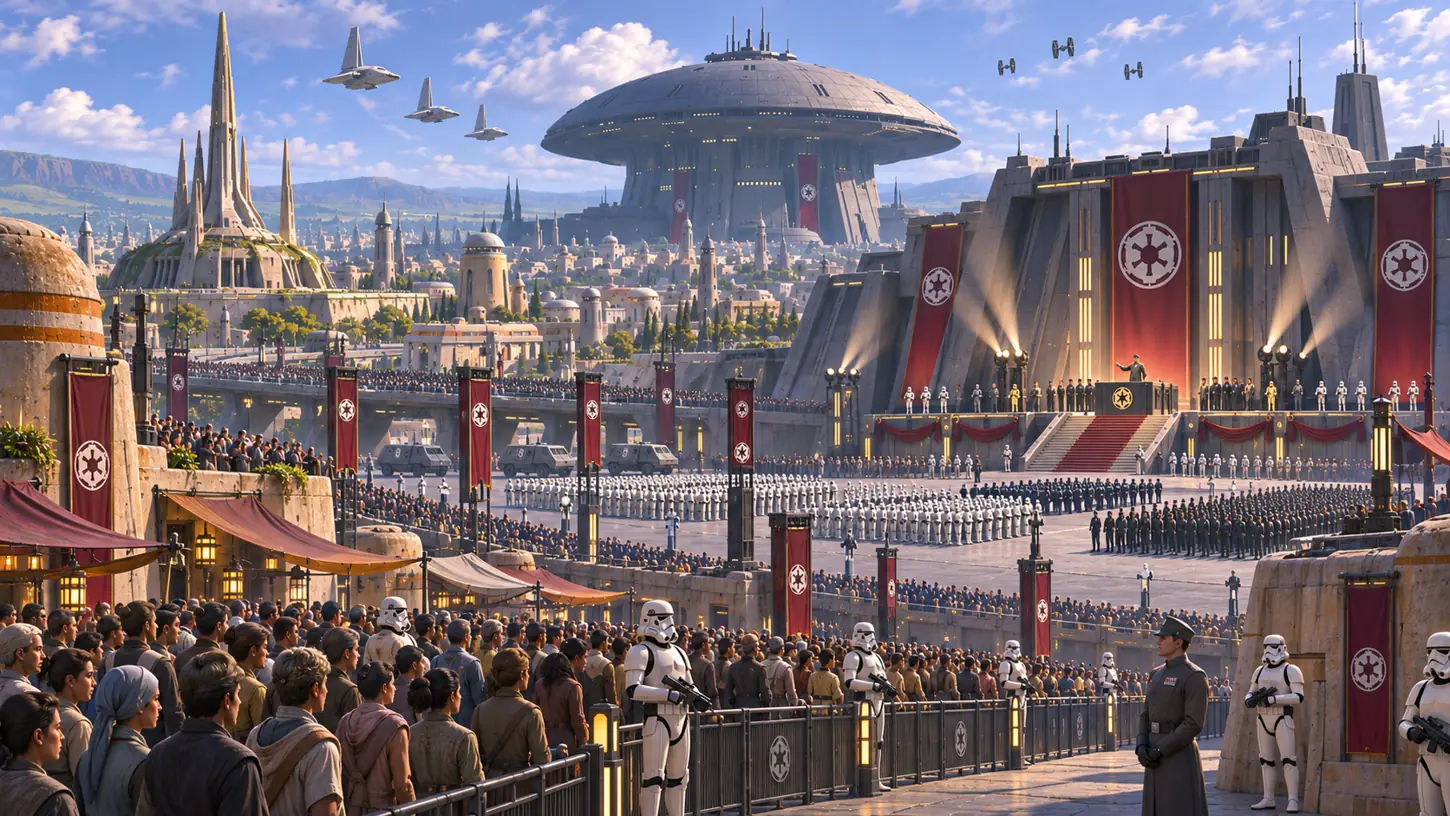
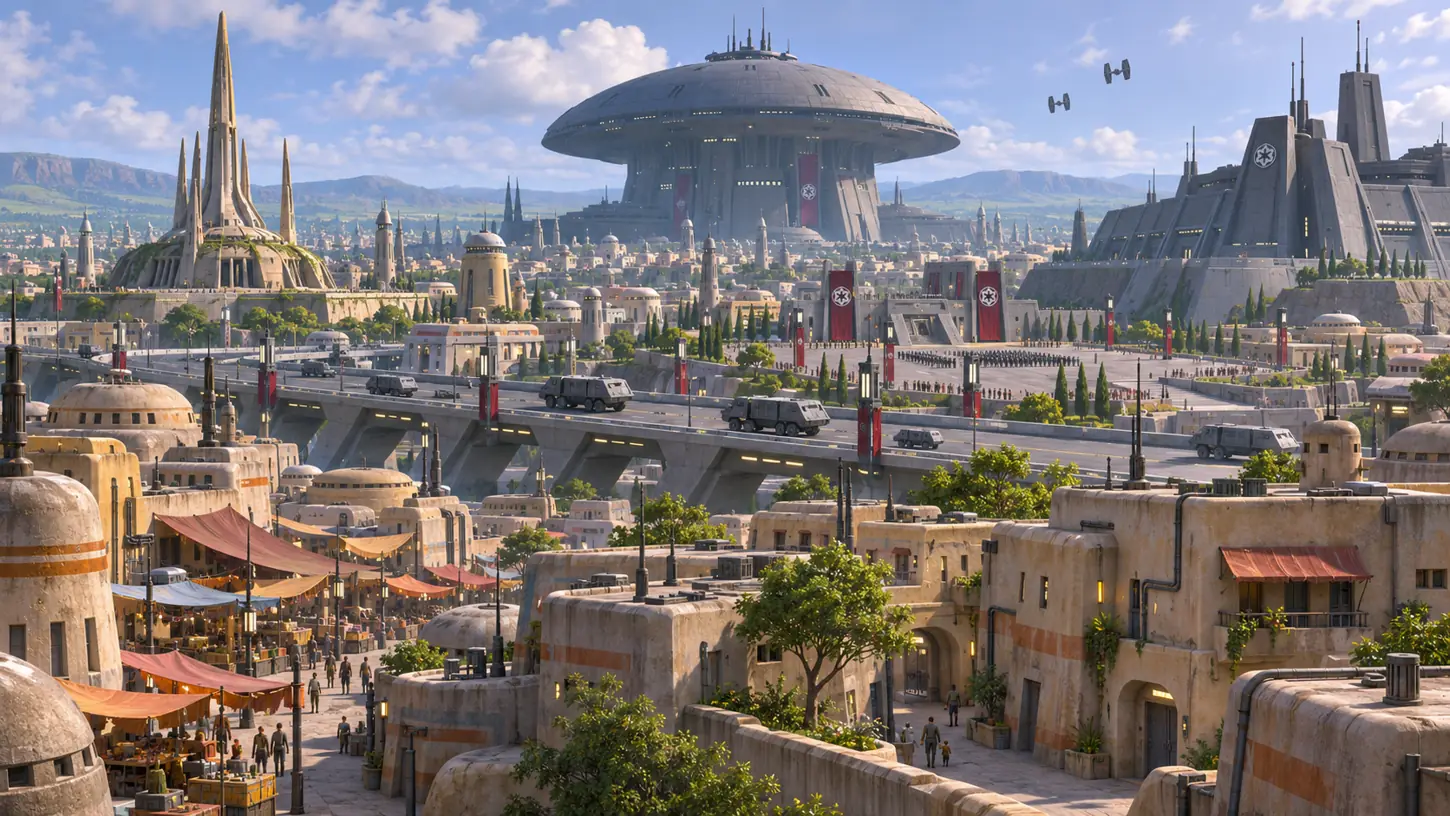
Original cinematic reconstruction inspired by documented places and events. Click a visible feature to investigate it. Layout and architectural details that are not confirmed by Canon remain interpretive.
Documented setting
Empire Day celebrations on Lothal included organized public displays of loyalty to the Emperor. The Ghost crew used the occasion to challenge Imperial messaging. This is an event-focused exploration, not a fabricated permanent parade plaza.
Complementary scenes
Explore related environments
These original reconstructions give historical and social context without reproducing the hero or claiming the pictured locations share exact coordinates.
Public ceremony took place in the wider occupied city. Original interpretive illustration, not a surveyed map.
City investigation / four evidence stations
Investigate Empire Day in Capital City
Each station examines a different aspect of this documented destination.
Selected investigation
Public assembly
Empire Day brought citizens into a visible celebration. Gathering together does not establish that every participant supported the regime; the episode depicts a staged public performance under occupation.
The anniversary of the Empire's founding became an occasion to perform official loyalty. Citizens assembled amid public propaganda and military celebration, making the political regime visible in ordinary urban space. The events could shape expectations about acceptable speech and participation even for residents whose personal opinions were different.
The sabotage
Kanan's rebel cell disrupted the celebration, turning the carefully staged demonstration of Imperial power into an occasion of public embarrassment. That disruption matters because it challenged the image of universal consent, not merely because it damaged equipment. A city event can be a useful interactive destination without inventing the architectural name or boundaries of a permanent 'Empire Day Plaza.'
What cannot be mapped
An event shown in a television episode is not automatically a named building. The cinematic panorama is a contextual interpretation. The visitor can explore the ceremony, propaganda and disruption as distinct narratives, but the interface does not label an arbitrary street corner as a precise, surveyed event site.
Verified place names and incidents are identified in official Star Wars sources. Landscape imagery is artistic interpretation, not an overhead survey or proof of where an unseen landmark stands. Scene changes show broad historical context; unknown later conditions are not filled in as fact.