Biography and command
Leema Kai has a limited confirmed biography. The source record supports a detailed mission account, not an invented childhood or portrait.
STORYCanon
APPEARANCEVoice-only
CAMPAIGNResurrection
The officer whose voice carries across Athulla
Leema Kai is a Jinata Security officer who commands a ship and its escorts in Star Wars Battlefront II: Resurrection. He does not appear as a visible person in the playable story. His orders and threats reach the protagonists over communications as they approach Athulla, where families have disappeared. This narrow but important appearance gives the character a practical role without establishing a detailed childhood, birthplace, species or facial appearance.
By the time Iden Versio, her daughter Zay and their ally Shriv Suurgav arrive, the Jinata system has fallen under the control of a nominal security organization that cooperates with the First Order. Leema's presence is evidence of its naval reach. Instead of appearing as an isolated smuggler, he commands other pilots, capital-ship personnel and transports in a coordinated armed response. His role is operational. Protectorate Gleb remains the organization's political leader.
The game reveals his character through coercive behavior. Kai tries to force the arriving ship into submission and suppresses contact from a local witness. The intercepted message concerns families abducted from Athulla. That context matters more than the officer's sarcastic remarks or the appearance of his starfighters: the blockade helps hide a campaign that removes people from their communities.
Jinata Security, Gleb and the First Order
Jinata Security, abbreviated J-Sec, controls territory that includes Vardos and Athulla. It retains Imperial-derived material culture and uses ships and personnel to enforce decisions across the system. Gleb commands it and has established a working arrangement with the First Order. Kai operates within that hierarchy. The story does not establish him as an independent galactic admiral or commander of First Order fleets.
Project Resurrection is the central reason for the force's secrecy. The First Order acquires abducted children and seeks to train them for military service. Jinata Security supplies local access and coercive capacity, including the ability to intercept ships and hide families' movements. Kai's role in this chain becomes clear when the Athulla encounter exposes his involvement in transporting abductees for Gleb.
A careful account should not describe the abductions as voluntary enlistment. The victims are removed through force. Nor does the story assign every First Order strategic decision to Kai personally. He is a commander within one operational part of a larger arrangement. His decisions have real consequences even though his superior officer and the First Order govern the broader project.
The later Imperial visual style of Jinata Security does not prove that Kai previously served the Empire. The crew and equipment may be connected to old Imperial military stock, but no established biographical source confirms his earlier military record. IDS records what the episode demonstrates and avoids using organizational aesthetics as a substitute for a documented personal past.
The Opportunity and the blockade around Athulla
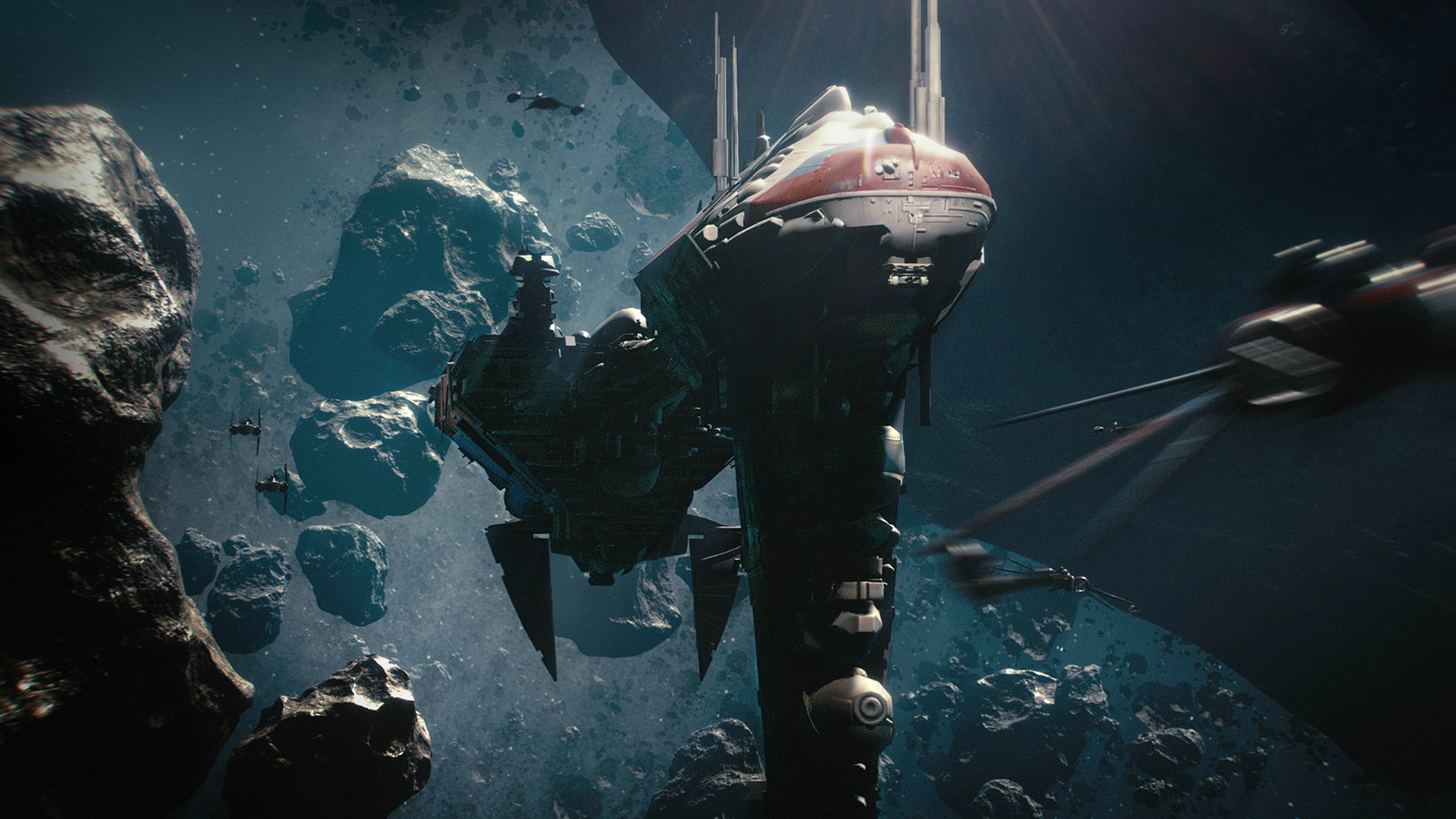
Kai's flagship is the Opportunity, a modified Nebulon-B escort frigate. It operates among asteroids near Athulla with fighters and armored transports. A ship of this size requires engineering, navigation, command and weapons crews. Its importance is not simply a greater number of hit points on a game screen: the vessel allows a private security force to exert armed authority over an approach to an inhabited planet.
When the Corvus arrives, a local Athullan attempts to relay information about missing families. That communication is interrupted as Jinata Security vessels move against Iden and her companions. The encounter joins information control to military force. The organization is not just attacking a suspicious craft; it is preventing outsiders from evaluating allegations against the security service itself.
Iden and Zay take X-wings into the battle while Shriv coordinates aboard the Corvus. The player is tasked with neutralizing fighters and transports, disabling the Opportunity's engines and confronting Kai. The mission makes the relationship between command and mobility visible. Without transport escorts and functioning engines, the frigate loses its capacity to carry out the same operation in the asteroid field.
Once the escorts are defeated, Kai leaves the frigate in his modified Naboo N-1 starfighter. The choice turns a capital-ship confrontation into a final single-pilot dogfight. His personal vehicle can deploy dangerous ordnance. He remains an antagonist conveyed through voice and spacecraft rather than through a human-sized character model.
Flight encounter: supported mission tactics
The original game's Resurrection campaign gives Iden an X-wing with a repair ability and an Ion Pulse. The latter disrupts nearby electronic systems and can be used against threats such as Kai's ordnance. These are mission mechanics, not intrinsic powers that belong to Kai or a permanent player-character skill tree.
The encounter is straightforward in its objective sequence but can become difficult if the player remains too close to the frigate's weapons and overlapping escorts. Clearing fighters, disabling transports and then attacking the Opportunity's engines reduces the number of active targets. A player who sees incoming ordnance should react to the displayed warning and consider using Ion Pulse or increasing distance if that ability is unavailable.
Kai's later starfighter phase requires tracking a smaller and more mobile target. Recovering shields and hull integrity with the repair ability, maintaining space from high-damage charges and keeping the target within the firing arc are sensible mission-specific tactics. These directions do not claim a precise health value, damage calculation or cooldown duration not established by the available material.
Defeating Kai is a fixed part of the campaign. It does not open a branch in which the player may recruit him, spare him for a later quest or choose to place him in charge of Jinata Security. The historical outcome of this fiction is distinct from whatever strategies a player uses to complete the same combat objective.
Defeat, surrender and the discovery of the larger scheme
Iden destroys Kai's modified N-1 in the battle over Athulla, killing him. The Opportunity remains, but his death and the loss of the escorts leave its crew exposed. Zay persuades the surviving Jinata forces to surrender by threatening fire from the Corvus. The mission depicts this as a bluff, since the Corvus lacks the weapon capacity the crew fears. It succeeds because the remaining officers cannot confidently assess the danger.
The surrender becomes an intelligence breakthrough rather than merely another defeated enemy wave. The remaining Jinata personnel supply information connecting the disappearances to Gleb and the main headquarters on Vardos. The protagonists can then move the investigation away from Athulla and toward the institution's leadership.
This sequence distinguishes the fate of a particular commander from the continued existence of a coercive network. Killing Kai ends his command of the Opportunity. It does not independently end the First Order's plans or the organization that helped carry them out. The investigation must move through records, surviving personnel and known facilities before those broader responsibilities become visible.
In the following campaign events, Iden and Shriv return to Vardos and discover that Hask has already killed Gleb. Jinata Security and its former First Order allies subsequently come into conflict. Kai does not participate in that later struggle. Any dossier that presents him in the Vardos battle after the Athulla dogfight would confuse chronology.
A character whose body is absent from the screen
Because Kai is voice-only, artists and researchers lack an official facial portrait from this particular game appearance. The opportunity to invent a uniformed commander may be tempting, but an unmarked illustration would mislead visitors into thinking that Lucasfilm or EA supplied an approved likeness. IDS therefore uses contextual space-battle imagery and explicitly labels it as a mission visual, not a portrait of Kai.
The Star Wars: X-Wing Second Edition Fugitives and Collaborators Squadron Pack supplies another material trace. Atomic Mass Games lists a Leema Kai pilot card for a BTL-A4 Y-wing, as well as Jinata Security Officer cards and a Protectorate Gleb upgrade. This establishes licensed tabletop representation. It does not mean that Kai visibly pilots a Y-wing during the game's Athulla mission: that scene centers on the modified N-1.
The distinction is significant when writing about video games. A playable tabletop card, a recorded voice, an on-screen ship, fan reference material and a published historical source are different forms of evidence. None can automatically be treated as a full photograph of the fictional person. A good character file helps readers distinguish those representations.
Kai is a useful example of how subordinate officials can be important even without lengthy personal backstories. He commands ships, participates in an abduction operation and attempts to stop investigators. The campaign gives enough to analyze delegated authority, coercive capacity and the limits of an intermediary officer. It does not establish private motives, a birth year, or a documented origin story.