
The Golden Age of the Sith was not an age of peace. It was an era when the original Sith Empire had accumulated territory, wealth, ritual knowledge, and formidable military power, while much of the Republic regarded the Sith as a distant legend. In the accounts of Star Wars Legends, the empire's isolation allowed generations of Sith Lords to develop their own political and religious traditions. The Empire looked secure under Marka Ragnos. Its weaknesses became obvious when he died. Rival Lords struggled over succession, two lost hyperspace explorers appeared on the edge of Sith space, and Naga Sadow turned an unexpected first contact into a war.
The central contradiction
How can a powerful empire be so vulnerable?
Its rulers built a formidable civilization around individual domination, secret knowledge, military followers, and personal prestige. That made the empire dangerous to its neighbors, but it also made a stable transfer of power difficult. The death of one long-reigning ruler threatened the relationships that kept competing Sith Lords inside one political system.
Its geography sharpened the problem. The Sith homeland was remote and partially protected by difficult hyperspace routes, preserving an independent center of power while limiting knowledge about the Republic. When navigation finally connected the two political worlds, elites on both sides misunderstood what they faced.


Before the golden age: exile, conquest, and the meaning of Sith
In the expanded history of Legends, the word Sith originally refers to a people and their cultures as well as to the later dark-side tradition. The indigenous Sith species possessed languages, kinship systems, ritual specialists, rulers, warfare traditions, and knowledge of the dark side before the surviving Dark Jedi arrived from Republic space. Equating all members of the species with the subsequent imperial ideology obscures that earlier history.
The Hundred-Year Darkness ended in the defeat of a faction of Dark Jedi. Around 6,900 BBY, exiles led by Ajunta Pall reached Sith territory and seized positions of power among the local population. They appropriated older practices, subordinated existing authorities, and established the ruling tradition subsequently remembered as the Dark Lords of the Sith. In later Legends accounts, intermarriage and the fusion of ruling lineages joined the newcomers' Jedi-derived Force techniques with indigenous Sith knowledge.
That process created a new political formation. It was not simply a distant branch of the Jedi Order and not merely a continuation of the earlier Sith kingdoms. The exiles brought a distinct military and ideological history, while local Sith populations provided the territorial, social, and ritual foundation of the emergent empire. Subsequent accounts sometimes present the takeover as a destiny for the species. An anthropological reading instead identifies the conquest, changed hierarchy, and selective preservation of local tradition.
Ajunta Pall's place as an early Dark Lord matters because it shows that the title once belonged to an imperial system rather than the later secret master-apprentice line. Names such as Karness Muur, Sorzus Syn, and other Exiles appear in broader Legends sources, but not every later account agrees on every aspect of their roles. The essential point for this era is the creation of a political elite whose claims to authority combined Force ability, conquest, inherited status, and control over the past.
Two meanings of Sith
Sith people: the historically distinct indigenous societies of Sith space.
Sith Lords: an institution and succession tradition built by Dark Jedi conquerors and their successors.
These meanings overlap across generations, but they are not interchangeable. A political elite can claim to embody a people's heritage without representing every member of that people.
Korriban, Ziost, and an empire hidden behind the stars
Korriban became a primary center of Sith memory, burial, and sacred authority. Tomb complexes and dynastic monuments treated dead rulers as political ancestors whose prestige could still influence the living. The Valley of the Dark Lords was more than scenery for dark-side mysticism. Its monuments helped make claims of succession visible: a new ruler entered a landscape already occupied by the dead rulers against whom that claim would be judged.
Ziost functioned as a major political center associated with the ruling Sith Empire. Other worlds in Sith space supported its military, economic, and ceremonial system. The remote Stygian Caldera and difficult navigation around Sith territory help explain why the Empire and the Republic could develop without sustained direct contact. The isolation was not absolute, but ordinary movement and communication did not connect the two states in the way later generations might assume.
The result was an uneven political map. From Sith space, Republic civilization was a distant possible rival; from Republic space, the Sith could be dismissed as legend. When a new navigational route became available, rulers interpreted contact through their existing fears and ambitions. Geography did not create the conflict by itself. It set the conditions under which a single voyage could suddenly matter so much.
Interactive lore file 01 · Chronology
Open the Sith historical record
Choose a turning point. The period labels are approximate where Legends sources treat entire political processes as a single date.
Dark Jedi exiles establish a new ruling order
Survivors of a schism within the Jedi reach Sith space, seize political authority, and combine their inherited Force practices with existing Sith traditions. The category “Sith Lord” begins to carry an imperial meaning distinct from its older ethnic one.
IDS inquiry: conquest and cultural incorporationThe fabric of the Sith Empire: rulers, soldiers, workers, and sacred knowledge
The Empire's high politics revolved around a Dark Lord of the Sith and other powerful Sith Lords with followers, fleets, estates, specialists, and local bases of support. The existence of a supreme ruler did not eliminate competing power centers. Each aristocrat's military resources could help defend the empire or support a bid for the throne. A victorious rival might change the balance of court politics without dismantling the broader unequal system.
The Sith did not rely solely on personal Force duels. Large-scale warfare required ships, weapons, supply, organized troops, communication, and labor. In Legends, Massassi warriors and other subordinated groups formed part of the imperial order. The depiction of these populations varies among stories. It would be inaccurate to assume every Sith inhabitant performed the same role or possessed identical privileges. Force ability and noble status were not evenly shared.
Ritual specialists and sorcerers had a second form of power: the ability to interpret inherited knowledge. Sith magic, alchemy, protective devices, amulets, weapons, tombs, and architectural settings linked political rule to the dark side of the Force. The material object mattered because access to it could be controlled. Knowledge located in a temple archive or private stronghold was not equally accessible to all subjects.
In this context, monumental art and burial sites were not simply celebrations of the dead. They were statements about who belonged at the top of society, whose violence deserved remembrance, and whose labor was excluded from the official story. A ruler's tomb made prestige visible for centuries; the identities of ordinary workers who built and supplied such places often disappeared from the narrative.
The term Golden Age must therefore be treated as a politically situated description. Sith Lords could describe their civilization as rich and powerful while overlooking those compelled to sustain it. A durable elite political order should not be mistaken for a harmonious society.
Interactive lore file 02 · Sith society
Inspect six sources of imperial power
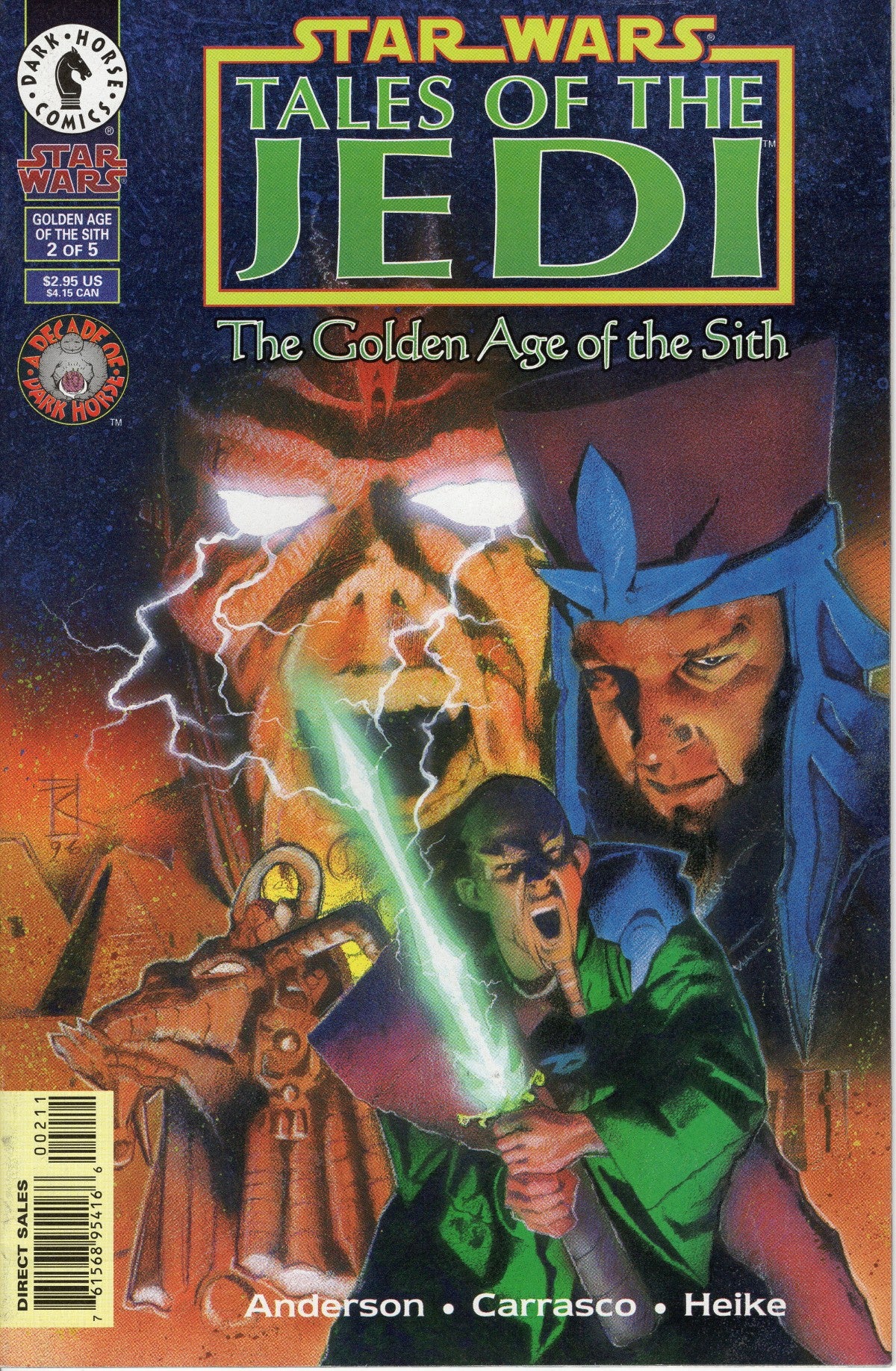
Switch between institutions and ask what kept the Sith Empire functioning between wars. The images reproduce genuine published comic covers; the interpretations are IDS analysis.
The Dark Lord holds together rival powers
Under a formidable ruler, Sith Lords can compete while still recognizing a supreme authority. Stability rests on more than ideology: the ruler must deter open rebellion and preserve a distribution of benefits that elites will tolerate.
Question: Does a state remain stable when succession depends on individual prestige?Marka Ragnos: the ruler whose death changed everything
Marka Ragnos stands at the center of the Golden Age narrative. Later Sith remember his reign as an era of imperial wealth and formidable authority. He is neither the founder of the Sith people nor the first Sith Lord. His significance lies in the way he held the aristocracy together. His long dominance postponed a confrontation among powerful aspirants who were prepared to use force against one another.
At his funeral on Korriban, two competitors embody different responses to the world beyond Sith space. Ludo Kressh favors protecting and consolidating existing Sith power. Naga Sadow sees renewed expansion and conquest as the path to greatness. Both seek legitimate succession, and both possess adherents. The struggle is not reducible to a philosophical debate: whoever takes the title can mobilize resources, appoint loyalists, and control the empire's outward policy.
Ragnos's spirit appears to admonish the rivals against destroying what they have inherited. The scene presents the dead emperor as a source of authority even after his body has been entombed. In the narrative, ancestral legitimacy does not settle the dispute. The living must still decide what to do with a political order built around an irreplaceable ruler.
Two generations of Sith power are visible in that moment. The older system claims continuity through a powerful predecessor. The emerging conflict treats political survival as dependent on the competing ambitions of his heirs. The very rituals meant to display unity become the stage for division.

Gav and Jori Daragon: two explorers between empires
Meanwhile, the Republic side of the story begins with two young hyperspace navigators, Gav and Jori Daragon. Their lives are shaped by the risks of exploration and debts associated with their vessel, the Starbreaker 12. Their story is not a tale of diplomats arriving with formal instructions. They are civilians seeking opportunity in a galaxy where profitable navigation can change a person's prospects.
When the Daragons make an unexpected journey into Sith space, they encounter a civilization that Republic society barely knows. Their arrival causes alarm because it demonstrates that an outside power can reach a territory long protected by distance and the difficulty of hyperspace travel. The same information also gives the Sith something they previously lacked: a potential route toward the Republic.
The twins are captured and drawn into the struggle over succession. For Ludo Kressh and his faction, the arrival of strangers represents danger. For Naga Sadow, it creates an opportunity to transform fear into an expansionist political program. Sadow's apparent concern for the newcomers conceals calculated manipulation. Gav is gradually pulled toward Sith teaching and power, while Jori seeks a way home.
Their diverging experiences are essential to the narrative. The characters begin as siblings pursuing a common future; contact with imperial institutions assigns them different roles. One becomes valuable as a possible apprentice and instrument of conquest, while the other becomes a messenger whose attempted warning may fail to persuade others. Their story demonstrates how rulers can turn people into political resources without those people controlling the larger struggle.
Naga Sadow and Ludo Kressh: succession becomes a security emergency
Sadow does not simply declare that the Sith should invade the Republic. He uses the strangers' arrival to make the prospect of outside danger politically useful. The factional dispute intensifies, including a deadly act of deception directed at his own side. In the comics' succession plot, the death of the ancient Sith Lord Simus is used to intensify hostility around the captive explorers and to help Sadow consolidate his claim to lead.
Sadow cultivates a public image of defending Sith prestige while arranging events that serve his campaign. His strategy converts a diplomatic unknown into a justification for war. The difference between a genuine external attack and one staged or exploited by an ambitious ruler becomes politically decisive. If the court believes itself besieged, dissent can be portrayed as weakness or betrayal.
Kressh resists Sadow's reckless outward expansion, but his opposition does not make him a democratic alternative. He remains a member of the same elite political order. The dispute concerns the disposition of imperial power: preserve what already exists, or risk a wider war for a larger dominion. No faction is shown constructing an equal political system for the Empire's subjects.
As Sadow gains the upper hand, he acquires both the means and the mandate to assemble forces for an invasion. The story's political tragedy is that control of the succession gives him power over the entire society's future, including the people who did not choose his strategy.
Interactive lore file 03 · Decision simulation
Take a seat on the Sith council
Three decisions confront a counselor during the crisis. Choose a response to reveal its political consequences, then continue. This is an analytical simulation, not a claim that the comics offer alternate endings.
FILE 01 / 03 · UNKNOWN CONTACT
Two unknown hyperspace explorers are brought before the court. What should be done first?
Analysis
Confidential council assessment · Complete
Your strategy: awaiting evaluation
Your three decisions, analyzed
The weakness in your strategy
Compared with what actually happened
Source context: The Golden Age of the Sith #1–5 and The Fall of the Sith Empire #1–5. This analysis evaluates fictional political choices. It does not change established Legends events or assign a personality diagnosis.
The Great Hyperspace War: when the maps collided
The war around 5,000 BBY emerges from the political crisis of the Golden Age. With access to hyperspace knowledge brought through the Daragon encounter, Sadow attempts to extend Sith power into Republic space. His forces strike Republic worlds, notably the Koros system governed by Empress Teta, while the Jedi and Republic must respond to an enemy they have scarcely understood. The war is depicted in the sequel series The Fall of the Sith Empire; the original Golden Age series is its crucial prelude.
The Republic is not a single passive victim in the broader story. Empress Teta has already been consolidating political authority in the Koros system, and Jedi figures such as Odan-Urr, his master Ooroo, and other defenders become part of the struggle. The political history of the Koros worlds matters because Teta's recent unification campaign has created both the institutions and tensions through which the invasion is experienced.
Sadow's military power includes illusions and amplified dark-side techniques that can make attacking forces appear far larger and more formidable than the underlying reality. The distinction matters. Perception can overwhelm a defender before every ship or soldier has arrived. But a strategy dependent on coordination, deception, and an extraordinary commander's concentration is vulnerable when communication and confidence collapse.
Gav Daragon's involvement sharpens that vulnerability. Sadow's recruitment of an explorer does not create durable loyalty. Gav ultimately comes to recognize the violence he has helped enable. Jori, on the Republic side, works to communicate the threat. Their separated stories trace the transmission of information between societies that had remained unfamiliar to one another.
The conflict extends across multiple theaters in Legends, including fighting connected to Koros Major, Coruscant, and Sith territory. Not every battle is portrayed in the initial comic arc, and individual accounts differ in how much detail they supply. The central result is clear: the campaign fails, Sadow's political project collapses, and Republic/Jedi forces overcome the invasion.
The end of the Golden Age and the survival of its ideas
Military defeat destroys the old empire's claims to stability. In Legends, Naga Sadow withdraws and eventually goes into hiding on Yavin 4. The surviving Sith tradition does not disappear completely. Fragments of knowledge, ritual objects, tombs, abandoned military sites, and the memory of rulers persist in different locations and are revisited by later dark-side practitioners.
Nearly a millennium later, the stories of Freedon Nadd and Exar Kun show how material traces of earlier Sith power can affect a new age. That later resurgence is not a direct continuation of the Golden Age court. It involves different circumstances, leaders, and institutions. The connection is the survival and reinterpretation of a tradition after its original political structure is destroyed.
Other Sith empires in Legends, including the later imperial system associated with Vitiate, have their own trajectories. Treating them as one uninterrupted government erases important differences. “Sith Empire” is a recurring type of political formation in the franchise, not always the name of the same state.
The original Golden Age ruling order, its central legitimacy, and the invasion project led by Sadow. Succession and war exposed the limits of elite solidarity.
Stories of the Dark Lords, knowledge preserved in ruins and artifacts, later interpretations of Sith power, and new efforts to claim an ancient inheritance.
Anthropology of the Golden Age: five questions that change the story
Who gets called a ruler? The comics foreground powerful Lords and the decisions they make, but the Empire's survival required administrators, laborers, troops, specialists, and inhabitants far removed from Korriban's court. Asking about these groups changes the unit of analysis from a ruler's career to a society.
Who can claim the ancestors? The funeral of Marka Ragnos makes the dead politically active. His image and spirit provide a vocabulary of continuity. Rival claimants can appeal to that continuity while advocating contradictory policies. Ancestral prestige helps legitimate claims, but it does not settle competition by itself.
What does an empire know about outsiders? Isolation shaped both Sith ambition and Republic assumptions. The Daragon encounter shows that navigation routes are forms of social knowledge. To know how to reach another society is to acquire commercial, diplomatic, or military options. Access to routes can be as consequential as access to weapons.
What does conquest do to identities? The historical formation of the Empire involved the transformation of the indigenous Sith people into subjects of new rulers. Later retellings tend to center Dark Jedi and royal genealogies. Distinguishing ethnic identity from the elite religious-political institution avoids reducing an entire people to the values of its conquerors.
Who benefits from remembering an era as golden? Political memory is selective. A powerful court can celebrate its temples and victories while obscuring coercion and inequality. Calling this era a Golden Age is meaningful evidence of a claim to imperial greatness, but it is not an independent evaluation of life throughout Sith territory.
Research questions
What the comics show, and what they leave open
Ragnos's lifetime prestige restrained rivals. The comics do not supply a comprehensive constitutional procedure for every transfer of the Dark Lord's title.
They foreground aristocrats, Force adepts, explorers, and war. They offer much less information about ordinary families, workers, and noncombatants.
Not automatically. Canon references to ancient Sith objects or names do not establish every event in the Legends comics.
Interactive lore file 04 · Archive challenge
Test your Sith historical judgment
Each question includes an explanation. The goal is to identify historical evidence and continuity, not to memorize names without context.
1. Who were the Sith before the Dark Jedi exiles arrived?
2. Which event exposed the court's major succession crisis?
3. Why did the Starbreaker 12 matter so much?
4. Which comic arc depicts the military aftermath of the Golden Age prelude?
Answer all four to complete the archive challenge.
Historical archive · Assessment complete
Your corrections
Continue the investigation
Review the original comic references → · Revisit Sith origins → · Revisit the succession crisis →
Reading order: follow the evidence, not just the dates
Begin with the six installments numbered #0–5 of The Golden Age of the Sith. The opening installment supplies broader Koros and Daragon background. The following issues move through the funeral of Marka Ragnos, the Sith succession crisis, the twins' captivity, and the political turn toward invasion. Continue with The Fall of the Sith Empire #1–5 to follow the ensuing Great Hyperspace War and the disintegration of Sadow's ambitions. The two comic arcs are connected but distinct works.
Published initially by Dark Horse, the comics are now catalogued by Marvel and have been reprinted in several collected Legends editions. Comic publication dates belong to the 1990s; the in-universe events are set approximately five thousand years before the Battle of Yavin. That distinction matters when using the works as evidence.
Primary source trail · Legends
References and evidence
The original comic issues are primary evidence for the events of this dossier. Publisher descriptions and archives verify dates, credits, and the relationship between the two stories. Later reference texts provide context, not license to import every retelling into canon.
- Primary comic · Dark Horse / Marvel archiveStar Wars: Tales of the Jedi – The Golden Age of the Sith #0 (1996). The Koros context and opening of the Daragon story.
- Primary comicThe Golden Age of the Sith #1 (1996). The explorers' journey and the developing contact story.
- Primary comicThe Golden Age of the Sith #2 (1996). Marka Ragnos, rival claimants, and the captured Daragons.
- Primary comicThe Golden Age of the Sith #3 (1996). Escalating court conflict and Sadow's deception.
- Primary comicThe Golden Age of the Sith #4 (1997). Gav and Jori's divided paths and Sadow's instruction.
- Primary comicThe Golden Age of the Sith #5 (1997). Conclusion of the prelude.
- Primary sequelTales of the Jedi – The Fall of the Sith Empire #1–5 (1997). The Great Hyperspace War and imperial defeat.
- Publisher backgroundMarvel, “Star Wars Spotlight: Tales of the Jedi”. Relationship between the Old Republic arcs.
- Publisher archiveDark Horse Comics, Star Wars graphic novel chronology. Original publication-era sequence.
- Collected editionStar Wars Legends: Tales of the Jedi Omnibus (2024). Marvel's verified reprint contents include both the Golden Age and Fall of the Sith Empire arcs.
- Secondary continuity cross-checkWookieepedia, Sith Empire (Legends) and Great Hyperspace War (Legends). Used to cross-check names, broad chronology, and later expansions; not substitutes for the comics.
Editorial method: Narrative events and named characters are attributed to their Legends sources. The questions about ethnicity, state formation, labor, memory, and political classification are IDS anthropological interpretation, not Lucasfilm descriptions of fictional academic disciplines. The era's name is a source's perspective, not a value judgment about life under Sith rule. See IDS evidence standards.
Art credits: Original Tales of the Jedi: The Golden Age of the Sith comic cover art (Russell Walks on numbered issues, Christopher Moeller on issue #0, and Duncan Fegredo on the collected edition). The images are reproduced as historical references to the publications; artwork is owned by its respective rights holders. Imperial Dark Sector is an independent fan publication and is not affiliated with Lucasfilm, Disney, Dark Horse Comics, or Marvel.