GALAXY ATLAS / TATOOINE / 3 HISTORICAL CITY SCENES / 15 LOCATION FILES

Tatooine: cities across time

Choose an era and city, then select a landmark, workshop, street or institution. Every labeled landmark opens a researched dossier. Geographic positions are artistic approximations, not official city coordinates.

Mos Espa Anakin's city · markets and podracing
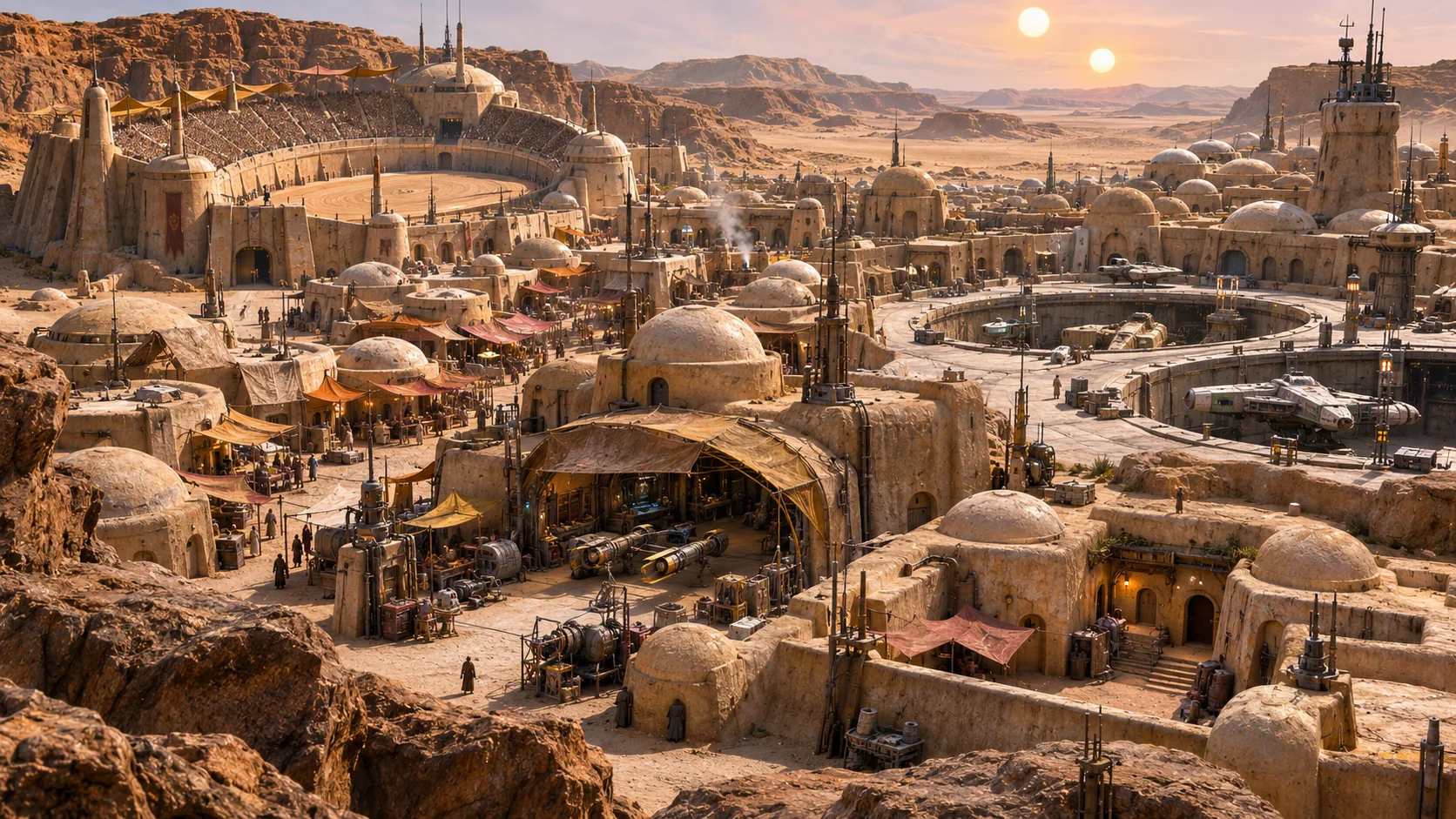
Original aerial artistic reconstruction of Mos Espa with its Grand Arena on the outskirts, crowded sandstone market and circular port basins.

SELECTED LANDMARK

Mos Espa Grand Arena

Podracing venue

The enormous Mos Espa Grand Arena stands on the edge of the settlement, not within a cramped market street. It hosts spectators from across Tatooine and visiting travelers drawn to the Boonta Eve Classic.

Open full location dossier ↗

6 locations in this view

The Grand Arena is documented on the city's outskirts. Named shops, houses and docking pits are approximate interpretive markers, not a surveyed map.

INTERACTIVE PLANET HISTORY / 4 SCENES

Tatooine through time

Change the period to update the historical panorama below, its context, and clickable subjects. Each view uses a distinct local illustration.

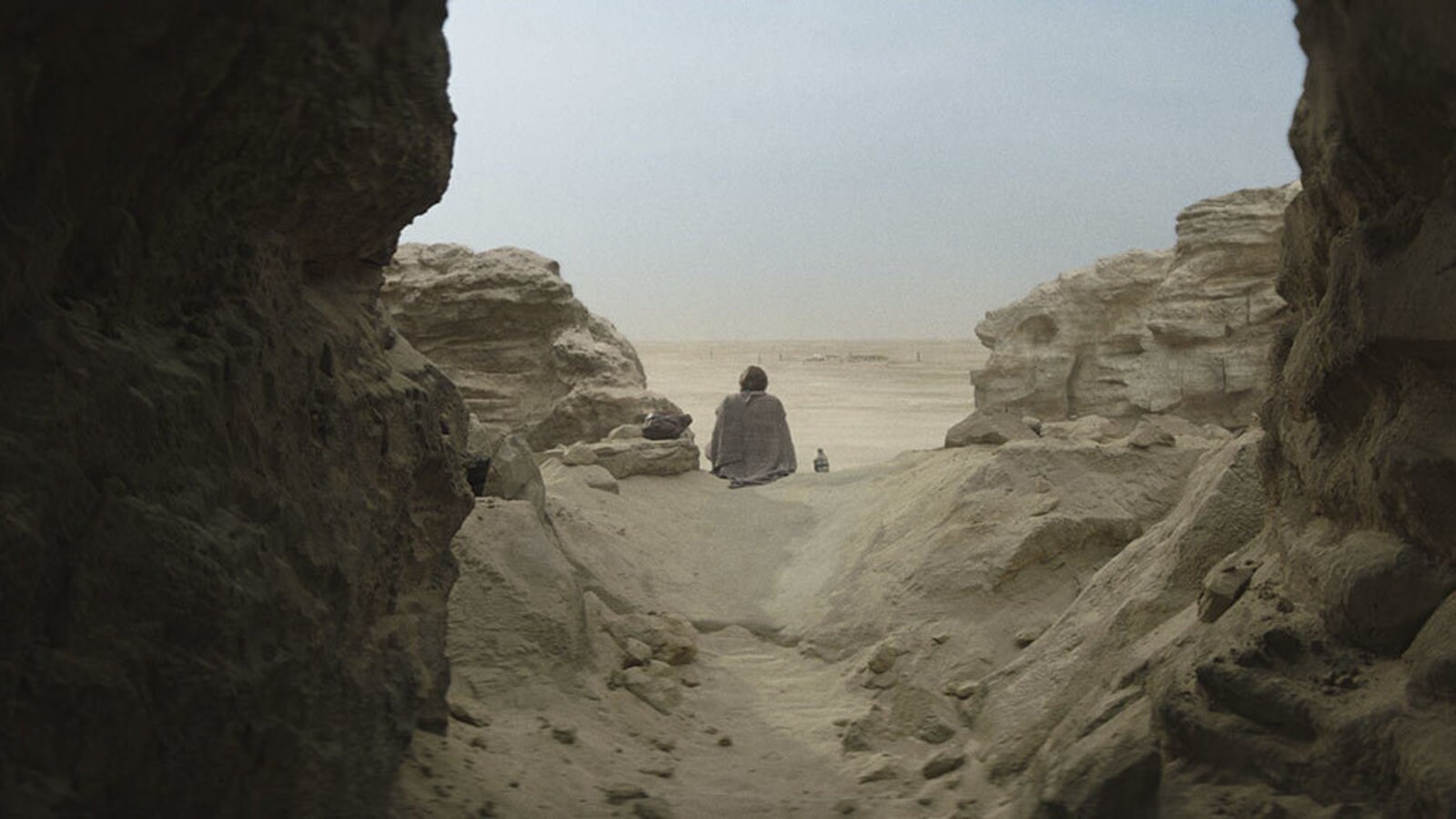
Original cinematic IDS desert-world illustration; this scene combines general Tatooine atmosphere and is not a measured map.

Original AI interpretive Tatooine landscape, not an official still. Official historical reference ↗

Across the recorded eras

A desert world across generations

Tatooine's deserts, towns, and moisture farms appear repeatedly across Star Wars history. Each era below changes the active landscape and the communities or institutions being explored.

Official Star Wars historical reference ↗
SELECTED SCENE SUBJECTThe desert world

A sparse Outer Rim planet under twin suns. Towns and outposts are separated by expanses of desert.

Open selected destination ↗

Original IDS artistic interpretations, not screenshots or surveyed maps. Pins are thematic scene annotations: a named subject may not be visible at the marker position. All images are distinct; contextual illustrations are not proof of a precise historical building layout.

01 / Orientation

Arrive on Tatooine

Under twin suns, Tatooine's desert landscape connects sharply different forms of life: port cities, dispersed households, mobile traders, and communities with long-standing relationships to the desert.

The official Databank documents moisture farming, the spaceports of Mos Eisley and Mos Espa, Tusken territories, and powerful Hutt influence in different periods. This local explorer separates those subjects so the world is not reduced to a list of Skywalker appearances.

Galactic region
Outer Rim
Grid reference
R-16
World type
Desert planet
Climate
Arid and hot
Major eras
Republic · Empire · New Republic

02 / Environment

Across the desert

Original cinematic AI interpretations informed by documented Star Wars settings. These are not official photographs, exact film stills, or verified maps.

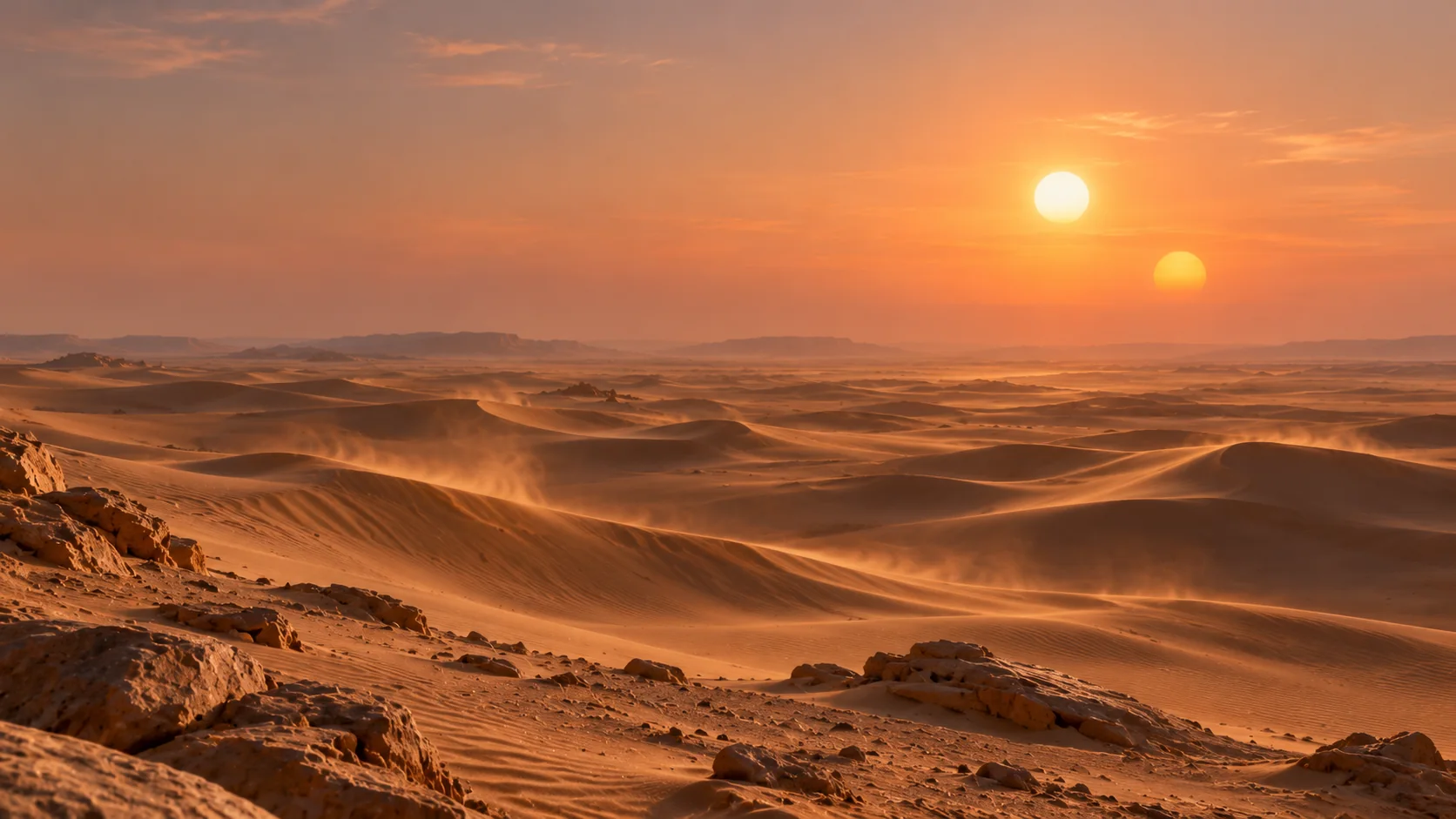
Hyper-realistic generated view of broad wind-sculpted dunes and hazy sandstone mesas on Tatooine.
Original AI environment interpretation · Not an official still

Open desert and long-distance routes

Dune Sea

The dune seas expose travelers to heat, scarce water, and shifting routes. Tusken communities understand this environment through histories of movement, territory, and survival that outsiders often overlook.

AI interpretation of Mos Espa's crowded sandstone buildings, commercial streets and spaceport towers.
Original AI environment interpretation · Not an official still

Markets, workshops, and Hutt-era power

Mos Espa

Domed buildings and crowded commercial spaces make Mos Espa a center of work, spectacle, and trade. During the Republic era, enslavement endured under Hutt political influence.

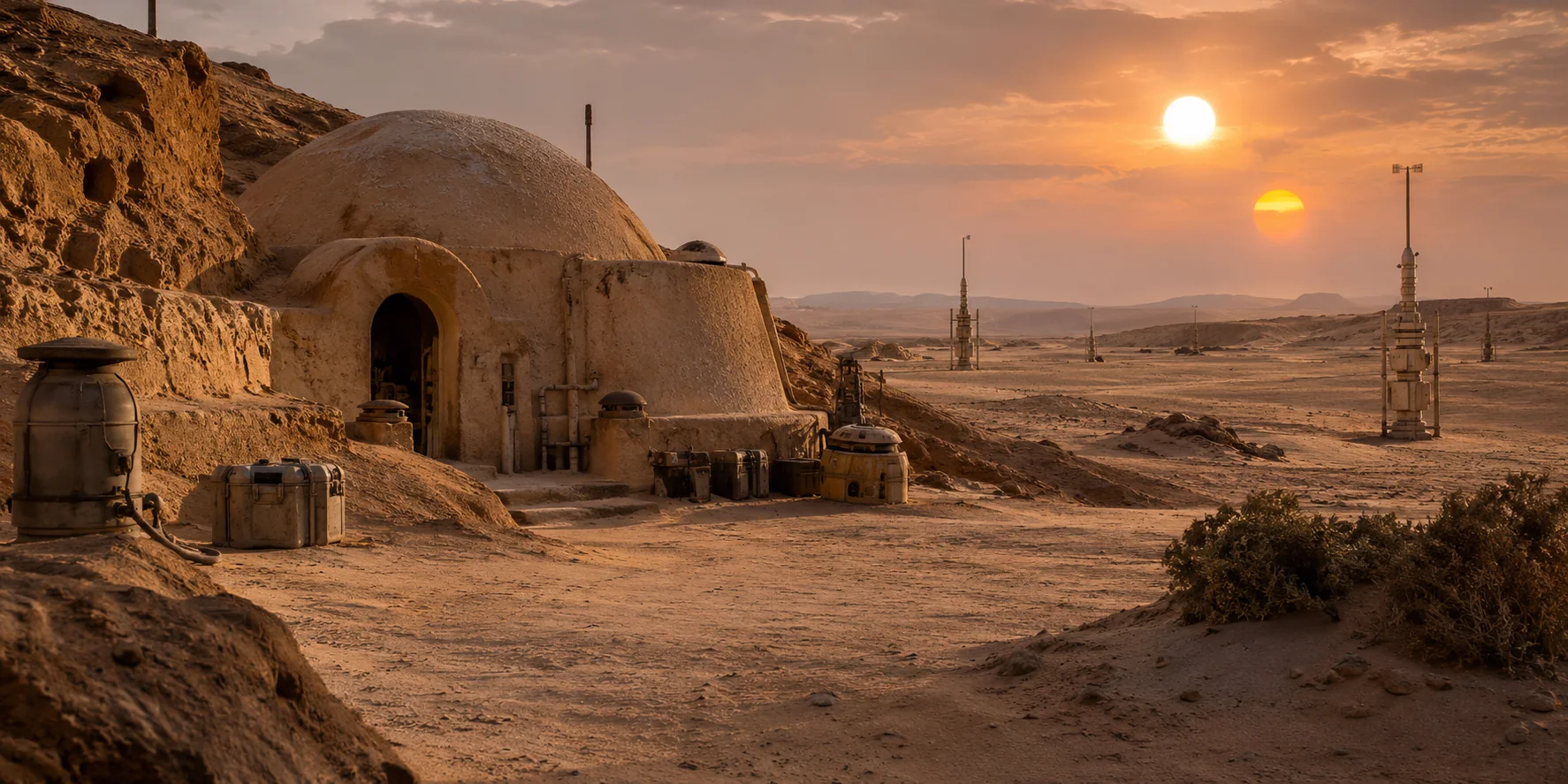
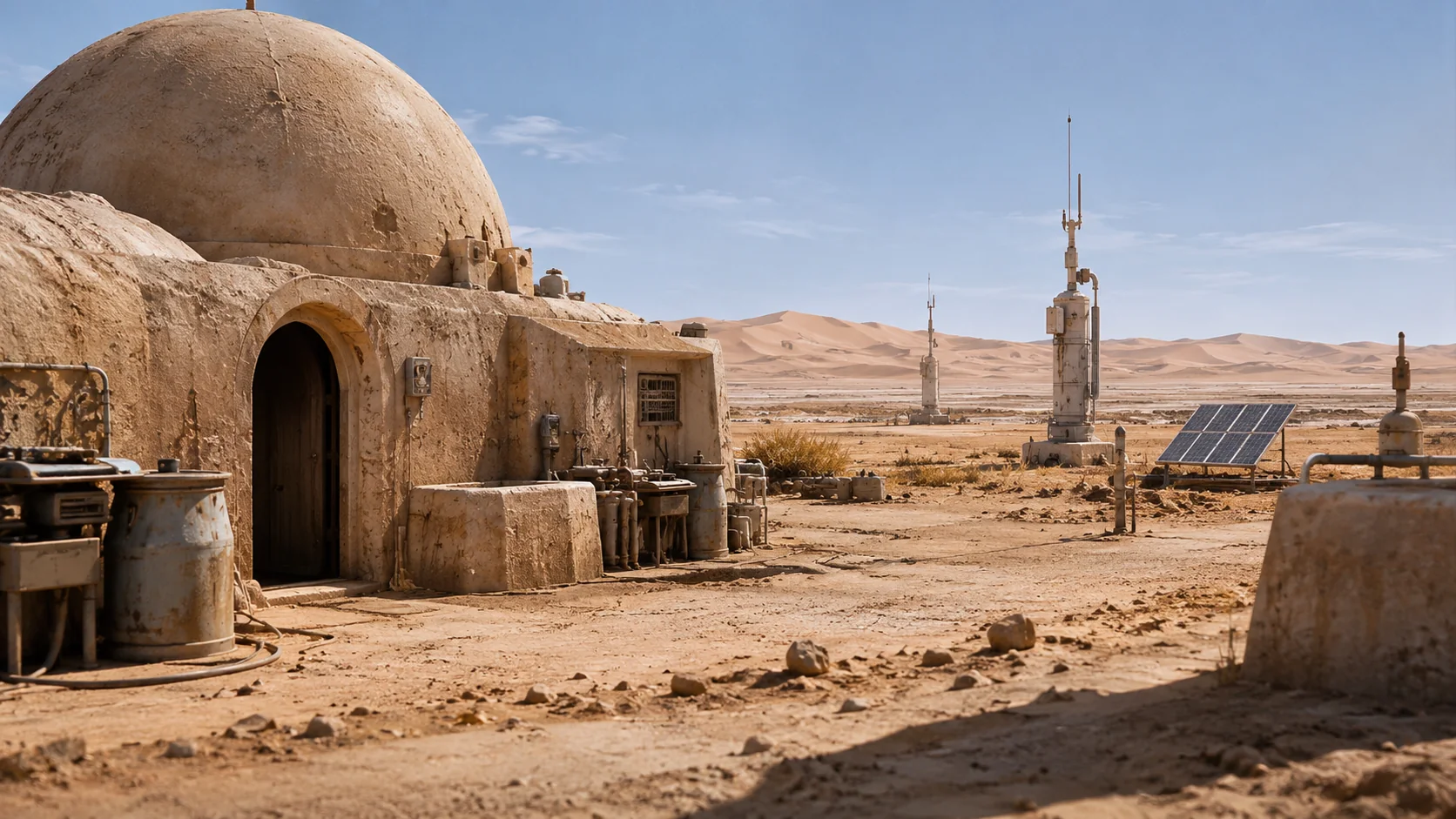
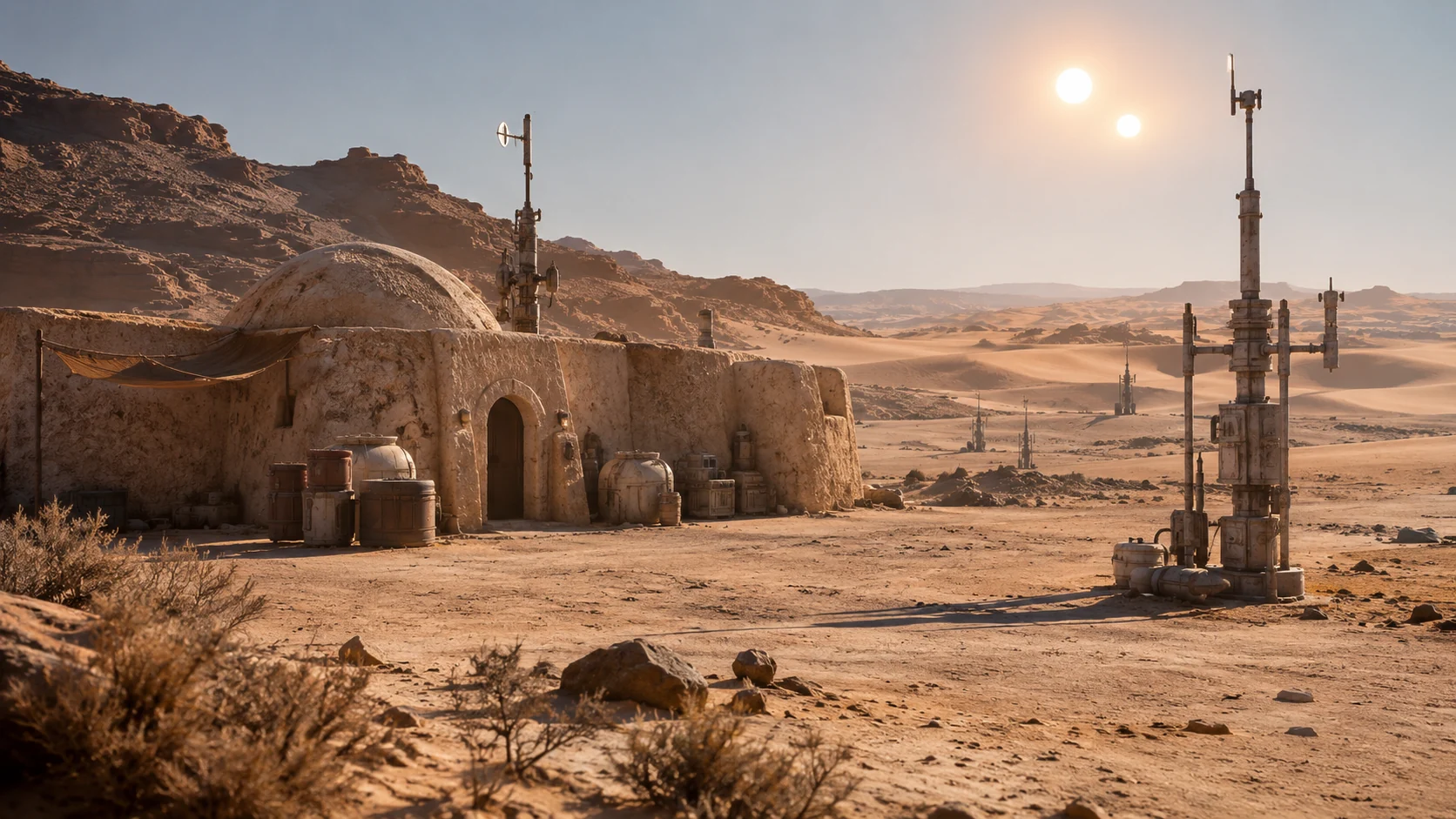
AI interpretation of a working Tatooine moisture farm with domed household architecture and moisture vaporator equipment.
Original AI environment interpretation · Not an official still

Household labor in an arid frontier

Moisture farms

Vaporators and dispersed homesteads define a landscape where collecting water is daily labor. The Lars homestead is one of the best-known examples of this form of settlement.

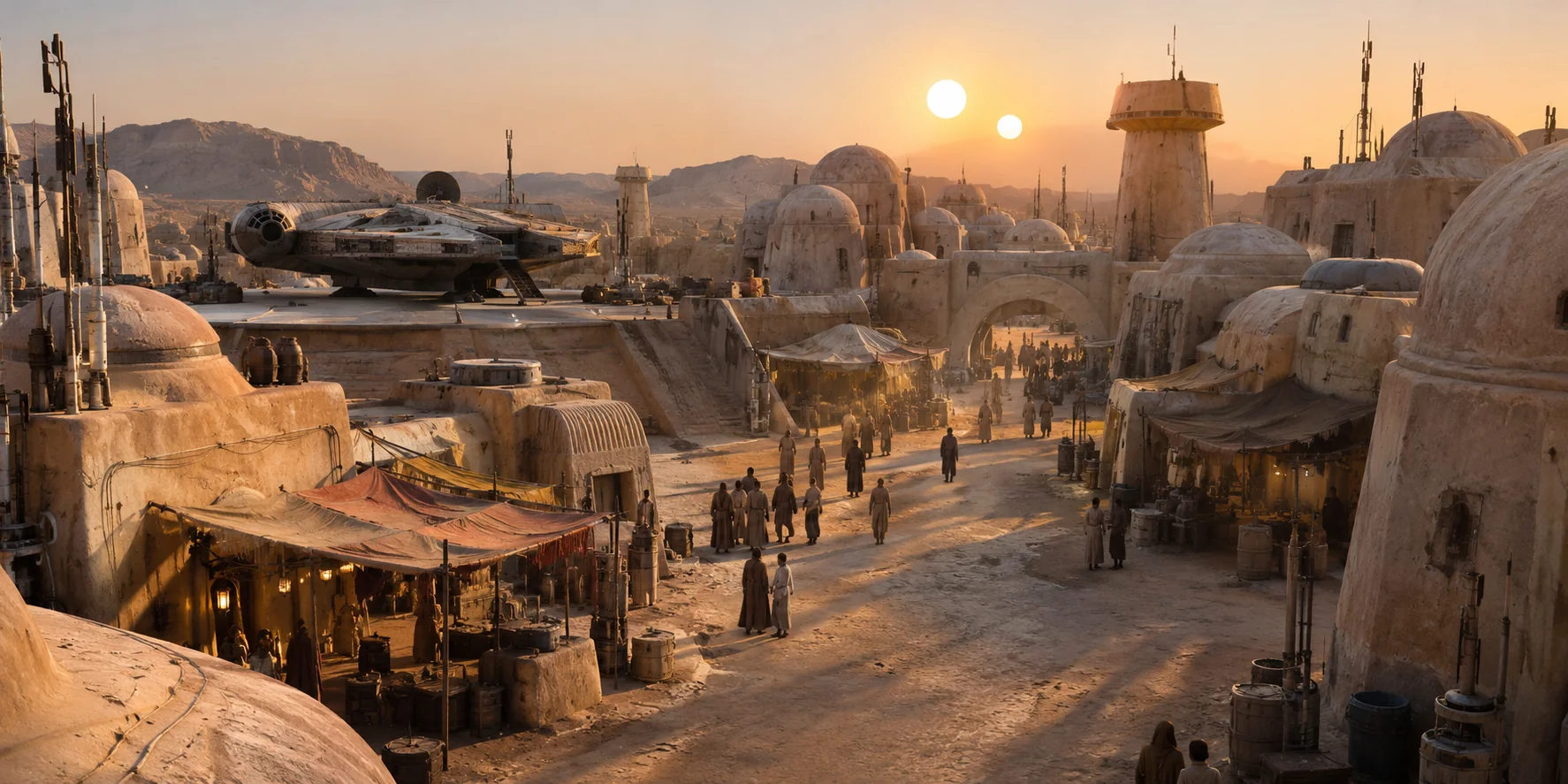
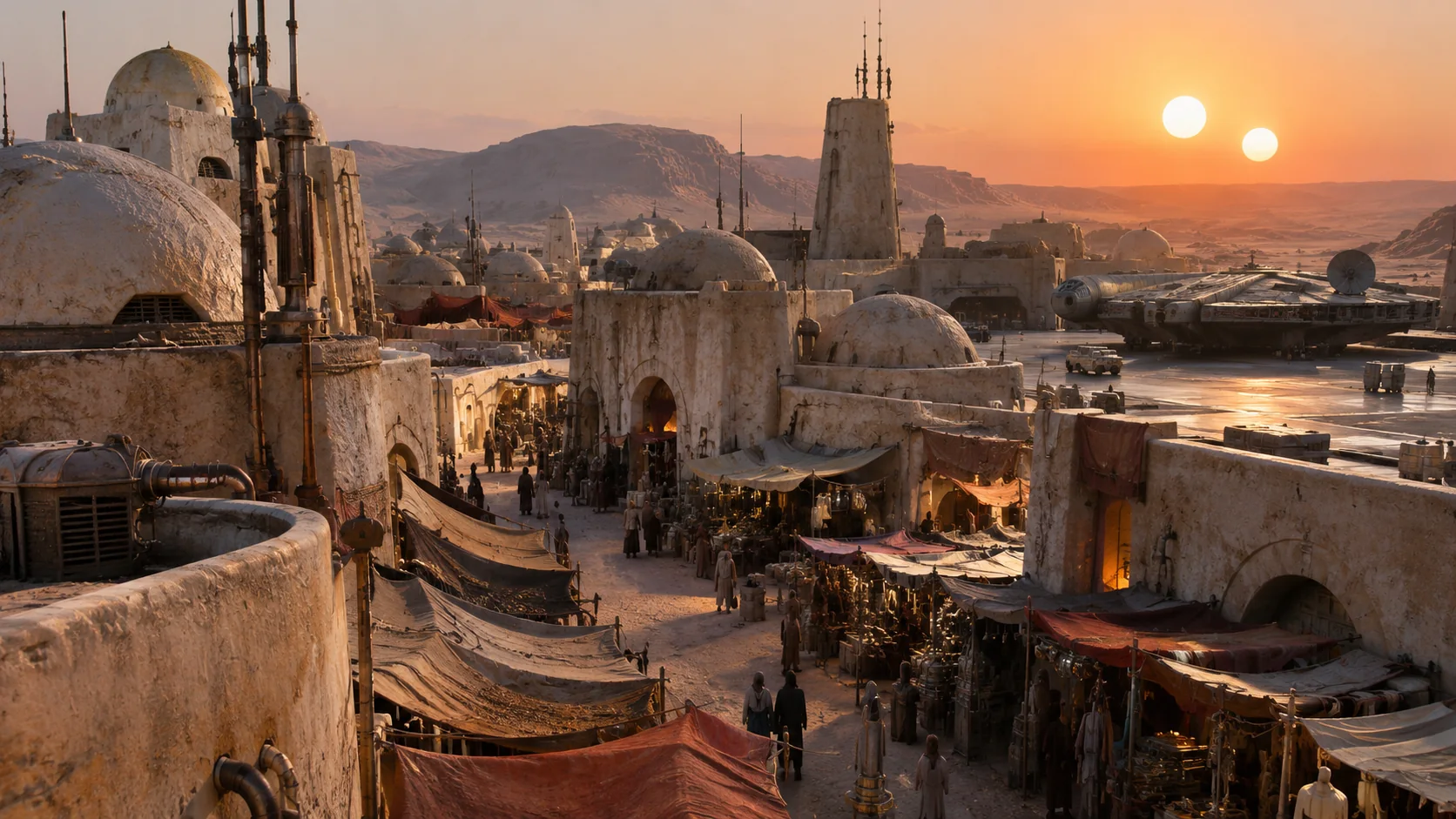
Hyper-realistic AI interpretation of a Mos Eisley spaceport street with domed buildings, markets and a landing area.
Original AI environment interpretation · Not an official still

Ships, workshops and urban exchange

Mos Eisley Spaceport

An arrival in Mos Eisley passes through busy trade and transport spaces. Ship repair, commerce, and travelers form the setting for its many stories.

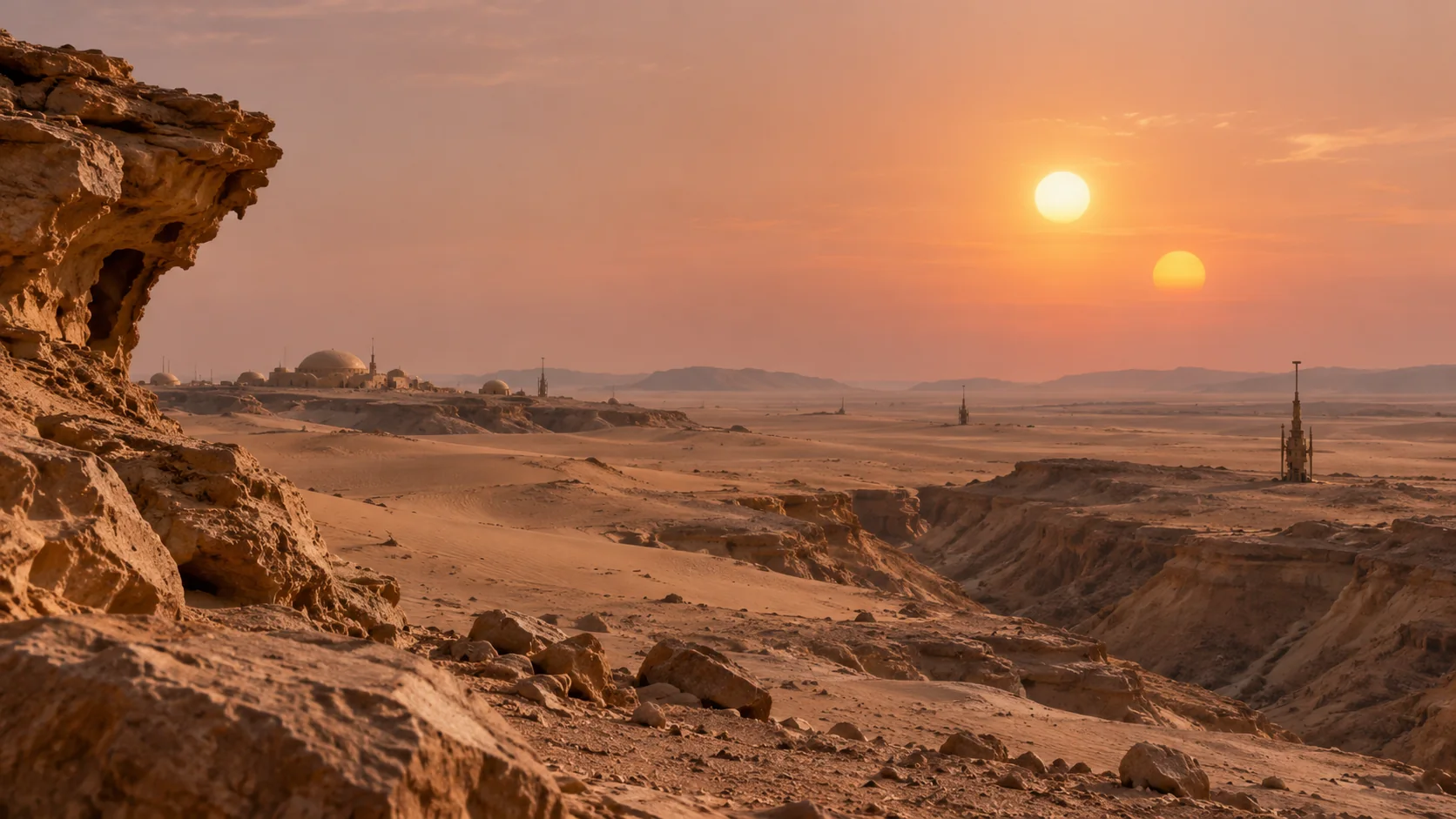
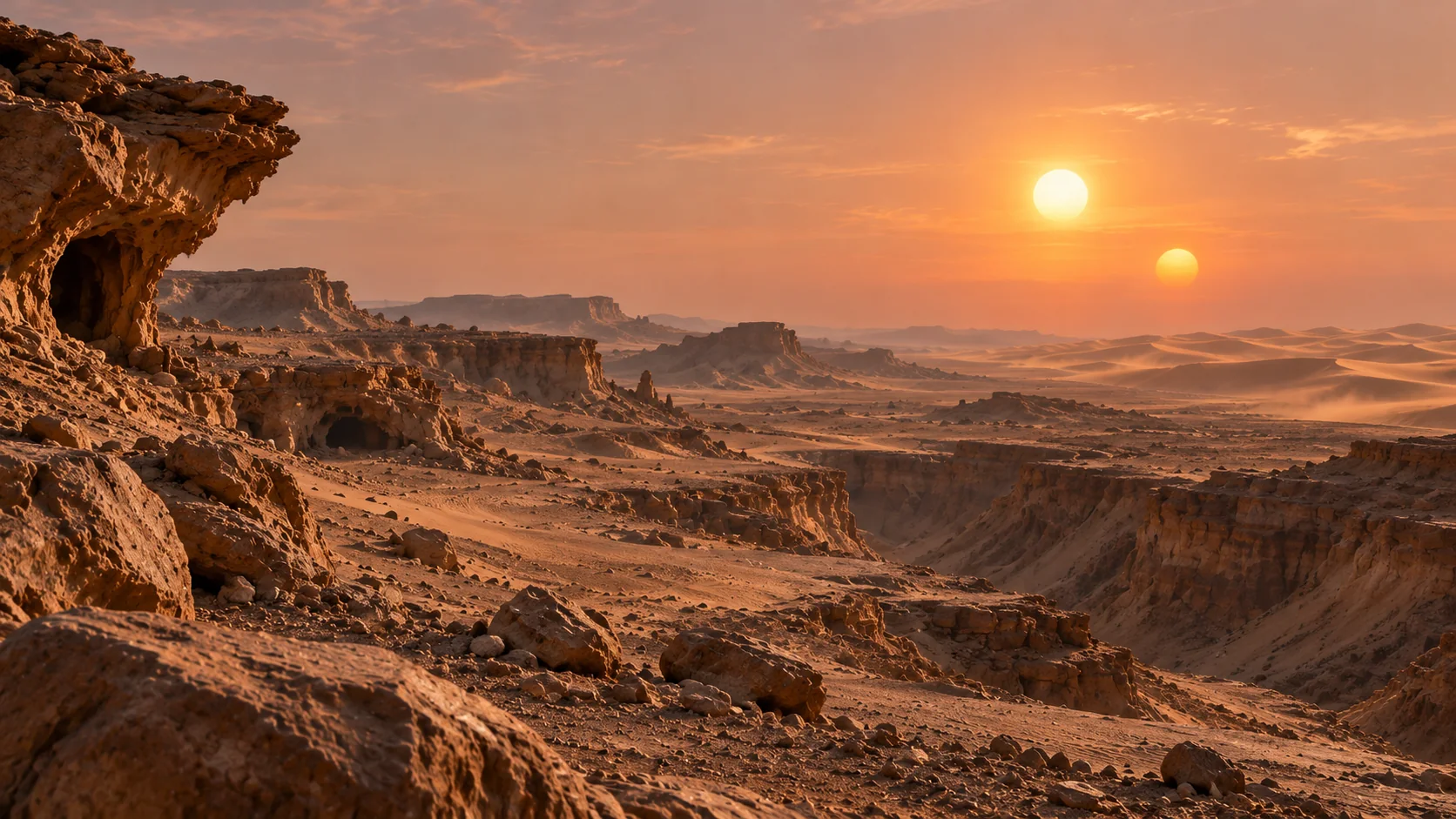
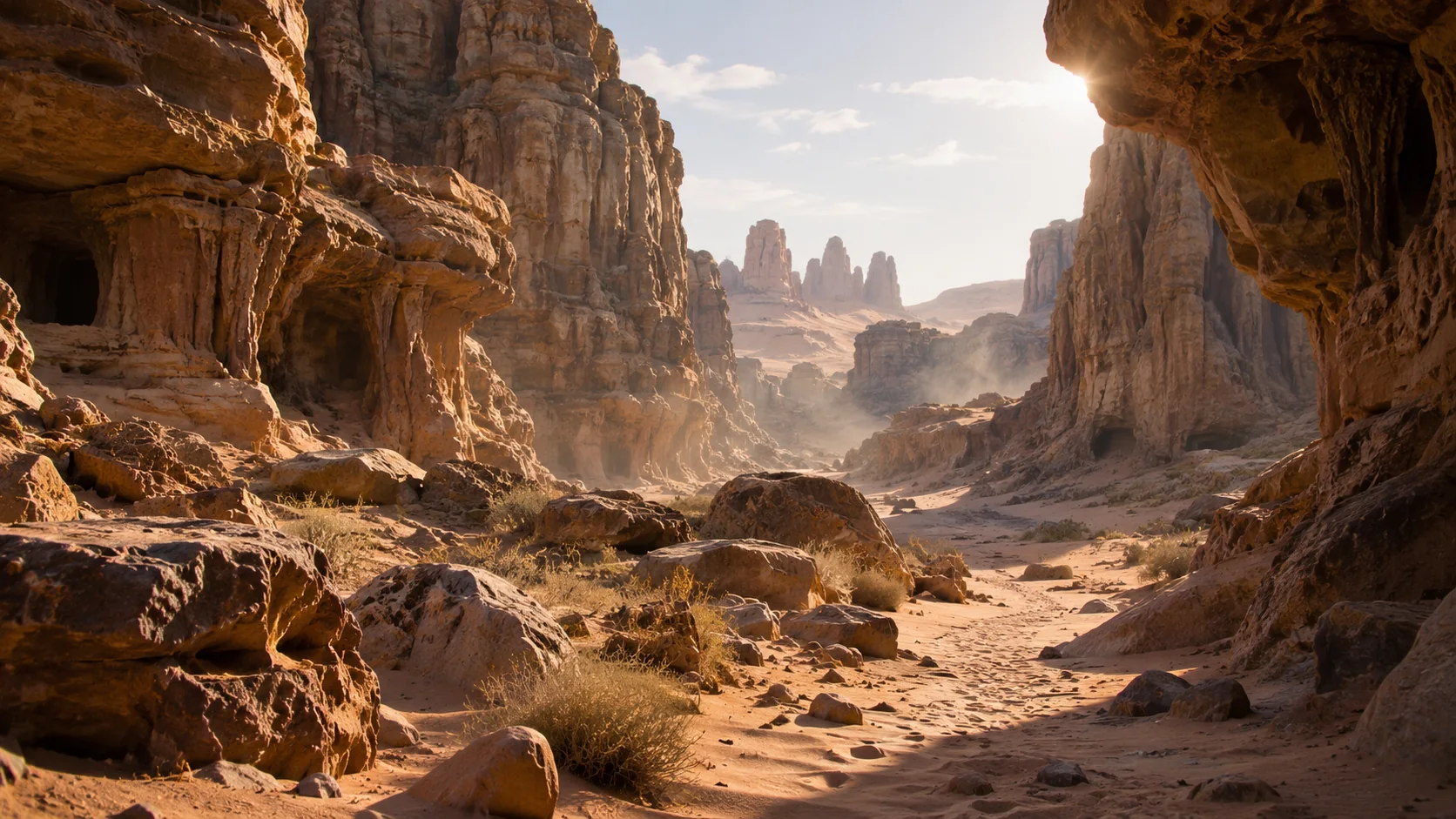
Hyper-realistic AI interpretation of the Jundland Wastes with rocky mesas, canyons and desert sand.
Original AI environment interpretation · Not an official still

Eroded canyons and rocky desert

Jundland Wastes

The Jundland Wastes is a rugged region of cliffs and badlands, not simply another featureless dune field.

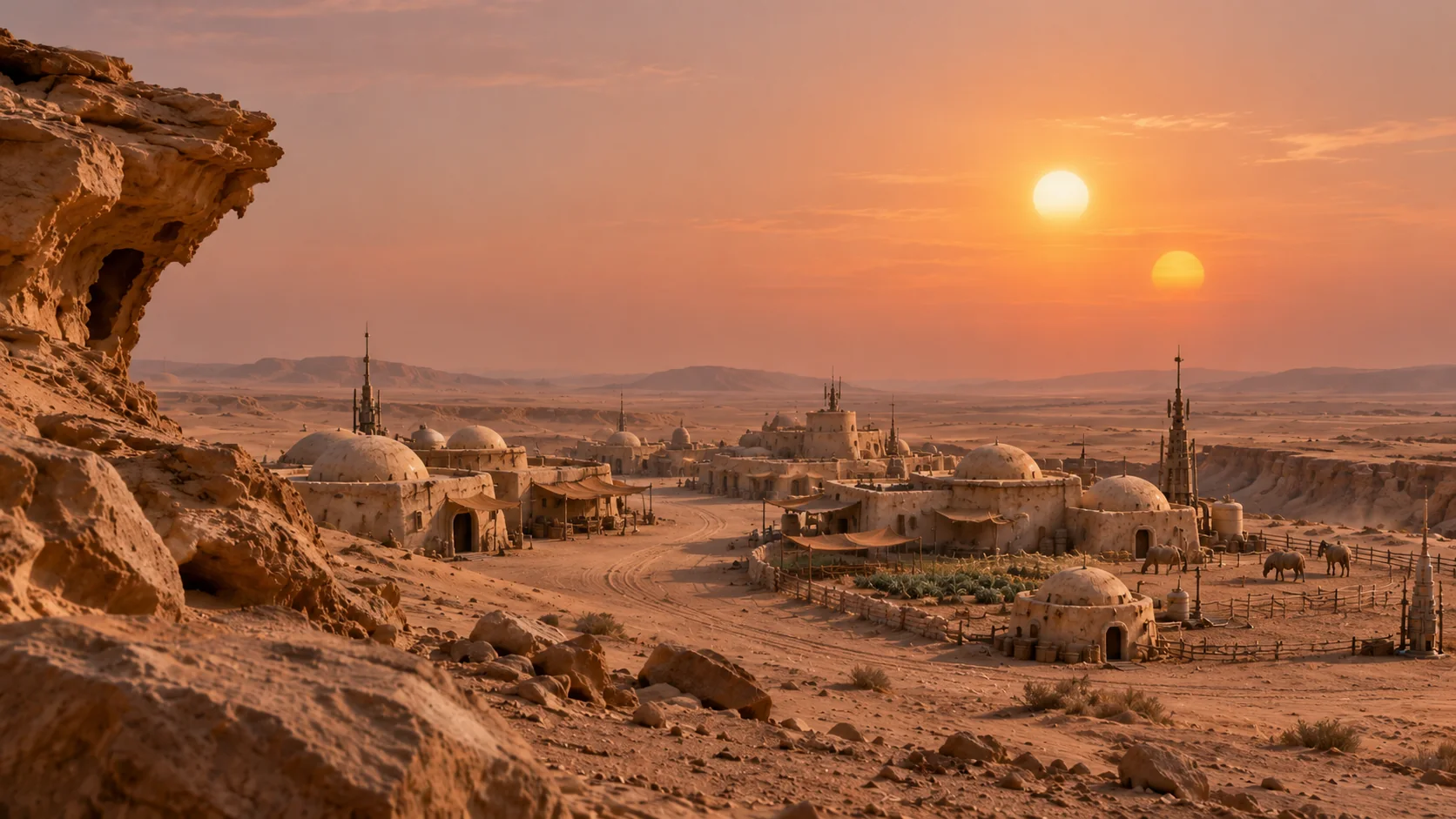
Hyper-realistic AI interpretation of a small Tatooine farming settlement and its weathered low buildings.
Original AI environment interpretation · Not an official still

Community of farmers and settlers

Anchorhead

Smaller settlements such as Anchorhead connect dispersed farms and traders. This is an interpretive street scene, not an exact surveyed town plan.

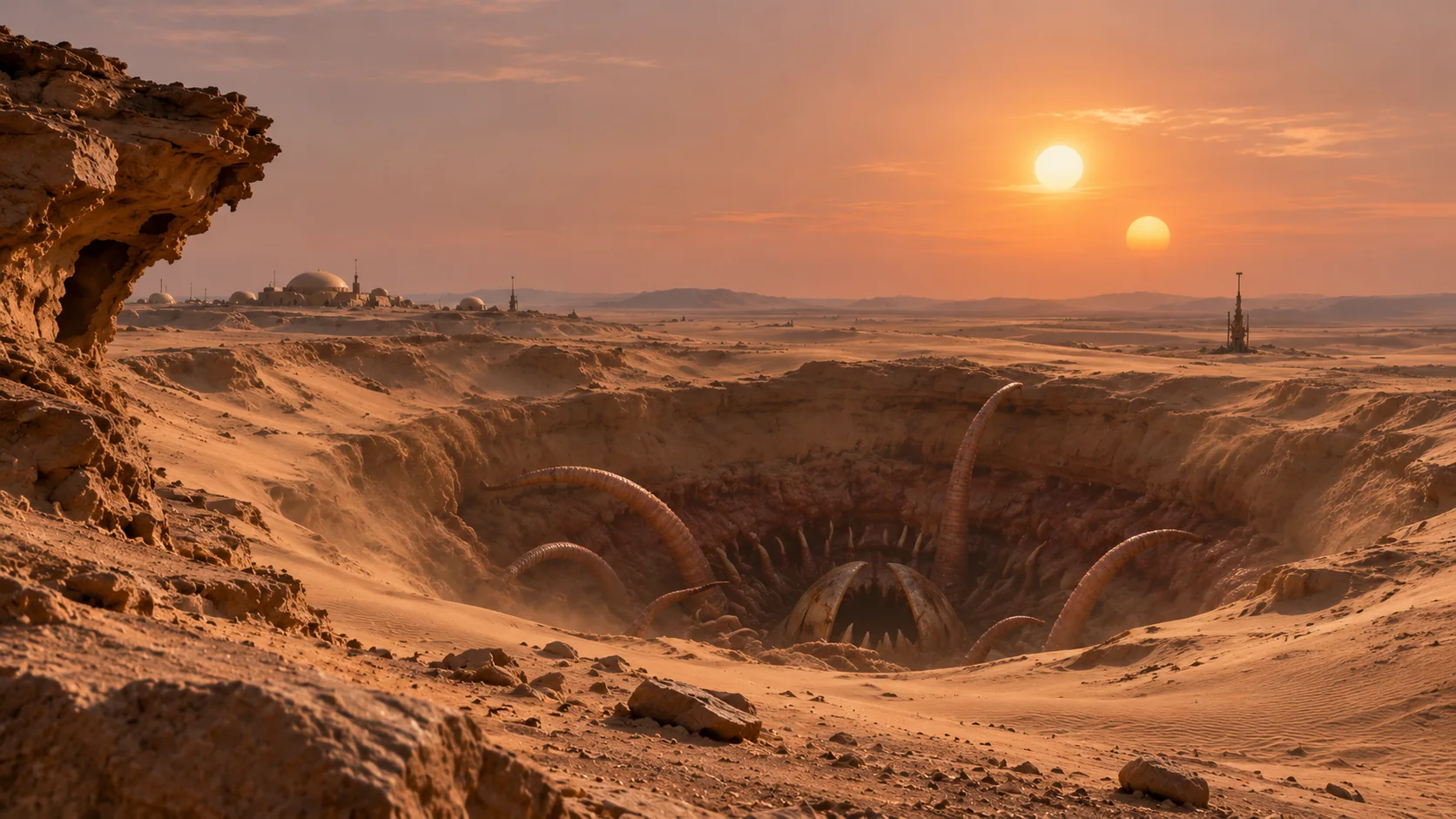
AI interpretation of the arid terrain surrounding a deep desert basin associated with the Great Pit of Carkoon; it is not a literal on-screen reconstruction.
Original AI environment interpretation · Not an official still

Desert landmark and the sarlacc

Great Pit of Carkoon

The Great Pit is the sarlacc's lair and the setting of Jabba's executions. The artwork is an atmospheric terrain interpretation, not a depiction of the creature's exact anatomy.

Hyper-realistic AI interpretation of a rocky canyon environment on Tatooine.
Original AI environment interpretation · Not an official still

Travel through the badlands

Sandstone canyons

Tatooine's canyons and rocky wilderness require different travel strategies from the exposed dune fields.

Hyper-realistic AI interpretation of a small desert industrial outpost with domed buildings and utility towers.
Original AI environment interpretation · Not an official still

Work outside the main ports

Rural outposts

Life beyond the large cities includes outposts, workshops, farms and isolated facilities that depend on equipment and transport networks.

03 / Planetary exploration

Find a place to explore

Select a numbered site on the map or use the location list. The map is schematic because verified local coordinates are unavailable.

Interpretive overview. Positions, routes, and distances are not to scale.

Local site navigator / 07 destinations

AI-generated interpretive image of Mos Eisley spaceport and market.
Original AI terrain interpretation
Spaceport

Mos Eisley

Interstellar arrivals, cargo, cantinas, pilots, and exchange.

Enter Mos Eisley Spaceport →

Local lives / Image gallery

Work, travel and everyday life

Explore original photorealistic AI interpretations of markets, moisture farming, travel and urban spaces. These depict settings rather than documented individual people or particular social groups.

Hyper-realistic AI interpretation of market activity and buildings in a Tatooine trading town.
Port cities and local commerce

Work and trade

Large towns bring together markets, services and offworld traffic.

Explore this setting ↗Original AI interpretation
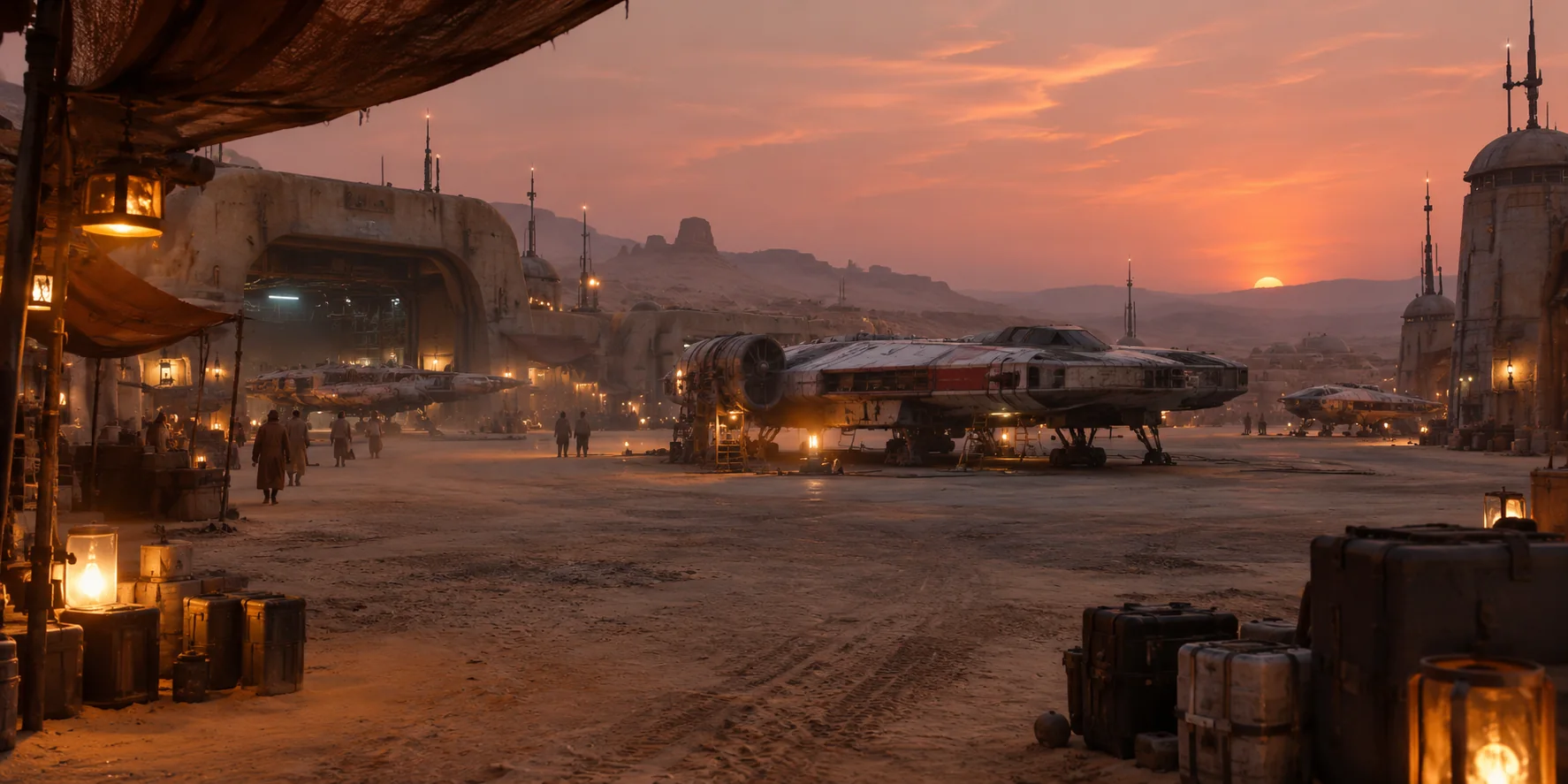
Hyper-realistic AI interpretation of starships, hangars and cargo infrastructure at a desert spaceport.
Transportation infrastructure

Cargo and arrivals

Landing pads and repair areas connect local businesses to interstellar travel.

Explore this setting ↗Original AI interpretation
Hyper-realistic AI interpretation of a moisture-farming work area with equipment and a domed home.
Moisture collection and maintenance

Household labor

Farming households depend on reliable machinery, water collection and repair work.

Explore this setting ↗Original AI interpretation
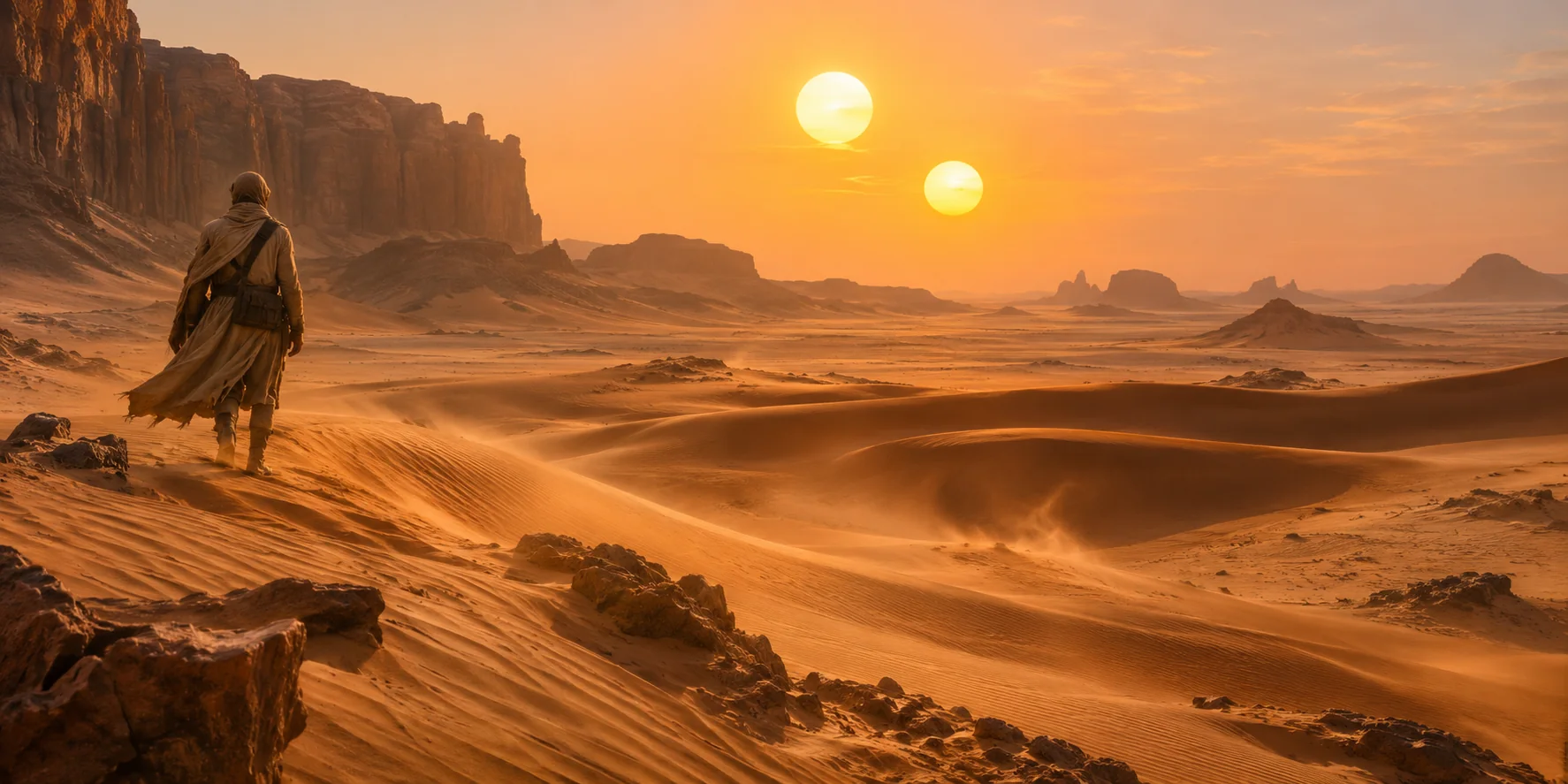
Hyper-realistic AI interpretation of a robed traveler crossing dunes beneath the twin suns; not a depiction of an identifiable group.
Travel and settlement

Across open desert

Travel outside town entails exposure to heat, changing terrain and long distances.

Explore this setting ↗Original AI interpretation
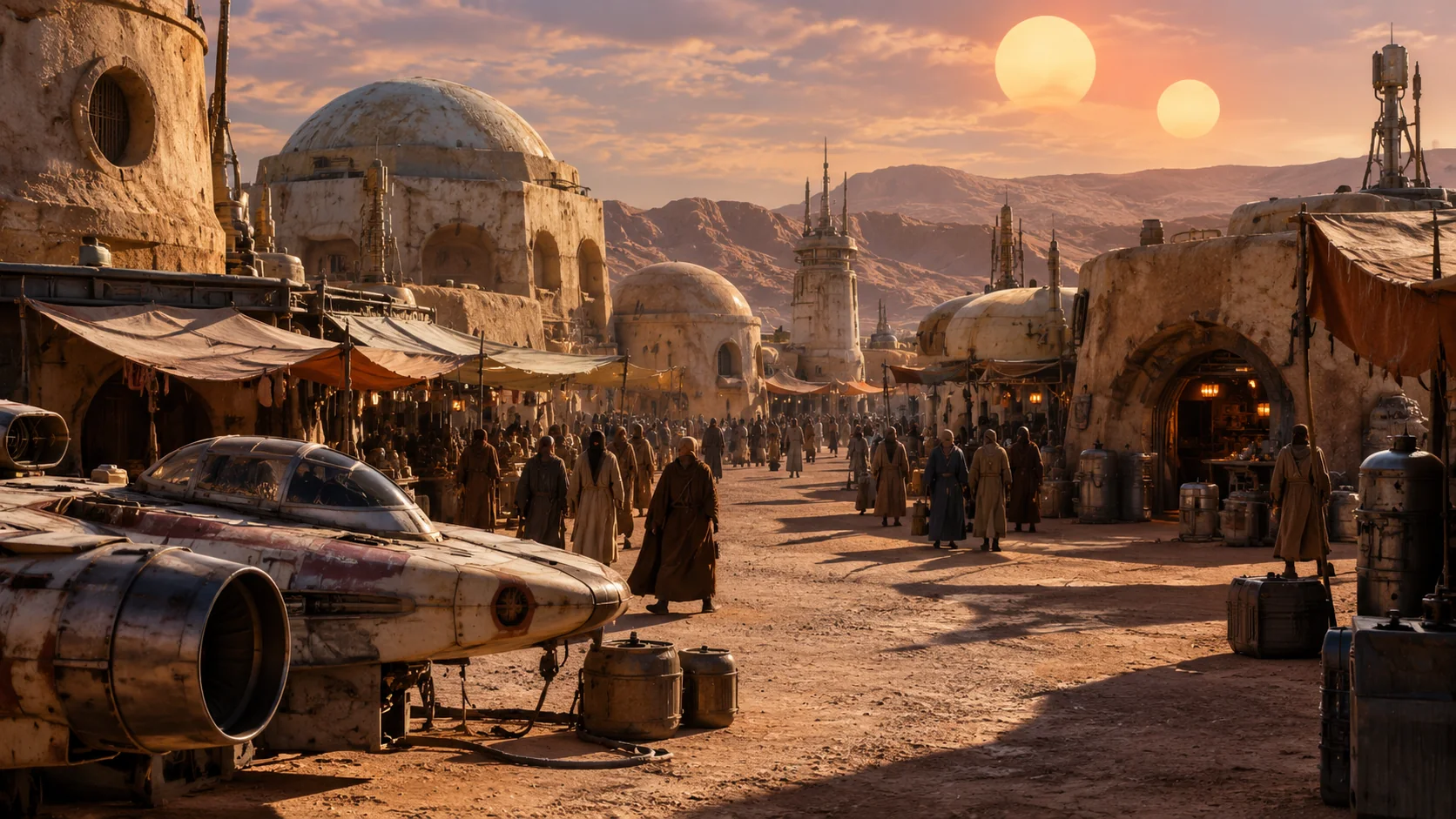
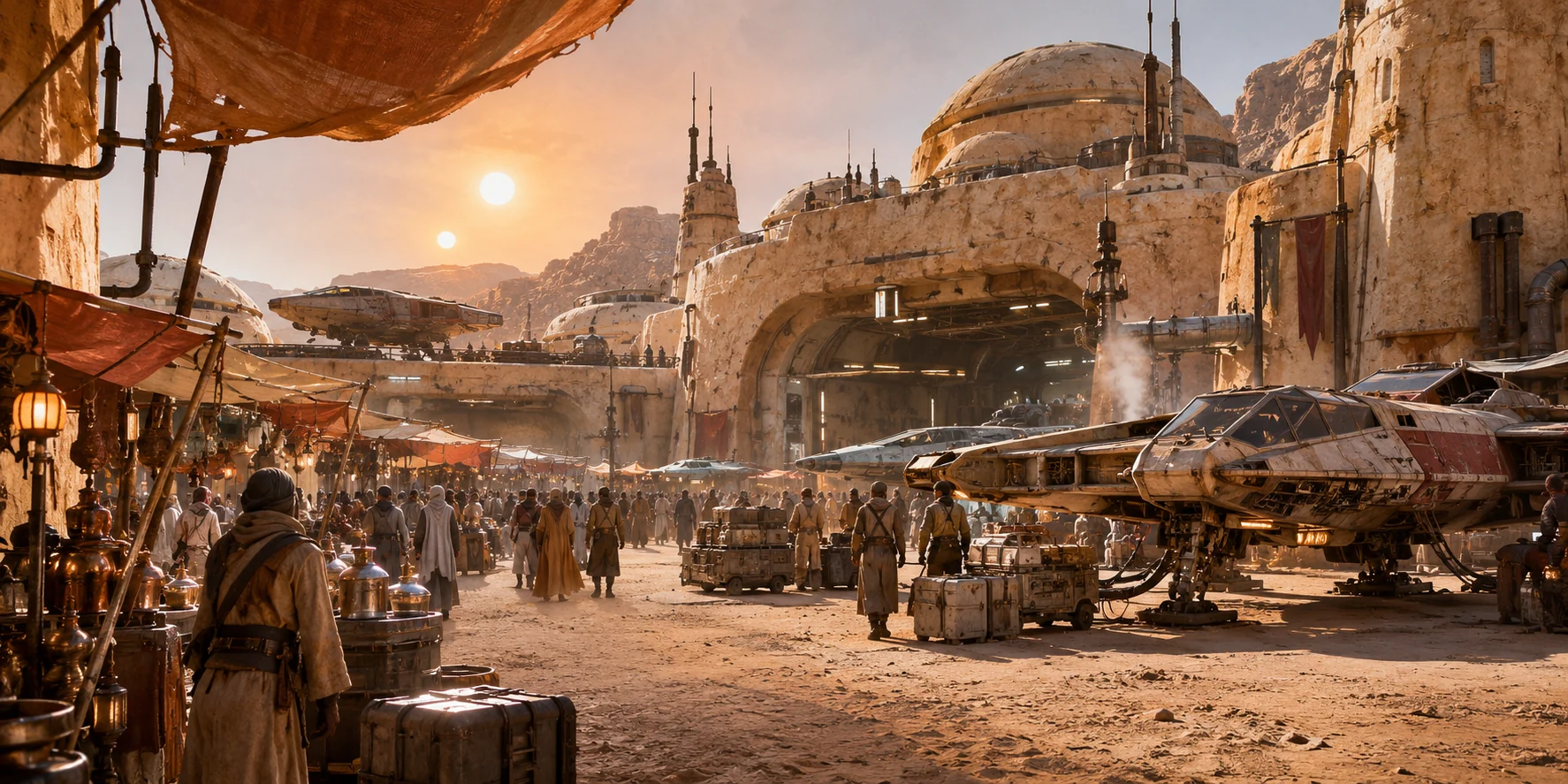
Hyper-realistic AI interpretation of a bustling Tatooine market street with a parked starship.
Daily life in spaceport streets

Market exchanges

A lived city includes merchants and travelers alongside its famous film settings.

Explore this setting ↗Original AI interpretation
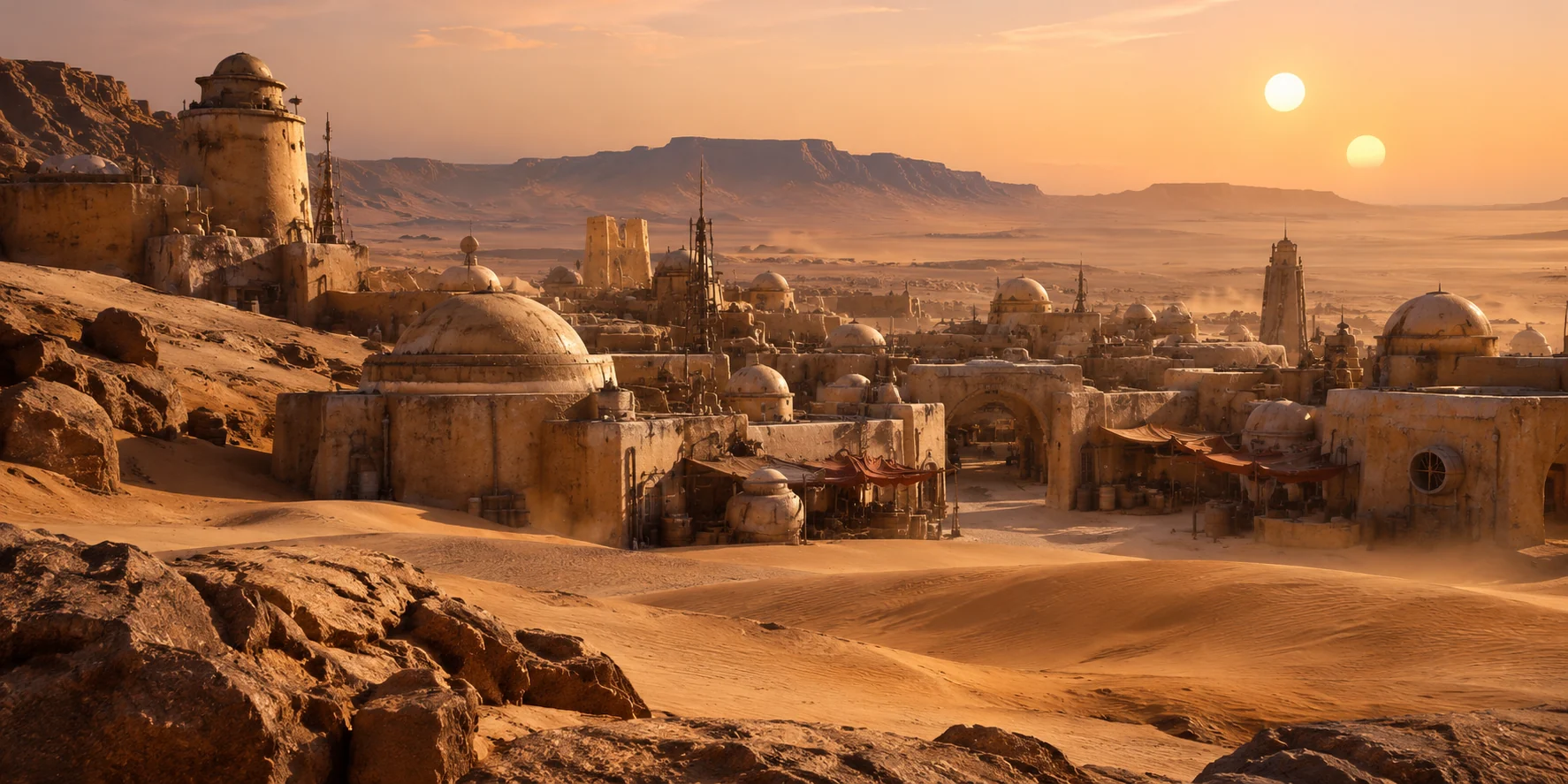
Hyper-realistic AI interpretation of Mos Espa's dense low-rise city skyline among desert ridges.
City scale and built environment

Mos Espa panorama

Mos Espa's architecture combines domed buildings and large urban gathering spaces.

Explore this setting ↗Original AI interpretation

04 / Societies

People who make a life here

Communities, economies, and traditions differ across space and era. Neither culture nor citizenship can be inferred from a species name alone.

Indigenous desert traditions

Tusken communities

Communities with distinct territorial histories, ritual practices, social bonds, and forms of desert knowledge. Represent them as people with cultural agency, not a generic obstacle.

Explore connection →

Mobile salvage networks

Jawa traders

Scavenging and repair networks connect remote homesteads and settlements. Sandcrawlers serve as mobile centers of trade.

Explore connection →

Water and subsistence

Moisture-farming households

Dispersed households depend on vaporators, equipment maintenance, family labor, local markets, and travel corridors.

Explore connection →

Commerce and power

Spaceport and Hutt networks

Pilots, merchants, debtors, criminal organizations, and local authorities intersect in Mos Espa and Mos Eisley; arrangements change across eras.

Explore connection →

05 / Living environment

Creatures of the desert

Documented Tatooine fauna. Species-specific illustrations and records will be expanded in later world batches.

Herd mammal

Bantha

Large furry mammals used as mounts and strongly associated with Tusken lives.

Desert reptile

Dewback

Hardy riding animals seen across the desert and with Imperial patrols.

Desert predator

Krayt dragon

Powerful predator associated with Tatooine's dangerous wilderness.

Pit-dwelling creature

Sarlacc

A creature best known from the Great Pit of Carkoon.

Burrowing creature

Worrt

A smaller desert animal identified in the official Databank.

06 / Characters

Lives connected to Tatooine

These connections distinguish upbringing, residence, exile, and political influence instead of treating every visitor as native.

07 / Historical layers

The world changes over time

  1. Republic era

    Podracing, markets, and enslavement

    Mos Espa's economy and the childhood of Anakin Skywalker.

  2. Imperial era

    The Lars homestead and Mos Eisley

    Luke's upbringing, Obi-Wan's exile, local commerce, and Imperial activity.

  3. New Republic era

    After Jabba

    Rival powers, Boba Fett, Freetown, and local attempts at governance.

08 / Collecting on this world

Collecting Tatooine

Start with authentic IDS catalogs. World-specific trading-card matches and named product records will appear only after their identities and images are verified.

09 / Material culture

Artifacts and objects

Notable equipment and objects should ultimately have individual illustrated dossiers, including provenance, use, history, and location changes.

Cultural weapon

Gaderffii stick

Associated with Tusken material culture and craft; interpretations should recognize use and social context.

Official reference ↗
Mobile built environment

Sandcrawler

The Jawas' huge transport and trading environment, central to salvage and repair economies.

Official reference ↗
Vehicle

Anakin's podracer

A locally significant technological object tied to Mos Espa's Boonta Eve race.

Official reference ↗

10 / Evidence and navigation

Sources and deeper reading

Complete original research preserved Open the 13-section Tatooine research dossier Environment · people · politics · religion · history · primary references
Tatooine landscape
Official Star Wars imagery · Source record ↗

Outer Rim · Planetary file

Tatooine

Tatooine is a harsh twin-sun desert world where moisture farmers, Tusken communities, Jawas, criminal syndicates, merchants, migrants, and offworld settlers compete and cooperate far from strong central government.

01 · Orientation

World overview

Tatooine is a harsh twin-sun desert world where moisture farmers, Tusken communities, Jawas, criminal syndicates, merchants, migrants, and offworld settlers compete and cooperate far from strong central government. IDS treats Tatooine as a lived world rather than background scenery. Its location in Outer Rim, its classification as Desert frontier world, and its association with Tusken Raiders, Jawas, settlers and migrants create a social setting shaped by geography, institutions, mobility, and historical change. The purpose of the file is to connect those conditions instead of reducing the planet to a single battle, character, or visual landmark.

02 · Environment

Landscape, climate, and adaptation

Water scarcity shapes almost every aspect of life. Settlements cluster around ports, farms, trade routes, and reliable resources, while large stretches of desert remain difficult for outsiders to navigate. Moisture farming, scavenging, transport, and animal husbandry are adaptations to the environment rather than background details. Quick Facts identifies the climate as Hot and arid and the terrain as Deserts, canyons and dune seas. Those environmental conditions affect where settlements can develop, how people travel, what resources become politically important, and which forms of infrastructure are practical. Environment does not mechanically determine culture, but it places real constraints on labor, architecture, transportation, defense, and everyday life.

03 · Built environment

Settlement, architecture, and infrastructure

Tatooine’s settlements are adaptations to heat, scarcity, and weak centralized authority. Moisture farms spread households far apart, while Mos Eisley and Mos Espa concentrate trade, repair, lodging, entertainment, and transport around offworld traffic. Jawa sandcrawlers function as mobile commercial settlements, while Tusken camps follow different territorial and social logics. Underground or thick-walled architecture helps manage heat, making everyday buildings evidence of environmental adaptation rather than merely visual style.

04 · Society

People, community, and everyday life

Tatooine contains multiple societies with very different relationships to the land. Tusken communities maintain their own histories, territories, rituals, and kinship structures. Jawas travel in sandcrawlers and support a scavenging and repair economy. Settlers build farms and towns, while ports such as Mos Eisley and Mos Espa connect local life to galactic commerce.

05 · Economy & labor

Resources, work, and political economy

Water, transport, salvage, livestock, repair work, smuggling, hospitality, gambling, slavery in earlier periods, and criminal protection all shape Tatooine’s economy. Moisture farmers convert atmospheric water into survival and modest trade, Jawas turn discarded technology into marketable goods, and spaceports connect local work to galactic movement. Hutt power grows from controlling exchange and violence rather than from a productive state bureaucracy, leaving households and small businesses exposed to unequal bargaining relationships.

06 · Religion & worldview

Sacred landscape, belief, and moral order

Current canon does not establish one planet-wide Tatooine religion. The world contains many migrant, Indigenous, criminal, commercial, and settler communities with distinct traditions. Tusken ritual, ancestral connection to land, funerary customs, and oral memory are especially important examples of sacred worldview on the planet. Religion and worldview are treated as parts of social life rather than decorative lore. Sacred places, collective memory, ritual, moral authority, and relationships to land can influence how communities understand belonging and legitimate power. Where canon documents no shared planetary religion, IDS keeps that absence visible instead of inventing a uniform belief system for everyone living on the world.

Explore Religion & Worldviews →

07 · Institutions

Government, authority, and power

Formal state authority is weak compared with local power brokers. Hutt influence, criminal syndicates, bounty hunters, merchants, militias, and family networks often matter more than distant governments. That political fragmentation helps explain why slavery and exploitation persisted despite changes elsewhere in the galaxy. The major eras associated with Tatooine are Republic, Empire, New Republic. Political authority can therefore change as governments, militaries, occupations, local elites, resistance movements, or outside institutions gain and lose control. The archive uses frontier power, migration, subsistence to ask who can make decisions, who bears the costs of those decisions, and how planetary institutions connect local communities to larger galactic systems.

08 · Mobility

Movement, travel, and connection

Tatooine is remote but not disconnected. Spaceports, caravan routes, sandcrawlers, speeders, animal transport, and local guides link settlements across terrain that can be deadly to outsiders. Mobility also divides communities. Offworlders often treat the planet as a temporary stop, while Tusken groups understand routes and territory through much longer histories. Access to a starship can transform a person’s possibilities immediately, which is why leaving Tatooine carries such social importance for Anakin, Luke, and many migrants.

09 · Conflict & security

War, policing, occupation, and defense

Violence on Tatooine is decentralized. Hutts, syndicates, bounty hunters, settlers, raiders, Tusken communities, local militias, and occasional Imperial forces all exercise coercive power in different places. Conflict over water, territory, debt, slavery, and criminal control can matter more locally than distant galactic wars. Because no state fully monopolizes force, security depends heavily on family, reputation, hired protection, alliances, and knowledge of who controls a particular road, settlement, or stretch of desert.

10 · Points of interest

Places that make Tatooine legible

Places inside Tatooine make large planetary histories concrete. Cities, temples, factories, homes, bases, ruins, and landscapes show where institutions actually operate and where people work, worship, govern, travel, fight, remember, and build community. IDS treats these locations as evidence of social life rather than as a sightseeing checklist. Each point is included because it helps explain how geography, political authority, material culture, religion, or historical change becomes visible on the ground.

Trade · Mobility

Mos Eisley Spaceport

Mos Eisley links Tatooine to galactic transport, smuggling, wage labor, criminal brokerage, and migration. Its cantinas and hangars function as informal markets for pilots, information, and protection.

Open connected IDS file →
City · Political economy

Mos Espa

Mos Espa combined markets, entertainment, municipal government, slavery in the Republic era, Hutt influence, and later competing crime syndicates, making it one of Tatooine’s clearest urban political centers.

Open connected IDS file →
Household · Subsistence

Lars homestead

The Lars moisture farm shows ordinary settlement life through family labor, water extraction, isolation, and dependence on local infrastructure rather than through the criminal and military institutions that dominate many Tatooine stories.

11 · Change over time

Historical significance

Anakin Skywalker and Luke Skywalker both grew up on Tatooine, but the world has a much larger history than the Skywalker family. Control shifted among Hutts and other criminal powers, Imperial patrols came and went, and local communities continued adapting regardless of who claimed to govern the wider galaxy. The principal appearances listed for Tatooine are Skywalker saga, The Mandalorian, The Book of Boba Fett, Obi-Wan Kenobi. Those stories capture particular moments rather than the complete history of the world. IDS reads wars, occupations, migrations, regime changes, reconstruction, and institutional continuity as processes that reshape social life over time. Historical significance therefore comes from what changes for communities, not only from whether a famous event happened there.

12 · IDS lens

What this world reveals

Tatooine works as a frontier study because sovereignty is uneven. Different groups exercise authority over territory, trade, water, violence, and mobility without a single institution fully controlling the planet. The archive emphasis for Tatooine is frontier power, migration, subsistence. That focus is useful because it connects geography to social organization instead of treating the world as scenery. IDS asks how people experience institutions differently depending on class, community, mobility, political status, access to resources, and historical circumstance, and how those differences become visible in the built and natural environment.

13 · Sources & continuity

Official primary source

The factual baseline for this Tatooine file comes from official Star Wars reference material and the canon appearances listed in Quick Facts. IDS uses those sources for names, geography, political events, communities, and chronology, while the surrounding discussion of institutions, religion, settlement, labor, and social change is independently written analysis. Some aspects of everyday life on this world remain undocumented in current Canon.

Continuity focus: current Star Wars canon. Planet summaries are independently written for Imperial Dark Sector. Planet imagery is sourced from the official StarWars.com Databank.