
How does authoritarian rule become ordinary administrative routine?
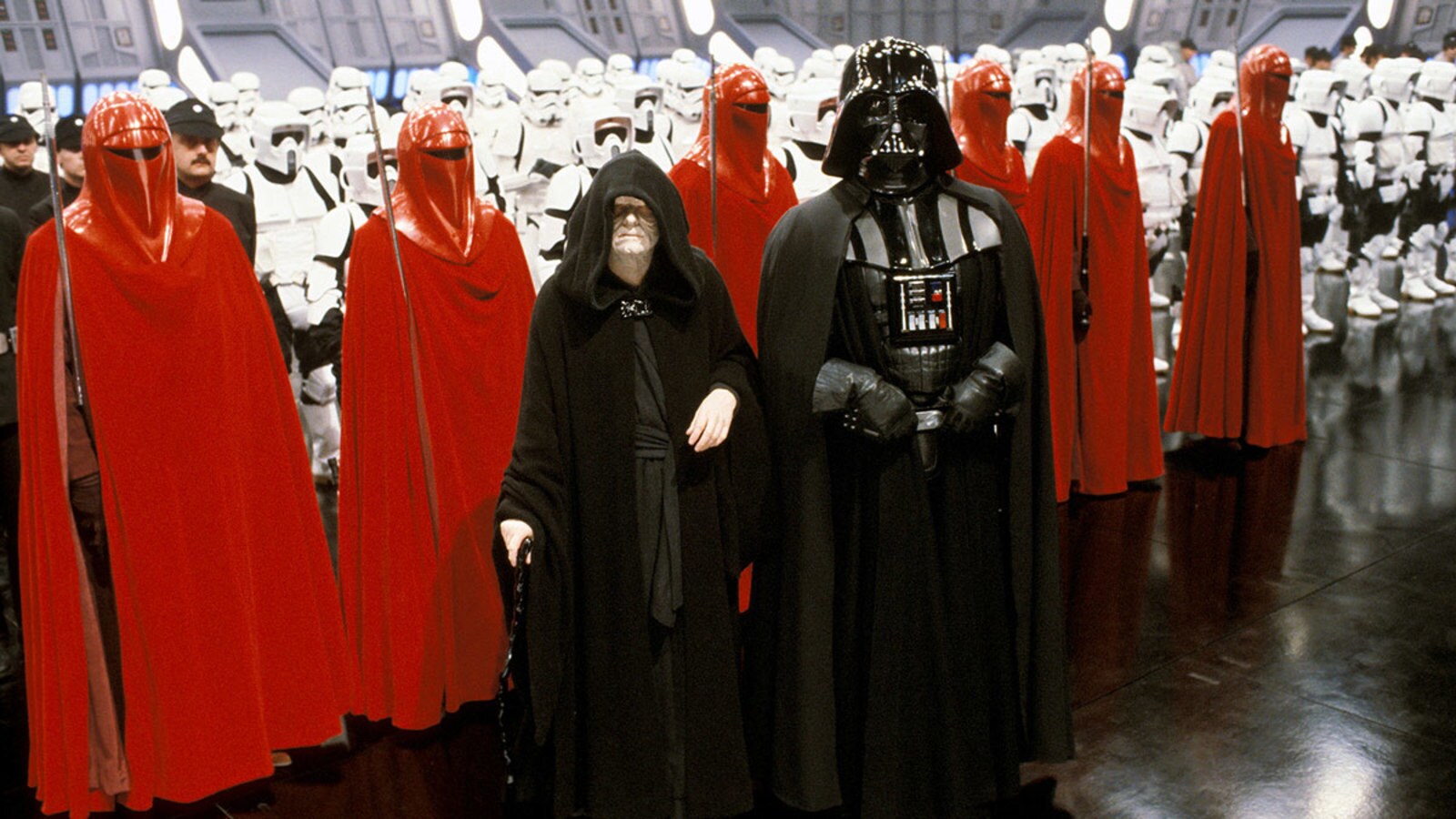
Definitive subject hub · State · Military · Surveillance · Occupation
The Galactic Empire
The Empire is not only Palpatine, Vader, and Star Destroyers. It is also governors, records, academies, intelligence offices, prisons, scientists, procurement, propaganda, standardized uniforms, logistics, local collaborators, and millions of ordinary roles that make centralized rule possible. This hub reads the Empire as an institution rather than a collection of villains.
Research orientation
Questions this hub helps answer
Use these questions as a reading strategy. The links below provide evidence from different IDS archives rather than one flattened summary.
What is the relationship between bureaucracy and spectacular violence?
How do surveillance, recruitment, science, and logistics extend Imperial power beyond the battlefield?
Why do Imperial institutions survive the Emperor's death in fragmented forms?
Mentioned in this file
Open the people, places, and institutions
Darth VaderOpen the character file referenced in this page.EndorExplore the world file connected to this subject.Obi-Wan KenobiOpen the character file referenced in this page.Grand Admiral ThrawnOpen the character file referenced in this page.New RepublicFollow the institution or faction referenced here.
01 · Connected archive
Start with the Empire as a state
Begin with the organization, lore, and political culture that explain how Imperial rule actually functions.
Galactic Empire organization
Structure, leadership, recruitment, bureaucracy, financing, territory, factions, and transformation.
Open →Galactic Empire loreThe broader political and historical system of Imperial rule.
Open →Imperial Political CultureHierarchy, discipline, conformity, work, symbolism, and everyday institutional life.
Open →Government & PoliticsPlace Imperial rule within wider Star Wars systems of sovereignty and legitimacy.
Open →Reign of the EmpireThe era in which authoritarian institutions consolidate after the Republic's collapse.
Open →02 · Connected archive
People inside the hierarchy
Different careers reveal how political authority, military rank, technical expertise, and proximity to Palpatine create unequal forms of power.
Emperor Palpatine
The ruler whose personal authority reorganizes the Republic into Empire.
Open →Darth VaderSith apprentice and extraordinary enforcer operating partly outside normal bureaucracy.
Open →Grand Moff TarkinRegional authority, military administration, and the politics of fear.
Open →Grand Admiral ThrawnFleet command, strategic analysis, and an outsider's rise within Imperial hierarchy.
Open →Director KrennicWeapons bureaucracy, scientific programs, status competition, and the Death Star.
Open →Dedra MeeroCareer ambition and pattern recognition inside the ISB.
Open →Moff GideonImperial continuity after the central state fractures.
Open →03 · Connected archive
Surveillance, soldiers, science, and fear
These files show how different institutions convert political goals into administrative and technical systems.
Imperial Security Bureau
Surveillance, intelligence, bureaucracy, interrogation, and classification of dissent.
Open →Stormtroopers & the Imperial SoldierRecruitment, training, uniformity, occupation, and military identity.
Open →Imperial ScienceResearch programs, scientific labor, coercion, and political priorities.
Open →Death Star DoctrineSuperweapons, deterrence, spectacle, and coercive legitimacy.
Open →Project NecromancerCloning, secrecy, Force-sensitive research, and the ruler's biological continuity.
Open →04 · Connected archive
Violence, occupation, and collapse
Follow the Empire from its founding violence through open rebellion and post-Endor fragmentation.
Order 66
The Republic military becomes the mechanism for destroying the Jedi.
Open →Great Jedi PurgeLonger-term state persecution after the initial coup.
Open →Battle of YavinThe destruction of the first Death Star and failure of a central fear strategy.
Open →Battle of EndorMilitary defeat, death of the Emperor, and succession crisis.
Open →Battle of JakkuA major post-Endor battle in the transition toward the New Republic.
Open →Imperial RemnantsHow personnel, ships, laboratories, ideology, and networks survive regime collapse.
Open →05 · Connected archive
Ships, weapons, and infrastructure
Imperial authority is made visible and mobile through standardized machines, stations, and supply systems.
Imperial-class Star Destroyer
A mobile bureaucracy carrying troops, fighters, command staff, detention, and logistics.
Open →ExecutorFlagship scale, command hierarchy, and concentration of resources around Vader.
Open →TIE FighterMass deployment, pilot expendability, carrier dependence, and standardization.
Open →Death StarA mobile political system organized around planetary destruction.
Open →Technology & ArtifactsDroids, weapons, surveillance, uniforms, and the material systems of rule.
Open →06 · Connected archive
Stories and media pathways
The Empire appears differently depending on whether the story follows rulers, soldiers, prisoners, rebels, workers, or postwar survivors.
Films
The original trilogy, Rogue One, Solo, and the cinematic language of Imperial power.
Open →SeriesAndor, Rebels, Obi-Wan Kenobi, The Bad Batch, The Mandalorian, and Ahsoka.
Open →BooksImperial careers, Thrawn, politics, military systems, and institutional perspectives.
Open →ComicsVader, officers, pilots, scientists, rebels, and post-film continuity.
Open →GamesImperial facilities, occupations, pilots, defectors, and survival after Order 66.
Open →07 · Connected archive
Collect and compare the Empire
Use the site's collecting and analysis systems to study how the Empire becomes material fandom and comparative government.
Commanders & Officers
Compare Imperial commanders with one another and with rival military traditions.
Open →Galaxy Comparison LabCompare the Empire with its First Order successor.
Open →Trading Card ArchiveImperial characters, ships, parallels, autographs, and faction collections.
Open →LEGO Star WarsStar Destroyers, TIEs, helmets, walkers, and Imperial display collecting.
Open →War & MilitaryPlace Imperial military institutions in the wider history of Star Wars warfare.
Open →Keep moving
Cross the archive from here
Subject hubs are designed as intersections. Return to the full hub index or move into the major archives that feed this page.