
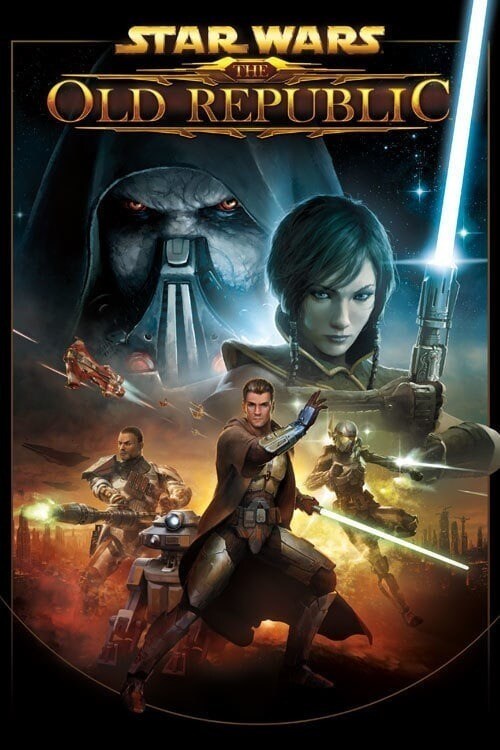
Knights of the Fallen Empire and Knights of the Eternal Throne transformed SWTOR's political geography by placing a third imperial power above the familiar Republic–Sith contest. Zakuul introduced its own ruling family, military forces and approach to governing conquered worlds.
An empire outside the established rivalry
The Eternal Empire was able to defeat conventional Republic and Sith resistance with forces neither state understood adequately. Its emergence makes the older conflict look provincial: two hostile governments could remain profoundly ignorant of a third military and political system.
Valkorion and dynastic sovereignty
Valkorion's paternal role and the succession conflicts surrounding Arcann and Vaylin turn family relationships into matters of empire-wide rule. The ruler's household is not a private sphere, since decisions there affect military command, public safety and the political status of whole worlds.
The Outlander and the Alliance
A prisoner becomes an organizer of cross-faction resistance. The Alliance relies on the resources of people whose previous loyalties conflicted. This gives the story an unusually visible problem of coalition-building: military victory is insufficient without mechanisms for incorporating former adversaries.
Memory and source control
Character fate and some relationships vary with the player's choices. IDS reports the broad story developments from the developer retrospective without silently choosing one player's decisions as a universal historical record.
Research questions and what cannot be inferred
The central interpretive task is to ask what the game presents directly and what must remain open. A published mission or codex can establish that a particular organization or character appeared in the narrative. It does not establish that every inhabitant shared a ruler's views, that all decisions were equally available to players, or that a single playable character represents a whole society. Different Origin Stories provide contrasting perspectives on the same institutions.
Material objects and systems also need context. A city, weapon, archive or ritual may be evidence that a polity invested resources in a particular practice; it does not independently prove the motives of everyone who participated. Political claims made by rulers or antagonists are best treated as claims unless supported by independent story material. That distinction is essential when a narrative itself explores propaganda, secrecy or contradictory memories.
Keep exploring
Continue the adventure
Discover the people and worlds behind the lore, or jump into a different game era.
Primary sources and cross-references
- Primary SWTOR developer or Holonet source
- SWTOR developer retrospective: The Story So Far
- Official Star Wars game profile
- timeline / eternal-empire-conquest-begins-3636
- timeline / outlander-rescued-3631
Star Wars: The Old Republic, its characters and visual designs are the property of their respective rights holders. IDS provides independent criticism and education.
Further SWTOR lore dossiers
The Old Republic is not only a licensed game set in an established era. It introduced institutions, conflicts, places, characters and stories that substantially expa
Read the Legends research file →State institutions and social hierarchyHow the SWTOR Sith Empire GovernsThe Sith Empire of SWTOR is a state rather than a single secretive religious order. Its political structure combines imperial monarchy, the Dark Council, military co
Read the Legends research file →Force traditions, surveillance and coercionThe Children of the Emperor and Political IdentityThe Children of the Emperor form one of the most unsettling political innovations in SWTOR's original Jedi Consular narrative. The plot imagines people whose identit
Read the Legends research file →Artificial worlds and military infrastructureIokath: Technology, Labor and Imperial AmbitionThe Iokath arc added a striking technological civilization to SWTOR's Legends setting. Rather than treating its machines as disposable obstacles, an anthropological
Read the Legends research file →