
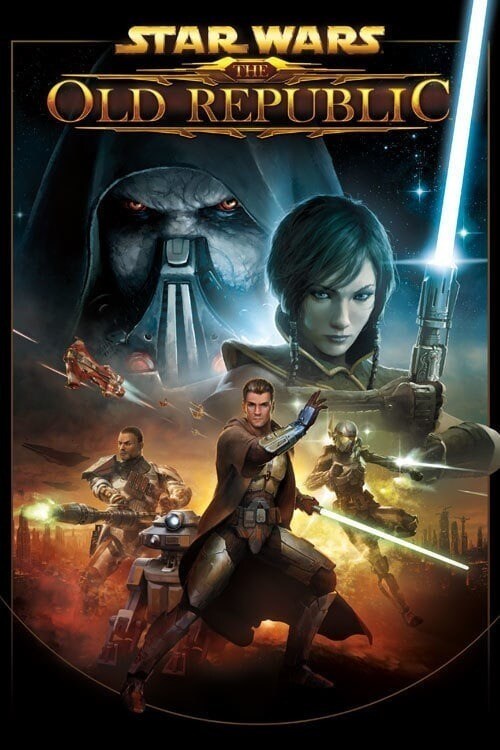
The Old Republic is not only a licensed game set in an established era. It introduced institutions, conflicts, places, characters and stories that substantially expanded the pre-film galaxy in the Legends continuity. The game's continuing releases also require researchers to distinguish its original 2011 plot from later narrative additions.
A world with competing institutions
The SWTOR setting presents the Sith Empire as a functioning territorial state, with a capital at Dromund Kaas, a military, an intelligence service, a Dark Council and formal relations with populations beyond Sith elites. Its rival is not simply a single Jedi character but a Republic with senators, armed forces, trade, dissent and special operations. Players experience those institutions differently depending on their Origin Story.
Eight perspectives on one political era
Jedi Knight and Jedi Consular reveal separate roles within the Jedi Order. Trooper and Smuggler show military employment and non-state commerce; Sith Warrior and Sith Inquisitor expose hierarchy, ritual knowledge and the place of ancestry in the Sith Empire. Bounty Hunter and Imperial Agent reveal contract labor and organized intelligence. These perspectives differ intentionally; none should be treated as a complete description of the era.
The narrative grows beyond launch
After the original class stories, SWTOR added shared and faction-specific narratives involving Makeb, Revanite conspiracy, Ziost, Zakuul, Iokath, renewed Republic–Empire conflict and Mandalorian politics. As later updates continue, older guides may describe mechanics that no longer work as written, even when the underlying story remains accessible.
Evidence standard
The official SWTOR developer retrospective supplies a reliable overview of major expansion story arcs. The original class stories are separately documented in the game's encyclopedia excerpts. Individual dialogue outcomes depend on player selections. IDS treats the surrounding worldbuilding as Legends story material and labels interpretations explicitly.
Research questions and what cannot be inferred
The central interpretive task is to ask what the game presents directly and what must remain open. A published mission or codex can establish that a particular organization or character appeared in the narrative. It does not establish that every inhabitant shared a ruler's views, that all decisions were equally available to players, or that a single playable character represents a whole society. Different Origin Stories provide contrasting perspectives on the same institutions.
Material objects and systems also need context. A city, weapon, archive or ritual may be evidence that a polity invested resources in a particular practice; it does not independently prove the motives of everyone who participated. Political claims made by rulers or antagonists are best treated as claims unless supported by independent story material. That distinction is essential when a narrative itself explores propaganda, secrecy or contradictory memories.
Keep exploring
Continue the adventure
Discover the people and worlds behind the lore, or jump into a different game era.
Primary sources and cross-references
- Primary SWTOR developer or Holonet source
- SWTOR developer retrospective: The Story So Far
- Official Star Wars game profile
- lore / ancient-sith
- timeline / old-republic
Star Wars: The Old Republic, its characters and visual designs are the property of their respective rights holders. IDS provides independent criticism and education.
Further SWTOR lore dossiers
The Sith Empire of SWTOR is a state rather than a single secretive religious order. Its political structure combines imperial monarchy, the Dark Council, military co
Read the Legends research file →Force traditions, surveillance and coercionThe Children of the Emperor and Political IdentityThe Children of the Emperor form one of the most unsettling political innovations in SWTOR's original Jedi Consular narrative. The plot imagines people whose identit
Read the Legends research file →Empire, occupation and legitimacyZakuul and the Eternal EmpireKnights of the Fallen Empire and Knights of the Eternal Throne transformed SWTOR's political geography by placing a third imperial power above the familiar Republic–
Read the Legends research file →Artificial worlds and military infrastructureIokath: Technology, Labor and Imperial AmbitionThe Iokath arc added a striking technological civilization to SWTOR's Legends setting. Rather than treating its machines as disposable obstacles, an anthropological
Read the Legends research file →