
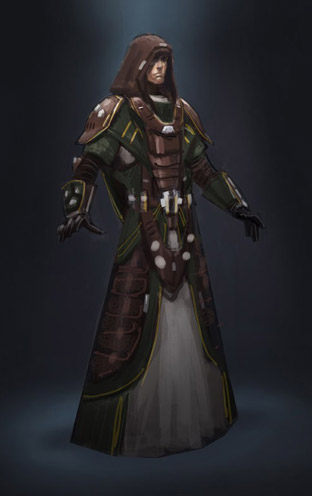
The Children of the Emperor form one of the most unsettling political innovations in SWTOR's original Jedi Consular narrative. The plot imagines people whose identities and conduct may be subject to a concealed influence they cannot reliably identify or control.
The threat within trusted institutions
The Consular discovers that ordinary methods of detection are insufficient to identify the Emperor's hidden operatives. The crisis therefore affects trust across the Jedi Order and Republic, including institutions that habitually treat their own training and internal examinations as reliable.
Recognition and individual responsibility
A plot device that conceals memory and intention raises a philosophical and legal question: how much responsibility should attach to someone acting under an external compulsion? The story does not establish a real-world model of manipulation. It offers a fictional environment for distinguishing voluntary complicity from imposed control.
The First Son
The Consular's hunt reaches a conclusion on Corellia, where the identity of the First Son reveals just how deeply apparent institutional membership can differ from hidden allegiance. The revelation must remain behind a spoiler warning on other class pages, because it changes how a first-time player reads early Consular conversations.
Why it matters
The narrative's strongest educational use concerns standards of evidence. Indiscriminate suspicion of an entire community would be an unjust response to undetectable infiltration. Intelligence failures do not cancel the obligation to distinguish accusations from proof.
Research questions and what cannot be inferred
The central interpretive task is to ask what the game presents directly and what must remain open. A published mission or codex can establish that a particular organization or character appeared in the narrative. It does not establish that every inhabitant shared a ruler's views, that all decisions were equally available to players, or that a single playable character represents a whole society. Different Origin Stories provide contrasting perspectives on the same institutions.
Material objects and systems also need context. A city, weapon, archive or ritual may be evidence that a polity invested resources in a particular practice; it does not independently prove the motives of everyone who participated. Political claims made by rulers or antagonists are best treated as claims unless supported by independent story material. That distinction is essential when a narrative itself explores propaganda, secrecy or contradictory memories.
Keep exploring
Continue the adventure
Discover the people and worlds behind the lore, or jump into a different game era.
Primary sources and cross-references
- Primary SWTOR developer or Holonet source
- SWTOR developer retrospective: The Story So Far
- Official Star Wars game profile
- lore / galactic-republic
- media / games / the-old-republic / classes / jedi-consular
Star Wars: The Old Republic, its characters and visual designs are the property of their respective rights holders. IDS provides independent criticism and education.
Further SWTOR lore dossiers
The Old Republic is not only a licensed game set in an established era. It introduced institutions, conflicts, places, characters and stories that substantially expa
Read the Legends research file →State institutions and social hierarchyHow the SWTOR Sith Empire GovernsThe Sith Empire of SWTOR is a state rather than a single secretive religious order. Its political structure combines imperial monarchy, the Dark Council, military co
Read the Legends research file →Empire, occupation and legitimacyZakuul and the Eternal EmpireKnights of the Fallen Empire and Knights of the Eternal Throne transformed SWTOR's political geography by placing a third imperial power above the familiar Republic–
Read the Legends research file →Artificial worlds and military infrastructureIokath: Technology, Labor and Imperial AmbitionThe Iokath arc added a striking technological civilization to SWTOR's Legends setting. Rather than treating its machines as disposable obstacles, an anthropological
Read the Legends research file →