
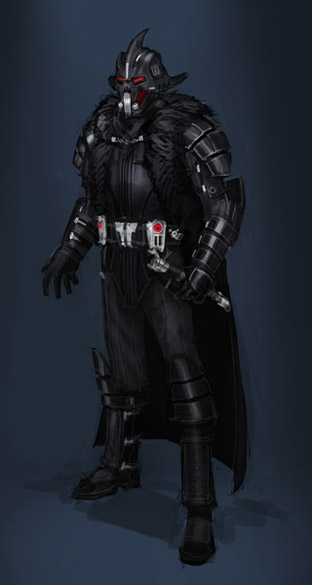
The Sith Empire of SWTOR is a state rather than a single secretive religious order. Its political structure combines imperial monarchy, the Dark Council, military command, intelligence networks, slavery and numerous subordinate populations. The eight playable perspectives reveal different places inside this unequal system.
The Emperor and the Dark Council
The Empire's official history presents an Emperor who withdrew from daily management while the Dark Council competed for authority. Sith membership therefore provides exceptional standing but not uniform control. Rival offices, personal retainers and client relationships shape what can actually be ordered and accomplished.
Sith and non-Sith citizens
An Imperial Agent or military officer can possess skills essential to the state while remaining subject to Sith superiors. The Inquisitor's original enslaved status exposes a still sharper hierarchy. The story distinguishes cultural belonging, legal position, military function and access to the Force rather than treating every Imperial as one kind of person.
Intelligence, military and knowledge
Cipher Nine's professional world reveals surveillance and internal coercion. Havoc Squad's Republic perspective provides an outside comparison of military obligations. Imperial scholarly and reclamation institutions seek artifacts and historical legitimacy, a practice that can be studied alongside the Sith Inquisitor's dependence on tombs and ghosts.
Anthropological judgment
A functioning bureaucracy can coexist with arbitrary personal rule. Institutional efficiency alone does not indicate legitimacy or equal citizenship. The Empire's power depends on the labor of people who may not share the prestige or freedom of Sith elites.
Research questions and what cannot be inferred
The central interpretive task is to ask what the game presents directly and what must remain open. A published mission or codex can establish that a particular organization or character appeared in the narrative. It does not establish that every inhabitant shared a ruler's views, that all decisions were equally available to players, or that a single playable character represents a whole society. Different Origin Stories provide contrasting perspectives on the same institutions.
Material objects and systems also need context. A city, weapon, archive or ritual may be evidence that a polity invested resources in a particular practice; it does not independently prove the motives of everyone who participated. Political claims made by rulers or antagonists are best treated as claims unless supported by independent story material. That distinction is essential when a narrative itself explores propaganda, secrecy or contradictory memories.
Keep exploring
Continue the adventure
Discover the people and worlds behind the lore, or jump into a different game era.
Primary sources and cross-references
- Primary SWTOR developer or Holonet source
- SWTOR developer retrospective: The Story So Far
- Official Star Wars game profile
- lore / sith-pureblood-synthesis
- lore / golden-age-of-the-sith
Star Wars: The Old Republic, its characters and visual designs are the property of their respective rights holders. IDS provides independent criticism and education.
Further SWTOR lore dossiers
The Old Republic is not only a licensed game set in an established era. It introduced institutions, conflicts, places, characters and stories that substantially expa
Read the Legends research file →Force traditions, surveillance and coercionThe Children of the Emperor and Political IdentityThe Children of the Emperor form one of the most unsettling political innovations in SWTOR's original Jedi Consular narrative. The plot imagines people whose identit
Read the Legends research file →Empire, occupation and legitimacyZakuul and the Eternal EmpireKnights of the Fallen Empire and Knights of the Eternal Throne transformed SWTOR's political geography by placing a third imperial power above the familiar Republic–
Read the Legends research file →Artificial worlds and military infrastructureIokath: Technology, Labor and Imperial AmbitionThe Iokath arc added a striking technological civilization to SWTOR's Legends setting. Rather than treating its machines as disposable obstacles, an anthropological
Read the Legends research file →